

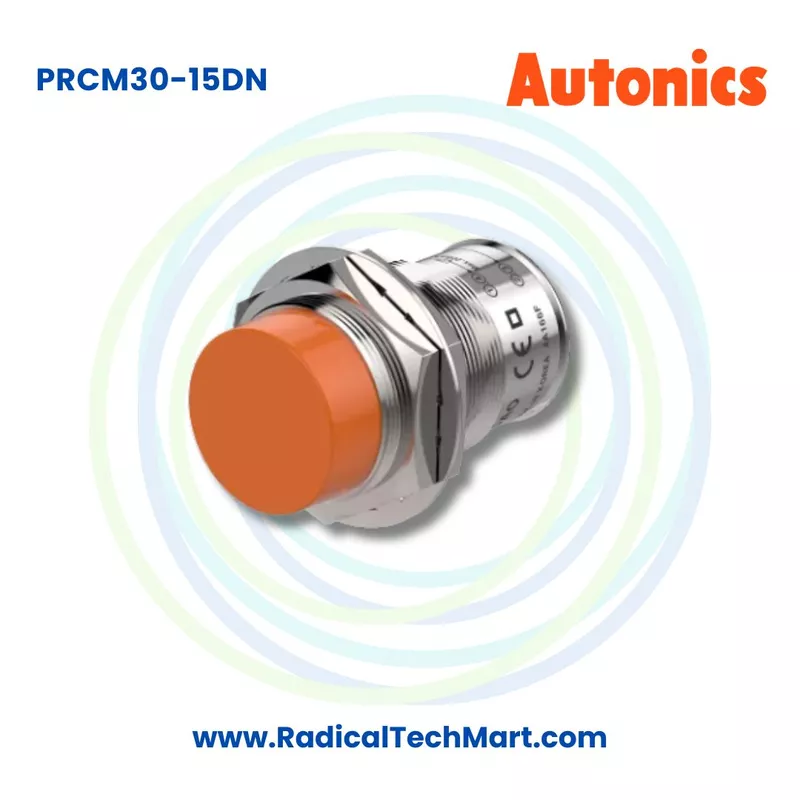


Autonics PRCM30-15 Series Inductive Proximity Sensor
The Autonics PRCM30 15mm NPN and PNP Inductive Proximity Sensor series is designed for reliable non contact detection of metallic objects in industrial automation systems. The series includes the PRCM30-15DN with NPN Normally Open output and PRCM30-15DP with PNP Normally Open output. Both models provide a 15 mm sensing distance, M30 cylindrical body, M12 connector, 12 to 24 VDC supply, 200 Hz response frequency and IP67 protection.
Customize
Share :
A. Product Overview
The Autonics PRCM30 15mm Inductive Proximity Sensor is a cylindrical industrial sensor used for detecting metallic objects without physical contact.
The two main models covered in this series are:
PRCM30-15DN: NPN Normally Open output
PRCM30-15DP: PNP Normally Open output
Both models have an M30 sensing head and provide a 15 mm sensing distance. They are non flush type proximity sensors, which allows a longer sensing range compared with many flush mounted sensors of similar size.
The sensors are suitable for use with PLCs, counters, control panels, packaging machines, conveyors and general industrial automation equipment.
Key Features
Brand: Autonics
Series: PRCM30
Models: PRCM30-15DN and PRCM30-15DP
Sensor Type: Inductive Proximity Sensor
Sensing Principle: Inductive metal detection
Sensing Distance: 15 mm
Sensing Side Diameter: 30 mm
Mounting: Non flush
PRCM30-15DN Output: NPN Normally Open
PRCM30-15DP Output: PNP Normally Open
Power Supply: 12 to 24 VDC
Operating Voltage: 10 to 30 VDC
Current Consumption: Maximum 10 mA
Control Output: Maximum 200 mA
Response Frequency: 200 Hz
Indicator: Red LED operation indicator
Connector: M12 connector
Protection Rating: IP67
Standard Sensing Target: 45 x 45 x 1 mm iron
Ambient Operating Temperature: minus 25°C to 70°C
Housing Material: Nickel plated brass
B. Working Principle
The Autonics PRCM30 inductive proximity sensor detects metallic objects by generating an electromagnetic field around its sensing face.
When no metal object is present, the electromagnetic field remains stable.
When a metallic target enters the sensing area, eddy currents are generated inside the metal. These currents affect the electromagnetic field produced by the sensor.
The sensor detects this change and switches its output.
For the PRCM30 series, the nominal sensing distance is 15 mm when used with the specified standard iron target.
Example
Suppose the sensor is installed beside a conveyor carrying metal components.
When no metal component is in front of the sensor:
Output: OFF
When a metal component enters the sensing area:
Output: ON
The output signal can then be sent to:
PLC
Counter
Relay
Machine controller
Alarm circuit
Automation panel
The system can use this signal to count objects, confirm their position or trigger another machine operation.
NPN and PNP Working Difference
The main difference between the two models is their transistor output configuration.
PRCM30-15DN
The PRCM30-15DN provides an NPN Normally Open output.
In an NPN sensor configuration, the sensor switches the output toward the negative side of the DC supply when the target is detected.
It is commonly used with PLC inputs designed for NPN or sinking sensor signals.
PRCM30-15DP
The PRCM30-15DP provides a PNP Normally Open output.
In a PNP configuration, the sensor switches the positive supply voltage to the output when the target is detected.
It is commonly used with PLC inputs designed for PNP or sourcing sensor signals.
Before selecting between PRCM30-15DN and PRCM30-15DP, the PLC or controller input type should always be confirmed.
C. Why Is the Autonics PRCM30 Used?
The PRCM30 series is used when machines require reliable non contact detection of metallic objects.
Metal Object Detection
It detects the presence or absence of metallic components without requiring mechanical contact.
Position Detection
The sensor can confirm whether a metal machine component has reached the correct position.
Product Counting
A metal product passing in front of the sensor can generate one switching signal.
These signals can be sent to a counter or PLC for production quantity monitoring.
Conveyor Automation
The sensor can detect metallic products, carriers or machine parts moving along a conveyor.
Machine Position Confirmation
It can confirm the position of:
Metal slides
Machine arms
Jigs
Fixtures
Cylinders
Mechanical stops
Tooling components
Limit Detection
An inductive proximity sensor can replace mechanical limit switches in applications where contactless sensing is preferred.
Machine Sequence Control
The sensor can provide a signal to the PLC when a metal component reaches a particular stage of the machine cycle.
Production Monitoring
The sensor can help monitor part movement and production cycles in automated manufacturing systems.
Advantages of Non Contact Detection
Because the sensor does not need to physically touch the target, there is less mechanical wear compared with traditional contact switches.
This makes inductive proximity sensors suitable for repetitive industrial applications requiring frequent switching.
Other advantages include:
Fast response
No mechanical contact
Long operating life
Reliable repetitive detection
Easy PLC integration
Resistance to industrial environments
Compact cylindrical installation
D. Suitable Buyers
The Autonics PRCM30 15mm NPN and PNP Inductive Proximity Sensor is suitable for a wide range of industrial users.
Industrial Automation Companies
Automation integrators can use the sensors with PLCs and machine control systems for metal detection and position sensing.
Machine Manufacturers
OEM machine builders can use PRCM30 sensors for position detection, component sensing and sequence control.
Control Panel Manufacturers
Panel builders can integrate NPN or PNP proximity sensors according to the PLC input configuration.
Packaging Machine Manufacturers
Suitable for detecting metallic machine components and monitoring machine movements during packaging operations.
Conveyor System Manufacturers
Can be used for detecting metallic objects or confirming mechanical positions within conveyor systems.
Automotive Industries
Suitable for automated assembly, component detection, fixture monitoring and machine positioning.
Machine Tool Manufacturers
Can be used in CNC machines, cutting machines, presses and other industrial equipment for position confirmation.
Material Handling Industries
Suitable for detecting metallic components during automated material movement.
Factory Maintenance Departments
Maintenance teams can use the PRCM30 series for replacement of existing M30 proximity sensors in compatible applications.
PLC System Integrators
System integrators can select either the NPN or PNP model depending on the PLC digital input configuration.
Frequently Asked Questions
1. What is the Autonics PRCM30 proximity sensor?
The Autonics PRCM30 is a cylindrical inductive proximity sensor designed for non contact detection of metallic objects in industrial automation systems.
2. What is the sensing distance of the PRCM30 series?
The PRCM30-15DN and PRCM30-15DP provide a nominal sensing distance of 15 mm.
3. What is the difference between PRCM30-15DN and PRCM30-15DP?
The main difference is the control output.
PRCM30-15DN: NPN Normally Open
PRCM30-15DP: PNP Normally Open
4. Is PRCM30-15DN an NPN sensor?
Yes. The PRCM30-15DN provides an NPN Normally Open output.
5. Is PRCM30-15DP a PNP sensor?
Yes. The PRCM30-15DP provides a PNP Normally Open output.
6. What is the power supply requirement?
The sensors operate on 12 to 24 VDC, with an operating voltage range of approximately 10 to 30 VDC.
7. Is the PRCM30 sensor normally open?
Both PRCM30-15DN and PRCM30-15DP covered here are Normally Open models.
8. What size is the sensor?
The sensing side diameter is approximately 30 mm, making it an M30 cylindrical proximity sensor.
9. Is the PRCM30 a flush or non flush proximity sensor?
The PRCM30-15DN and PRCM30-15DP are non flush type sensors.
10. What type of objects can the sensor detect?
It is designed primarily for detecting metallic objects.
11. Can it detect iron?
Yes. Iron is an appropriate sensing target for this inductive proximity sensor.
12. Can an inductive proximity sensor detect plastic?
Inductive proximity sensors are designed for metallic object detection. They are not normally used for detecting plastic, wood, glass or other non metallic objects.