

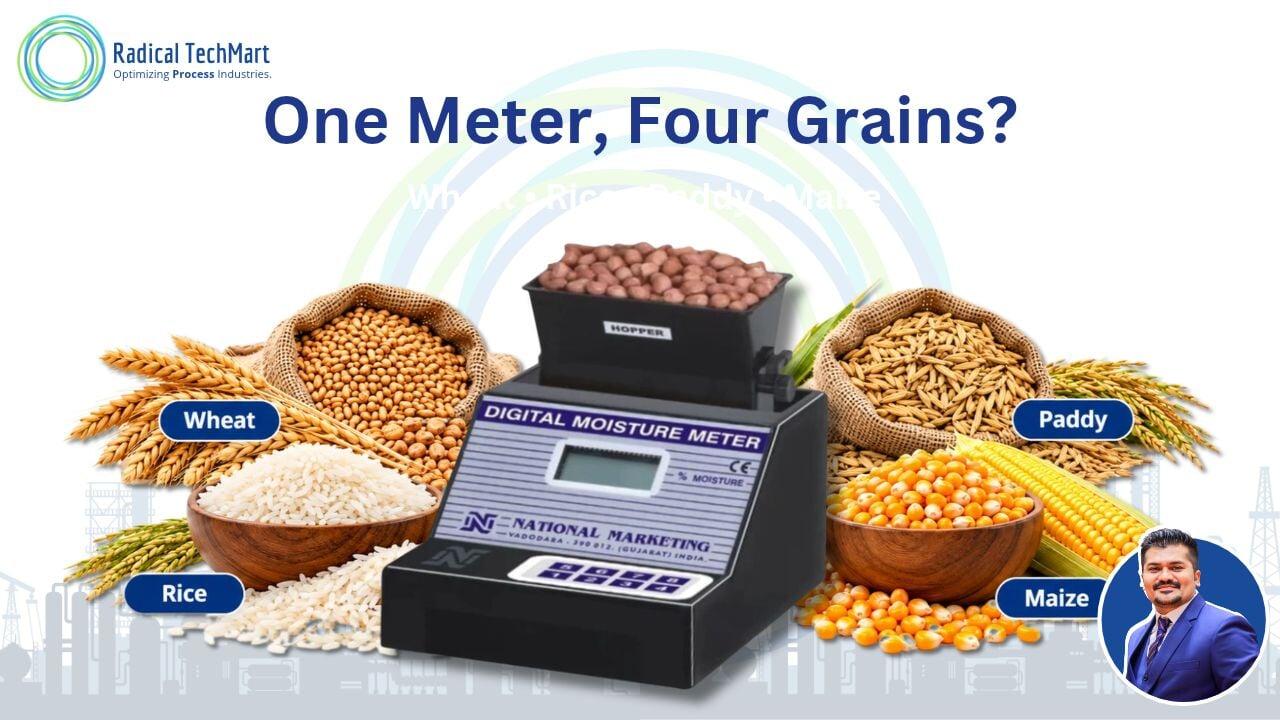
Can One Meter Test All Four? Wheat, Rice, Paddy and Maize Moisture Meter
A grain trader may purchase wheat in the morning, inspect paddy in the afternoon and receive maize the next day. At a rice mill, the same quality control team may need to check paddy before processing and rice after milling.
In both situations, buying a separate moisture meter for every grain would be inconvenient and expensive.
Naturally, buyers ask a simple question: Can one digital moisture meter measure wheat, rice, paddy and maize accurately?
Yes. A multi-grain digital moisture meter can test all four, provided the instrument has separate, suitable calibrations for wheat, rice, paddy and maize.
That last condition is important. A moisture meter capable of measuring several grains is not necessarily supplied with every grain calibration already installed.
For buyers comparing the DMM and DMA Digital Moisture Meter Series, understanding this difference can prevent an incorrect purchase.
Can One Moisture Meter Really Test Four Different Grains?
Yes, but the instrument must recognize the measurement characteristics of each grain.
Wheat, rice, paddy and maize do not have identical physical properties. They differ in grain structure, density, size and composition.
For example, paddy retains its outer husk, while rice has undergone processing. Wheat and maize also have different grain characteristics.
These differences matter because a digital grain moisture meter estimates moisture through an electrical measurement that must be calibrated for the material being tested.
Using a wheat calibration to measure paddy may produce a displayed reading, but that does not mean the reading represents paddy moisture correctly.
A suitable multi-grain meter therefore stores individual crop calibrations.
For a buyer who handles all four grains, the required configuration is straightforward:
| Grain | Required Calibration |
|---|---|
| Wheat | Wheat / Kanak |
| Rice | Rice / Chawal |
| Paddy | Paddy / Dhaan |
| Maize | Maize / Corn / Makka |
All four crops are listed among the supported grain applications in the National Instruments DMM and DMA Series documentation.
The important purchasing decision is to select a model containing all four calibrations, not simply a meter advertised for agricultural grains.
How Does a Digital Grain Moisture Meter Work?
The National Instruments DMM and DMA Series use the principle of measuring the dielectric constant of the material.
In simple words, the meter measures an electrical property of the grain sample that changes with moisture content.
The instrument then uses the selected grain calibration to estimate the percentage of moisture in that sample.
A typical measurement involves placing grain in the sample cavity, selecting the correct crop setting and allowing the instrument to display the moisture percentage.
For example, if a properly calibrated instrument displays 12.5% moisture for wheat, this is its estimated moisture content for that wheat sample.
However, the same reading method cannot be applied blindly to every grain. The calibration setting must match the sample.
The DMM Series also specifies non-destructive sample testing, meaning the grain does not need to be crushed or ground for the described testing method.
This makes the instrument practical for routine grain inspection where samples need to be checked repeatedly.
DMM vs DMA: Which Moisture Meter Should You Choose?
For buyers looking for one instrument to test wheat, rice, paddy and maize, two relevant product families are the DMM Digital Moisture Meter Series and the DMA Digital Moisture Meter Series.
Both offer multi-grain measurement capabilities, but their operating features differ.
| Feature | DMM Series | DMA Series |
|---|---|---|
| Measurement principle | Dielectric constant | Dielectric constant |
| Measurement range | 0% to 40% | 0% to 40% |
| Sensitivity | 0.1% | 0.1% |
| Stated accuracy | 0.2% | 0.2% |
| Measurement speed | One sample per minute | One sample per minute |
| Display | 3½ digit LCD | 16 × 2 alphanumeric LCD |
| Temperature compensation | Automatic | Automatic |
| Auto-calibration facility | Not specified | Provided |
| Field calibration/correction | Not specified | Provided |
| Crop name on display | Not specified | Provided |
| Power supply | Four pencil cells | Four pencil cells |
| Body | ABS moulded | ABS moulded |
| Approximate weight | Less than 1 kg | Less than 1 kg |
These are published technical specifications for the respective series. Actual performance and supplied calibration configuration should be verified against the selected instrument's current datasheet.
The biggest practical difference is the way each instrument supports the operator.
A DMM model makes sense when the buyer primarily needs routine moisture measurements and is comfortable selecting the correct calibration.
A DMA model becomes more attractive when several operators use the same instrument, different commodities are tested frequently, or field calibration and a more informative display are preferred.
DMM4 Digital Moisture Meter
A grain purchasing centre that handles four major commodities may not need a meter with a large number of crop calibrations. A four-crop configuration can be sufficient.
The DMM Series uses model numbering to indicate the number of stored crop calibrations. This makes DMM4 a relevant model to consider for four-grain testing.
Best for: Grain traders, purchasing centres, agricultural warehouses and buyers who need basic moisture testing for four specified commodities.
Why this model makes sense:
If wheat, rice, paddy and maize are the only commodities being tested, a meter configured with these four calibrations can meet the crop coverage requirement without selecting unnecessary additional calibrations.
Technical points to note:
Measuring range: 0% to 40%
Sensitivity: 0.1%
Stated accuracy: 0.2%
Display: 3½ digit LCD
Automatic temperature compensation
Non-destructive sample testing
Battery operation using four pencil cells
ABS moulded body
Published measurement rate: one sample per minute
Where it can be used: Grain trading shops, wheat procurement centres, rice mills, maize purchasing facilities, warehouses and agricultural quality inspection.
Selection caution: DMM4 indicates four stored crop calibrations. It does not automatically establish that every supplied DMM4 contains wheat, rice, paddy and maize. Confirm the exact four calibrations before ordering.
DMA4 Digital Moisture Meter
Consider a rice mill or grain trading business where different staff members test several commodities during the day.
The person taking a moisture reading may change from one shift to another. In such situations, clearly identifying the crop on the display is useful.
The DMA Series provides a 16 × 2 alphanumeric LCD displaying crop name, quantity and moisture percentage. It also includes auto-calibration and field calibration/correction features.
Best for: Multi-grain operations that prefer a more informative display and additional calibration functions.
Why this model makes sense:
When switching between wheat, paddy, maize and rice, displaying the selected crop name helps operators check which calibration is active.
This does not eliminate the need for correct sample handling, but it provides an additional opportunity to identify an incorrect crop selection.
Technical points to note:
Measuring range: 0% to 40%
Sensitivity: 0.1%
Stated accuracy: 0.2%
Display: 16 × 2 alphanumeric LCD
Microcontroller-based design
Multi-point calibration
Auto-calibration and field correction functions
Automatic temperature compensation
Weight/volumetric FLIP mode
Low battery and service indications
Optional Bluetooth connectivity in supported configurations
Where it can be used: Rice mills, grain procurement centres, quality control departments, agricultural warehouses, commodity trading operations and grain processing facilities.
Selection caution: The DMA4 should be ordered with the required four crop calibrations confirmed. Optional Bluetooth functionality and its availability for the chosen configuration should also be verified before purchase.
Why Separate Calibration Matters for Wheat, Rice, Paddy and Maize
The difference becomes clearer when we consider each grain individually.
Wheat Moisture Testing
Wheat moisture measurement is relevant during purchasing, storage and flour milling.
For example, a flour mill purchasing wheat from different suppliers needs consistent measurement procedures to compare incoming lots.
A wheat calibration helps the instrument interpret the electrical characteristics of the wheat sample correctly.
The operator should also ensure that the sample reasonably represents the full lot rather than collecting grain from only one convenient point.
Rice Moisture Testing
Rice mills may need to test rice after processing, before packaging or during warehouse inspection.
A moisture meter configured for paddy should not automatically be treated as correctly calibrated for processed rice.
The condition of the rice matters too. Raw rice, parboiled rice and broken rice may require different product calibrations where supported.
Before ordering, buyers should identify the specific rice products they intend to measure.
Paddy Moisture Testing
Paddy measurement is particularly relevant at agricultural procurement centres and rice mills.
Since paddy retains its husk, using a processed-rice setting is not an appropriate substitute for a dedicated paddy calibration.
If a business handles both paddy and rice, it should count them as two separate calibration requirements.
This is an important reason why some buyers underestimate the number of crop settings they need.
Maize Moisture Testing
Maize is commonly inspected during trading, storage and processing.
The meter should have a dedicated maize or corn calibration.
Where a business also handles maize flour, maize germ or other processed maize materials, those should not automatically be treated as equivalent to whole maize kernels.
The intended material must match the supported calibration.
What Specifications Actually Matter When Buying a Multi-Grain Moisture Meter?
A buyer may initially compare only price and the number of crops.
However, a better selection considers the daily operating requirement.
Crop calibration capacity: Count the different commodities and processed forms that require independent settings. Four grains may require four calibrations, but additional materials increase the requirement.
Measurement range: The DMM and DMA Series specify a 0% to 40% measuring range. Confirm that this range is appropriate for the grains and measurement conditions being tested.
Accuracy and sensitivity: Both series list 0.2% accuracy and 0.1% sensitivity. Sensitivity indicates the displayed measurement increment, while accuracy describes the stated measurement performance. They should not be confused.
Measurement speed: Both series specify one sample per minute. For routine incoming grain inspection, the buyer should evaluate whether this meets the expected testing volume.
Calibration facilities: Where periodic verification or field correction is important, DMA offers additional documented functions compared with the basic DMM Series.
Display readability: A numerical display may be sufficient for one trained operator. A crop-name display may be preferable when multiple people use the instrument.
Portability: The specified dimensions are 125 × 150 × 210 mm, with a weight below 1 kg, making these units practical for movement between inspection points.
Power supply: Four pencil cells make operation possible without depending on a continuous external electrical supply.
Common Mistakes Buyers Should Avoid
One of the most common mistakes is assuming a meter supporting many agricultural materials includes all those calibrations in the purchased model.
The manufacturer's overall grain list describes the available measurement applications. The individual instrument model determines how many calibrated items can be stored.
Other mistakes include:
Selecting only by price: A lower-cost meter is not a saving if it lacks one of the necessary crop calibrations.
Treating rice and paddy as the same grain setting: They should be checked separately.
Ignoring the exact crop list: Four stored calibrations do not necessarily mean the four crops your business handles.
Using the wrong selected crop: The displayed moisture result may be misleading.
Testing an unrepresentative sample: A small sample from one part of a large lot may not reflect the overall moisture condition.
Ignoring calibration verification: Periodic checks are important where moisture results influence commercial transactions.
Assuming every model has Bluetooth: This is an optional feature associated with applicable DMA configurations, not a standard feature of every instrument.
Do This, Not That
| Do This | Not This |
|---|---|
| Confirm all four required grain calibrations | Assume every multi-grain meter has them |
| Select paddy and rice separately | Use one calibration for both |
| Match the meter configuration to actual commodities | Buy based only on the number printed in the model name |
| Verify calibration with suitable reference samples | Assume the display is always correct |
| Compare display and calibration functions | Compare only the purchase price |
| Confirm current pricing and technical details | Depend on an old price list |
Quick Selection Checklist Before Purchase
Before finalizing a digital grain moisture meter, check the following:
- Is wheat calibration included?
Is rice calibration included?
Is paddy calibration included?
Is maize calibration included?
Does the meter have enough capacity for future commodities?
Is the 0% to 40% measuring range suitable?
Is the specified accuracy suitable for the intended application?
Is a basic LCD sufficient, or is a crop-name display preferred?
Are field calibration and correction functions required?
Are current price, warranty, service support and calibration documentation confirmed?
Grain Moisture Meter Price in India: Is a Four-Crop Model More Economical?
A buyer should compare the cost of a single multi-grain meter against the cost and maintenance of several separate instruments.
For a business testing only wheat, rice, paddy and maize, a suitable four-calibration configuration may be more economical than purchasing additional crop capacity that will not be used.
However, a grain processing unit planning to handle barley, jowar, bajra or other commodities may benefit from selecting a model with more stored calibrations.
The DMM family includes configurations up to DMM8, while the DMA documentation describes configurations extending to DMA15. Availability of particular models and calibration sets should be confirmed when requesting a quotation.
The selection question is therefore not simply, "Which moisture meter is cheapest?"
It is, "Which meter includes all the calibrations and operating functions my business actually needs?"
Why Buy a Grain Moisture Meter from Radical TechMart?
At Radical TechMart, grain moisture meter selection begins with understanding the materials being tested.
A trader asking for a four-grain moisture meter may have a different requirement from a rice mill handling paddy, raw rice, parboiled rice and broken rice.
Before recommending a configuration, the important points are:
Which grains will be tested?
How many separate calibrations are required?
Who will operate the instrument?
How frequently will the meter be used?
Is basic measurement sufficient, or are additional calibration features preferred?
Is future expansion to other crops expected?
Radical TechMart can help buyers compare suitable DMM and DMA configurations, review available specifications and request pricing and availability.
This approach helps reduce the risk of ordering a model that cannot measure all the required commodities.
Final Thoughts: Which Is the Best Moisture Meter for Wheat, Rice, Paddy and Maize?
For a buyer who needs to test only these four grains, a properly configured four-calibration digital moisture meter is a logical starting point.
The DMM4 is worth considering when routine measurement and cost-conscious selection are the priorities.
The DMA4 is worth considering when the buyer prefers a crop-name display, auto-calibration facilities and more advanced operating functions.
Neither should be ordered based on the model number alone. Confirm that the supplied instrument includes the exact wheat, rice, paddy and maize calibrations.
If additional commodities are expected in the future, a model with greater calibration capacity may be the better long-term purchase.
One instrument can certainly simplify multi-grain moisture testing. The right choice is the instrument that measures the correct commodities with the required calibration and operational features.
Frequently Asked Questions
1. Can one moisture meter measure wheat, rice, paddy and maize?
Yes. A multi-grain digital moisture meter can measure all four when it contains suitable individual calibrations for wheat, rice, paddy and maize.
2. Which is the best moisture meter for four different grains?
A DMM4 or DMA4 with the correct four calibrations is worth considering. Choose DMM4 for basic routine testing or DMA4 when additional display and calibration functions are preferred.
3. Can I use a rice moisture meter for paddy?
Only if the instrument includes a suitable paddy calibration. A meter with only a processed-rice setting should not be assumed to measure paddy correctly.
4. What is the measurement range of the DMM and DMA moisture meters?
The published range for both series is 0% to 40% moisture, with 0.1% sensitivity and 0.2% stated accuracy.
5. How long does a grain moisture test take?
The published measurement rate for the DMM and DMA Series is one sample per minute.
6. What is the difference between DMM and DMA digital moisture meters?
The DMM Series provides basic digital moisture measurement with an LCD. The DMA Series adds a 16 × 2 alphanumeric display, auto-calibration, field correction and additional operating functions.
7. Can a grain moisture meter test other crops?
Yes, depending on the installed calibrations. The product families support various materials such as barley, jowar, bajra, pulses and oilseeds. The exact crop list must be confirmed for the selected instrument.
8. What is the price of a moisture meter for wheat, rice, paddy and maize?
Prices depend on the model and number of crop calibrations. Request a current quotation for the required DMM or DMA configuration, including applicable taxes, freight and optional features.
Get the Right Multi-Grain Moisture Meter from Radical TechMart
Need one digital moisture meter for wheat, rice, paddy and maize?
Share your required grain list with Radical TechMart to compare appropriate DMM and DMA models.