

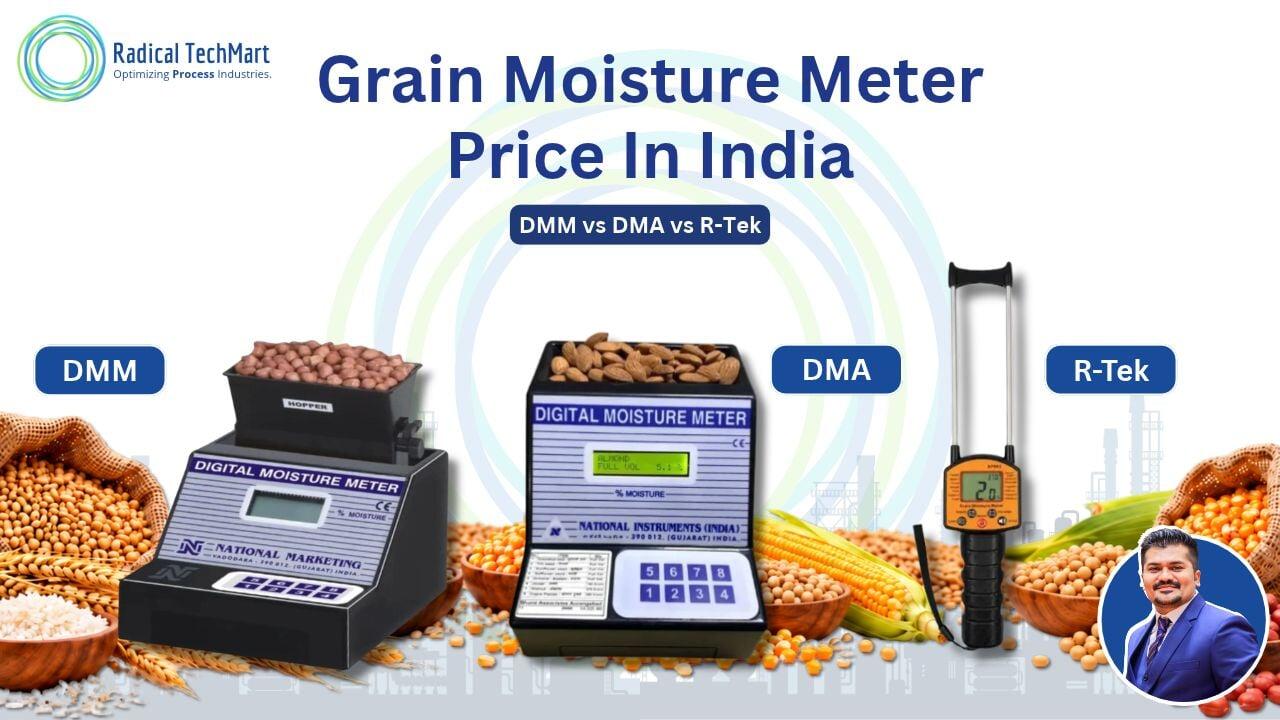
DMM, DMA and R-Tek Model Comparison: Moisture Meter Prices
A grain trader purchasing wheat may need a moisture meter for a few quick checks every day. A rice mill may need to test paddy throughout incoming material inspection. A warehouse handling wheat, maize, soybean and pulses may need several commodity calibrations in one instrument.
All three buyers need a grain moisture meter, but they do not necessarily need the same model or budget.
This is where comparing the grain moisture meter price in India becomes more important than simply finding the cheapest instrument.
A lower-priced meter may be sufficient for occasional testing of supported commodities. However, if moisture measurement is part of daily procurement, storage approval or quality control, calibration flexibility, measurement resolution and operating convenience become equally important.
At Radical TechMart, buyers can compare National DMM and DMA grain moisture meters alongside R-Tek moisture testing instruments. The right choice depends on the grains being tested, testing frequency, required measurement accuracy and available budget.
Grain Moisture Meter Price in India: What Should You Expect?
National DMM Series: Starting from ₹5,412
National DMA Series: Starting from ₹6,750
R-Tek RT-640: Listed price ₹3,150
Prices are indicative website listings, not confirmed transaction quotes. Availability, taxes, shipping and current selling prices should be checked before ordering.
The difference in price is partly explained by what each instrument is designed to do.
National DMM models are intended for regular agricultural moisture measurement, with stored calibrations for selected commodities. DMA models add automatic calibration functions and more advanced operating features.
R-Tek's RT-640 provides a probe-style grain testing alternative and supports a defined group of grains. It may be attractive to buyers looking for a lower initial purchase price.
The important point is to compare equivalent measurement capabilities, not just displayed prices.
DMM vs DMA vs R-Tek Grain Moisture Meter Comparison
Specification | National DMM | National DMA | R-Tek RT-640 |
|---|---|---|---|
Starting price | ₹5,412 | ₹6,750 | ₹3,150 |
Moisture range | 0 to 40% | 0 to 40% | 5 to 30% |
Resolution | 0.1% | 0.1% | 0.5% |
Listed accuracy | 0.2% | 0.2% | ±(1%RH + 0.5), manufacturer notation |
Calibration | Regular/manual adjustment | Automatic calibration functions | Eight specified grain types |
Display | 3.5 digit LCD | 16 × 2 alphanumeric LCD | Digital display |
Temperature compensation | Automatic | Automatic | Confirm compensation function |
Suitable applications | Routine commodity testing | Frequent multi-commodity testing | Budget-focused grain checks |
Importantly, 0.1% resolution does not mean 0.1% accuracy. Resolution describes the smallest displayed measurement increment. Accuracy describes the instrument's expected measurement error under defined conditions.
The R-Tek RT-640 accuracy notation should be clarified before making a direct numerical accuracy comparison.
National DMM Grain Moisture Meter: When the Regular Model Is Enough
The DMM Series makes sense for grain traders, agricultural warehouses and procurement teams that need repeatable moisture measurements without paying for automatic calibration convenience.
For example, a trader regularly testing wheat and paddy may not need an eight-commodity instrument. A model configured for two required commodities could be a more economical choice.
Best for: Routine moisture testing where the commodity list is known and operators can manage the regular calibration procedure.
Why This Model Makes Sense
The DMM family offers a 0 to 40% measurement range, 0.1% sensitivity, automatic temperature compensation and a rugged ABS body.
Its stored item calibration structure allows buyers to choose the model according to the number of commodities they need to test.
The instrument measures changes in the dielectric constant of the material to estimate moisture content. This is useful for commercial grain handling because different commodities need appropriate calibration.
Important Technical Specifications
Measuring range: 0 to 40%
Listed accuracy: 0.2%
Sensitivity: 0.1%
Testing time: Approximately one sample per minute
Temperature compensation: Automatic
Power supply: Four pencil cells
Weight: Less than 1 kg
Calibration options: DMM through DMM-8
Common applications: Wheat trading, paddy procurement, rice mills, maize storage, pulse trading and agricultural quality inspection.
Selection caution: Confirm exactly which commodities are included in the selected model's calibration before purchasing. Buying DMM-4 does not automatically mean that every four commodities of your choice are already programmed.
National DMA Grain Moisture Meter: Is Auto Calibration Worth the Extra Price?
Consider a warehouse where different operators check wheat, paddy, soybean, mustard and maize during the same working day.
In such cases, the cost of an instrument is not the only concern. Operators must select the correct commodity and follow a consistent testing process.
The DMA Series is worth considering when automatic calibration and more detailed operating functions are important.
Best for: Grain procurement centres, food processors, quality inspection departments and warehouses performing frequent moisture testing.
Why This Model Makes Sense
The DMA family retains the main measurement capabilities of the DMM family while adding automatic calibration, field correction functions and an alphanumeric display.
The 16 × 2 LCD can show information such as the selected crop name, quantity and moisture percentage. This provides additional context during testing compared with a basic numerical display.
Important Technical Specifications
Moisture range: 0 to 40%
Listed accuracy: 0.2%
Sensitivity: 0.1%
Automatic calibration function
Multipoint calibration
Field calibration and correction functions
Automatic temperature compensation
16 × 2 alphanumeric LCD
Optional Bluetooth Low Energy connectivity with an Android application, subject to configuration
The DMA technical specifications also identify weight and volumetric modes and list a broader DMA family extending to DMA-15. Radical TechMart's listed online product variants cover DMA-1 to DMA-8.
Common applications: Rice mills, grain procurement, seed testing, warehouse quality control, agricultural commodity inspection and food processing.
Selection caution: Automatic calibration should not be interpreted as guaranteeing perfect accuracy in every material or eliminating the need for periodic verification. The correct crop calibration and sampling method remain important.
R-Tek Grain Moisture Meters: Lower Initial Cost for Selected Applications
The R-Tek RT-640 is a practical alternative for buyers who want a handheld probe-style moisture meter for supported grains.
Unlike the DMM and DMA families, which use stored item calibrations across a broad catalogue of agricultural materials, the RT-640 is specified for eight grain types.
Its applications include food allocation, grain processing and storage.
Best for: Budget-conscious buyers requiring portable moisture checks for grains included in the instrument's supported list.
Why This Model Makes Sense
The RT-640 can measure moisture and temperature, making it useful for on-site grain checks.
Its probe arrangement may suit particular storage and handling situations where direct sample access is practical.
Important Technical Specifications
Moisture measurement range: 5 to 30%
Moisture resolution: 0.5%
Temperature measurement: -10°C to 60°C
Supported grains: Paddy, wheat, barley, forage, corn, rapeseed, soybean and rice
Data hold function
Low battery indication
Backlight control
Power supply: Three AAA batteries
The manufacturer's listed moisture accuracy expression should be confirmed before relying on the meter for strict procurement tolerances.
Common applications: Grain warehouses, wheat and paddy checking, maize handling, agricultural trading and routine stored-grain inspection.
Selection caution: Do not assume every R-Tek moisture meter can test every type of grain. Different R-Tek instruments, including RT-814, RT-640 and AR-991, are offered in the wider moisture meter range, but they are not interchangeable for grain applications.
How Much More Does a DMA Model Cost Than a DMM?
For buyers comparing National grain moisture meters, the first question is whether the additional DMA features justify the price difference.
The published model prices provide a useful starting point.
Number of commodities | DMM Price | DMA Price | Difference |
|---|---|---|---|
1 commodity | ₹5,412 | ₹6,750 | ₹1,338 |
2 commodities | ₹5,711 | ₹7,009 | ₹1,298 |
3 commodities | ₹5,971 | ₹7,269 | ₹1,298 |
4 commodities | ₹6,230 | ₹7,528 | ₹1,298 |
5 commodities | ₹6,490 | ₹7,788 | ₹1,298 |
8 commodities | ₹7,269 | ₹8,567 | ₹1,298 |
These are indicative model prices. Final prices and stock availability should be verified before purchasing.
Consider a grain procurement centre testing several hundred samples each week.
If the team tests only two commodities and follows a consistent procedure, a DMM model may meet its requirements.
However, when several people operate the instrument and frequently change commodities, the additional DMA functionality may justify the approximately ₹1,300 price difference.
This does not mean that DMA is automatically the better investment. The deciding factor is whether its extra features solve an actual testing or operating problem.
Why Calibration Matters More Than Saving a Few Hundred Rupees
A grain moisture meter estimates moisture using an electrical measurement that depends on the material being tested.
Wheat, rice, paddy, soybean and groundnut have different physical properties. Their response to the measurement principle can differ.
This is why the correct commodity calibration matters.
Consider a buyer handling paddy and wheat. If the instrument is configured for wheat while the operator is testing paddy, the resulting moisture value may not accurately represent that paddy sample.
For small purchases, the financial impact may be limited. For a warehouse receiving several tonnes of grain, an incorrect moisture reading can influence acceptance decisions, drying requirements and storage planning.
Before buying, confirm whether the instrument supports the exact commodity, its physical form and the required measurement range.
For example, whole groundnuts, shelled groundnuts and groundnut cake should not be treated as identical materials without verifying their calibration suitability.
How to Choose the Right Grain Moisture Meter for Your Budget
The most economical instrument is not necessarily the one with the lowest purchase price. It is the least expensive model that meets the actual measurement requirements.
Buyer Requirement | Model to Consider | Main Reason |
|---|---|---|
Lower-cost grain testing | R-Tek RT-640 | Lower listed purchase price for supported grains |
Regular testing of one or two commodities | National DMM-1 or DMM-2 | Avoid paying for unnecessary calibration capacity |
Routine testing of several commodities | National DMM multi-item model | Multiple stored commodity calibrations |
Frequent testing with calibration convenience | National DMA | Automatic calibration and additional functions |
Quality inspection involving many commodities | DMA multi-item model | Broader stored calibration requirements and operator convenience |
Testing flour, feed, spices or dry fruits | Suitable DMM or DMA configuration | Exact material calibration is essential |
A Practical Example: Wheat and Paddy Testing
A procurement buyer handling wheat and paddy every day may choose between a two-commodity DMM and DMA.
If operators are comfortable with the regular DMM calibration process, the DMM-2 is a sensible starting point.
If testing is frequent, multiple operators are involved and calibration convenience matters, DMA-2 becomes worth considering.
Now consider a food processor handling wheat, rice, maize, pulses, oilseeds and flour.
A two-commodity instrument may be inadequate regardless of its price. The buyer should first confirm all required commodity calibrations and then choose the appropriate model capacity.
Common Mistakes When Buying a Digital Grain Moisture Meter
1. Choosing the Cheapest Model Without Checking Commodity Support
A meter intended for a limited number of grains may not suit spices, flour, pulses or dry fruits.
2. Assuming Every Model Has the Same Accuracy
R-Tek RT-640 and National DMM/DMA specifications use different measurement ranges, resolutions and accuracy descriptions. They should not be treated as equivalent.
3. Buying More Calibrations Than Required
If a business tests only wheat and paddy, an eight-item model may add unnecessary cost.
4. Confusing Automatic Calibration With Automatic Commodity Detection
Confirm how the operator selects the crop and what the automatic calibration function performs.
5. Ignoring Sample Preparation
Inconsistent sampling, foreign material and unsuitable measurement procedures can affect results even when the instrument itself is functioning correctly.
6. Comparing Only the Displayed Product Price
Check GST treatment, shipping charges, accessories, calibration documentation, warranty terms and availability.
7. Ignoring Future Requirements
A warehouse expecting to handle additional commodities may benefit from selecting adequate calibration capacity at the beginning.
Do This, Not That
Do This | Not This |
|---|---|
List the commodities before comparing prices | Select the meter by price alone |
Confirm measurement range and accuracy | Compare only display resolution |
Choose the calibration capacity you need | Automatically purchase the highest model |
Verify sample preparation requirements | Assume all grains use the same testing method |
Confirm final price and stock | Depend entirely on an older online listing |
Ask about calibration verification | Assume auto calibration never requires checking |
Quick Grain Moisture Meter Buying Checklist
Before placing an order, confirm:
Which grains or agricultural materials will be tested?
How many different commodity calibrations are necessary?
Is the required model DMM, DMA or R-Tek?
What moisture measurement range is needed?
What accuracy is required for the buying or quality decision?
Is handheld probe testing or a sample chamber arrangement preferred?
How many samples will be tested daily?
Are automatic calibration functions important?
Is a calibration certificate required?
What is the final price, including applicable charges and delivery?
This short checklist can prevent a buyer from spending more on unnecessary features or purchasing a meter that cannot test the required material.
Why Buy Grain Moisture Meters from Radical TechMart?
Selecting a moisture meter becomes easier when the discussion starts with the material and testing requirement rather than only a product model.
Radical TechMart offers grain moisture testing instruments suitable for agricultural procurement, commodity handling, storage and food processing applications.
Buyers can compare DMM, DMA and available R-Tek options based on their measurement requirements.
For example, an enquiry mentioning only "grain moisture meter required" is incomplete.
A more useful enquiry would specify wheat and paddy testing, approximately 50 samples per day, portable operation, required accuracy and preferred budget.
With those details, the model comparison becomes more meaningful.
Customers can explore the available National DMM and DMA grain moisture meters to compare the listed variants and technical details.
Final Thoughts: Which Grain Moisture Meter Offers Better Value?
The best grain moisture meter is the one that meets your testing requirements without unnecessary expense.
For buyers with a limited budget and a clearly defined grain list, the R-Tek RT-640 is worth evaluating.
For regular testing across selected agricultural commodities, National DMM offers a practical balance between measurement capability and purchase cost.
For frequent testing where automatic calibration, multiple crop settings and additional operating functions are valuable, National DMA deserves consideration.
When comparing the grain moisture meter price in India, focus on four things: actual commodity compatibility, measurement performance, calibration requirements and total purchase cost.
A few hundred rupees saved during procurement should not create uncertainty in grain acceptance, storage or quality decisions.
Frequently Asked Questions
1. What is the grain moisture meter price in India?
Prices depend on the model and its measurement features. Radical TechMart's published listings show National DMM starting at ₹5,412, National DMA starting at ₹6,750 and R-Tek RT-640 at ₹3,150 on an indexed category listing. Confirm current prices before ordering.
2. What is the difference between DMM and DMA grain moisture meters?
DMM is the regular calibration series, while DMA provides automatic calibration functions and additional features such as field correction and an alphanumeric display.
3. Is a DMA moisture meter better than a DMM?
DMA may be more convenient for frequent testing, but DMM can be sufficient for regular use when its calibration procedure and commodity capacity meet the application.
4. Which is the best low-price grain moisture meter in India?
R-Tek RT-640 is one lower-priced option worth considering for its specified grain types. Whether it is the best choice depends on required accuracy, moisture range and testing method.
5. Can DMM and DMA meters measure wheat, rice and paddy moisture?
Yes, these materials appear in the supported commodity lists. The correct calibration must be included in the selected model.
6. What is the accuracy of National DMM and DMA grain moisture meters?
The technical specifications list 0.2% accuracy and 0.1% sensitivity. Buyers should confirm the applicable accuracy conditions in the final datasheet.
7. Can one grain moisture meter test multiple agricultural commodities?
Yes, provided the instrument has the appropriate stored calibrations. National DMM and DMA are available in models configured for different numbers of items.
8. Where can I buy a digital grain moisture meter online in India?
Radical TechMart lists National DMM and DMA moisture meters and R-Tek moisture testing options. Customers can compare specifications, prices and model availability before purchasing.