

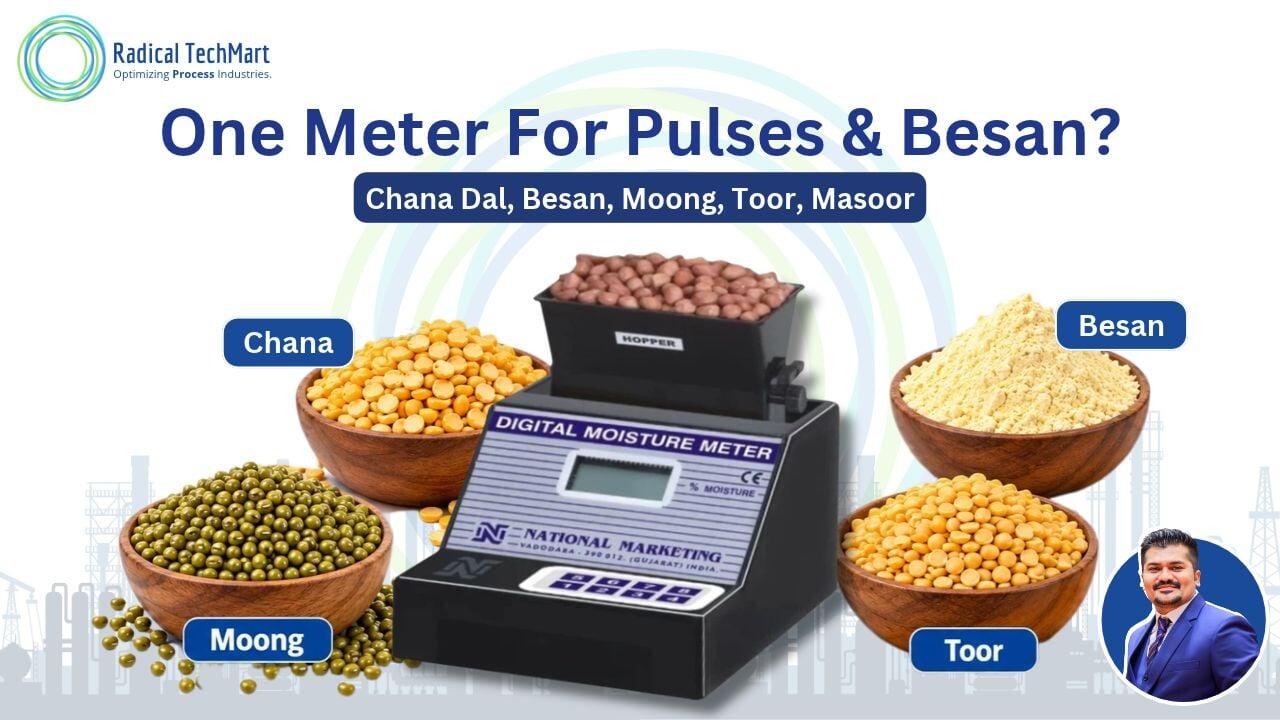
Which Materials Can Be Tested? Chana Dal, Besan, Moong, Toor and Masoor Moisture Meter
A dal mill may receive whole chana, process it into chana dal and later supply besan to a food manufacturer. Another processor may handle moong, toor and masoor in both whole and split forms.
The purchase team has a practical question: Can one digital moisture meter measure all these materials, or is a separate instrument required for every pulse and flour?
The answer depends on the material calibrations available in the meter.
The National Instruments DMM and DMA Digital Moisture Meter Series list several whole pulses, split dals and processed materials, including besan, among their measurement applications.
However, there is an important distinction between a material appearing in the manufacturer's supported application list and that calibration being included in a particular instrument.
One meter may be used for several pulses and besan when it has the correct calibrations for each material.
Before selecting a model, buyers should identify whether they need to measure whole pulses, split dals, flour or a combination of these.
Can One Moisture Meter Test Chana Dal, Besan, Moong, Toor and Masoor?
A suitable multi-material digital moisture meter can cover these requirements, provided each required material has an appropriate stored calibration.
According to the available DMM and DMA product documentation, the following materials are listed:
| Material | Listed in Product Documentation | Important Selection Point |
|---|---|---|
| Chana Dal | Yes | Confirm split chana dal calibration |
| Besan | Yes | Confirm specific besan calibration |
| Moong / Mung Whole | Yes | Different from split moong dal |
| Moong / Mung Dal | Yes | Confirm dal calibration |
| Toor / Redgram Whole | Yes | Different from toor dal |
| Toor / Redgram Dal | Yes | Confirm dal calibration |
| Masoor / Lentil Whole | Yes | Different from masoor dal |
| Masoor / Lentil Dal | Yes | Confirm dal calibration |
The documentation lists besan under the category of other processed materials, while whole pulses and dals appear in the pulses section.
This matters because the same raw agricultural commodity can have different physical characteristics after processing.
For example, whole chana, chana dal and besan are related products, but they should not automatically be measured using one identical calibration.
If a business handles chana dal, besan, moong dal, toor dal and masoor dal, the purchase requirement should specify all five materials separately.
Why Pulse and Flour Compatibility Matters
A moisture meter does not identify moisture correctly simply because a material fits inside its sample cavity.
The instrument must interpret the electrical properties of the particular material being tested.
Whole pulses, split dals and flour have different physical forms.
Whole pulses have an intact grain structure. Split dals have undergone processing that changes their physical form. Besan is a powdered material with packing characteristics different from those of whole or split pulses.
These differences can influence the electrical measurement.
Consider a dal mill that purchases whole chana and processes it into chana dal.
If the operator uses a whole chana calibration to test split chana dal, the meter may still display a moisture percentage. But the displayed number should not be assumed accurate for the processed material.
The same issue becomes more important when measuring besan.
A setting intended for whole pulses is not automatically suitable for flour.
For businesses where moisture measurement affects acceptance, storage or product quality, this is a significant purchasing consideration.
How Does a Digital Moisture Meter Measure Pulses and Besan?
The National Instruments DMM and DMA Series use a dielectric measurement principle.
In simple terms, the instrument measures an electrical property of the sample that varies with its moisture content.
The instrument uses the selected material calibration to estimate the percentage of moisture present.
A typical test involves preparing a representative sample, placing it in the instrument's measuring cavity, selecting the relevant material calibration and reading the displayed moisture percentage.
For whole pulses and split dals, sample preparation must follow the instrument manufacturer's procedure.
For besan and other powdered materials, the buyer should confirm the prescribed filling method and whether the supplied calibration supports the required product.
The instrument should not be assumed suitable for every flour merely because it supports one powdered material.
For example, a besan calibration does not automatically establish compatibility with wheat flour, rice flour or another powder.
Chana Dal, Moong, Toor and Masoor: What Should Be Checked?
Chana Dal Moisture Testing
Chana dal is a common raw material for dal processing, food manufacturing and besan production.
A dal mill may need to inspect chana dal before storage, packing or further processing.
For this application, the meter should have a calibration specifically intended for chana dal.
Best for: Dal mills, pulse traders, food processing units and raw material inspection.
Why calibration matters: Whole chana and split chana dal are physically different materials. A calibration suitable for one should not automatically be used for the other.
Selection caution: Confirm whether the supplied meter includes chana whole, chana dal or both.
Moong Moisture Testing
Moong is handled in different forms, including whole moong and processed moong dal.
A processor purchasing whole moong and selling moong dal may need two different measurement settings.
The DMM and DMA documentation separately lists mung or greengram whole and mung or greengram dal.
Best for: Pulse processing mills, moong traders, procurement centres and packaging operations.
Why calibration matters: Processing changes the physical condition of the grain, so the meter must use the calibration intended for the tested product.
Selection caution: Do not order a meter with only whole moong calibration if the main testing requirement is moong dal.
Toor Dal Moisture Testing
Toor, also called redgram, is commonly received as a whole pulse and processed into dal.
Moisture measurement can support incoming material inspection and finished product quality checks.
Both whole redgram and toor dal appear separately in the manufacturer's supported material list.
Best for: Toor dal mills, agricultural commodity buyers and food processors.
Why calibration matters: A meter used for whole redgram should not automatically be treated as suitable for split toor dal without the appropriate calibration.
Selection caution: Specify whether the application involves whole toor, toor dal or both.
Masoor Moisture Testing
Masoor is another pulse where the material form matters.
A trading operation may handle whole lentils, while a processing unit may also need to inspect split masoor dal.
The product documentation lists masoor or lentil whole and masoor or lentil dal separately.
Best for: Lentil processors, pulse mills, agricultural warehouses and food manufacturing units.
Why calibration matters: The meter must be configured for the actual material being sampled.
Selection caution: Confirm the exact masoor product and its calibration before ordering.
Can the Same Moisture Meter Test Besan Flour?
This is one of the most important questions for buyers who operate both dal processing and flour production facilities.
Besan is included in the manufacturer's listed measurement applications.
However, buyers should not assume that every DMM or DMA configuration is supplied with besan calibration.
A digital moisture meter may be technically capable of measuring powdered materials, but the supplied instrument must have a suitable calibration and the correct sample handling procedure.
Besan differs from whole pulses because it is a fine powder.
Its packing density and sample consistency can influence the measurement conditions.
For this reason, a besan manufacturer should confirm:
Whether a dedicated besan calibration is available
Whether it is included in the selected model
What sample filling procedure is required
Whether the tested besan grade matches the calibration
What accuracy and verification procedure applies to besan testing
The available documentation supports besan as a listed application, but it does not provide a separate besan-specific accuracy study or detailed powder sample preparation procedure.
Those details should be confirmed before purchasing an instrument for commercial quality control.
DMM vs DMA Moisture Meter: Which Is Better for Pulses and Besan?
Two relevant options are the DMM Series and DMA Series digital moisture meters.
Both operate on the dielectric measurement principle, but their features differ.
| Specification | DMM Series | DMA Series |
|---|---|---|
| Measuring principle | Dielectric constant | Dielectric constant |
| Measuring range | 0% to 40% | 0% to 40% |
| Sensitivity | 0.1% | 0.1% |
| Stated accuracy | 0.2% | 0.2% |
| Measurement time | One sample per minute | One sample per minute |
| Display | 3½ digit LCD | 16 × 2 alphanumeric LCD |
| Temperature compensation | Automatic | Automatic |
| Auto-calibration | Not specified | Available |
| Field correction | Not specified | Available |
| Material name display | Not specified | Available |
| Power | Four pencil cells | Four pencil cells |
| Construction | ABS moulded body | ABS moulded body |
The specifications above are the published series-level specifications. Actual material coverage and performance must be verified for the ordered calibration configuration.
DMM5 Digital Moisture Meter for Five Materials
A pulse trader or processor that needs to test five materials may consider a five-calibration configuration.
The DMM Series model numbering indicates the number of stored material calibrations.
For example, DMM5 is relevant when five separate calibrations are needed.
Best for: Traders, small dal mills and procurement operations requiring routine moisture checks on five specified materials.
Why this model makes sense:
If the buyer only needs chana dal, besan, moong dal, toor dal and masoor dal, a five-material calibration configuration may be sufficient.
The DMM Series provides a compact instrument for routine sample measurement without requiring advanced display functions.
Technical points to note:
Measuring range: 0% to 40%
Sensitivity: 0.1%
Stated accuracy: 0.2%
Measurement speed: one sample per minute
3½ digit LCD
Automatic temperature compensation
Four pencil cell power supply
ABS moulded body
Weight below 1 kg
Where it can be used: Dal mills, commodity trading facilities, warehouses, food processing plants, procurement centres and pulse packaging units.
Selection caution: DMM5 indicates five stored calibrations. It does not guarantee that the five supplied calibrations will be the exact five materials required. Confirm the calibration list before purchase.
DMA5 Digital Moisture Meter for Five Materials
For a larger processing operation where multiple materials are tested regularly, the DMA Series offers additional functions.
The DMA uses an alphanumeric LCD that can display the selected item name, quantity and moisture percentage.
It also includes auto-calibration and field calibration/correction features.
Best for: Dal mills and food processing operations that prefer clear material identification and additional calibration functionality.
Why this model makes sense:
When the operator switches from chana dal to besan or from moong dal to toor dal, the displayed material name helps verify the selected setting.
This is particularly relevant where several employees share one instrument.
Technical points to note:
Measuring range: 0% to 40%
Sensitivity: 0.1%
Stated accuracy: 0.2%
Measurement speed: one sample per minute
16 × 2 alphanumeric LCD
Multi-point calibration
Automatic temperature compensation
Auto-calibration facility
Field correction function
Low battery and service indications
Optional Bluetooth connectivity for supported configurations
Where it can be used: Pulse processing facilities, besan manufacturing units, grain testing departments, warehouse inspection points and agricultural commodity processing operations.
Selection caution: Confirm all five required calibrations and obtain the recommended powder sampling procedure for besan before finalizing the model.
What If You Need to Test Both Whole Pulses and Split Dals?
This is where buyers frequently underestimate their calibration requirements.
Suppose a dal mill wants to measure:
| Material | Calibration Required |
|---|---|
| Chana whole | 1 |
| Chana dal | 1 |
| Besan | 1 |
| Moong whole | 1 |
| Moong dal | 1 |
| Toor whole | 1 |
| Toor dal | 1 |
| Masoor whole | 1 |
| Masoor dal | 1 |
| Total | 9 |
In this example, the buyer needs nine separate material calibrations if each listed material is to be tested using its own setting.
A five-calibration instrument would not satisfy the full requirement.
The DMA Series documentation describes models with additional stored calibration capacities, extending to DMA15.
For businesses handling several whole pulses, split dals, flours and other processed materials, a higher-capacity configuration may be worth considering.
The final requirement should always be based on the actual materials being tested, not simply the number of agricultural crop names.
Common Mistakes to Avoid When Buying a Pulse Moisture Meter
Mistake 1: Assuming whole pulse and dal use the same calibration
Whole moong and moong dal, or whole toor and toor dal, should be treated as separate requirements unless the manufacturer confirms otherwise.
Mistake 2: Assuming besan is covered by chana calibration
Besan is a powdered processed material. A dedicated suitable calibration must be confirmed.
Mistake 3: Selecting a model only by calibration count
A five-calibration instrument is useful only if those five calibrations match the actual materials.
Mistake 4: Ignoring sampling conditions
Moisture readings can be affected by inconsistent sample handling. Follow the manufacturer's prescribed measurement method.
Mistake 5: Assuming all flours can be tested
Compatibility with besan does not prove compatibility with every flour or powder.
Mistake 6: Ignoring verification requirements
Where the instrument is used for material acceptance, payment decisions or formal quality records, confirm calibration documentation and the verification method.
Mistake 7: Purchasing only on price
A lower-cost model can become an expensive mistake if an important material calibration is missing.
Do This, Not That
| Do This | Not This |
|---|---|
| Confirm each pulse and dal calibration | Assume one pulse setting covers all forms |
| Specify besan separately | Assume chana calibration covers besan |
| Count whole and split materials separately | Count only crop names |
| Verify sample preparation requirements | Fill the cavity without following instructions |
| Confirm model calibration capacity | Select only by model price |
| Request current technical documentation | Rely only on an old price list |
Quick Selection Checklist
Before ordering a digital moisture meter for pulses and besan, confirm:
Chana dal calibration required
Besan calibration required
Moong whole or moong dal calibration required
Toor whole or toor dal calibration required
Masoor whole or masoor dal calibration required
Total number of material calibrations calculated
Required measurement range confirmed
Accuracy and verification requirements understood
Powder sample preparation procedure obtained
Basic display or alphanumeric display selected
Calibration and field correction requirements considered
Current price, availability, warranty and documentation confirmed
Why Buy a Pulse and Besan Moisture Meter from Radical TechMart?
A customer asking for a moisture meter for pulses may actually need an instrument for several different materials.
A dal mill may handle whole chana, chana dal and besan. A trader may require only whole moong and toor. A food manufacturer may need to inspect split pulses and powdered raw materials.
These are different measurement requirements.
At Radical TechMart, the selection process focuses on identifying the actual materials before recommending a suitable instrument configuration.
Buyers can inquire about DMM and DMA models, supported material calibrations, available technical specifications and current pricing.
This helps reduce the likelihood of purchasing a meter that lacks an essential calibration.
Final Thoughts: Which Moisture Meter Is Right for Chana Dal, Besan, Moong, Toor and Masoor?
For buyers testing chana dal, besan, moong dal, toor dal and masoor dal, a suitably configured five-calibration digital moisture meter is a reasonable starting point.
The DMM5 may be appropriate for routine measurement when a basic numerical display is sufficient.
The DMA5 may be more attractive for buyers who prefer an alphanumeric display and additional calibration functions.
If the requirement includes both whole and split pulses, the calibration count may increase considerably.
Most importantly, do not assume that a material appearing in the manufacturer's supported application list is automatically available in every supplied meter.
Confirm the exact calibration list, particularly for besan and other powdered products, before purchasing.
The best moisture meter is the one configured for the materials your business actually tests.
Frequently Asked Questions
1. Can one moisture meter test chana dal, besan, moong, toor and masoor?
Yes, a suitable multi-material meter may test all five when the required individual calibrations are installed. Confirm the exact material list before ordering.
2. Can the same moisture meter test chana dal and besan?
Yes, if it has suitable separate calibrations. A calibration for chana dal should not automatically be used for besan flour.
3. Is moong dal calibration different from whole moong?
The manufacturer's supported material list identifies whole mung and mung dal separately. Buyers should specify which material they need to measure.
4. Can a digital moisture meter test toor and masoor dal?
The DMM and DMA product documentation includes toor dal and masoor dal among the supported materials. Availability in the selected model must be confirmed.
5. Which model should I consider for five materials?
DMM5 and DMA5 are relevant five-calibration configurations. The exact five calibrations should be confirmed with the supplier.
6. What is the difference between DMM and DMA moisture meters?
DMM provides basic digital moisture measurement, while DMA adds an alphanumeric display, auto-calibration and field correction features.
7. What is the measuring range of the DMM and DMA Series?
Both series specify a 0% to 40% measuring range with 0.1% sensitivity and 0.2% stated accuracy.
8. Can the same moisture meter test wheat flour, rice flour and besan?
These are separately listed processed materials, but each requires a suitable calibration. Besan compatibility alone does not confirm compatibility with wheat flour or rice flour.
Get the Right Moisture Meter for Pulses and Besan
Need a digital moisture meter for chana dal, besan, moong, toor, masoor or other food processing materials?
Contact Radical TechMart with your material list and required testing application.