

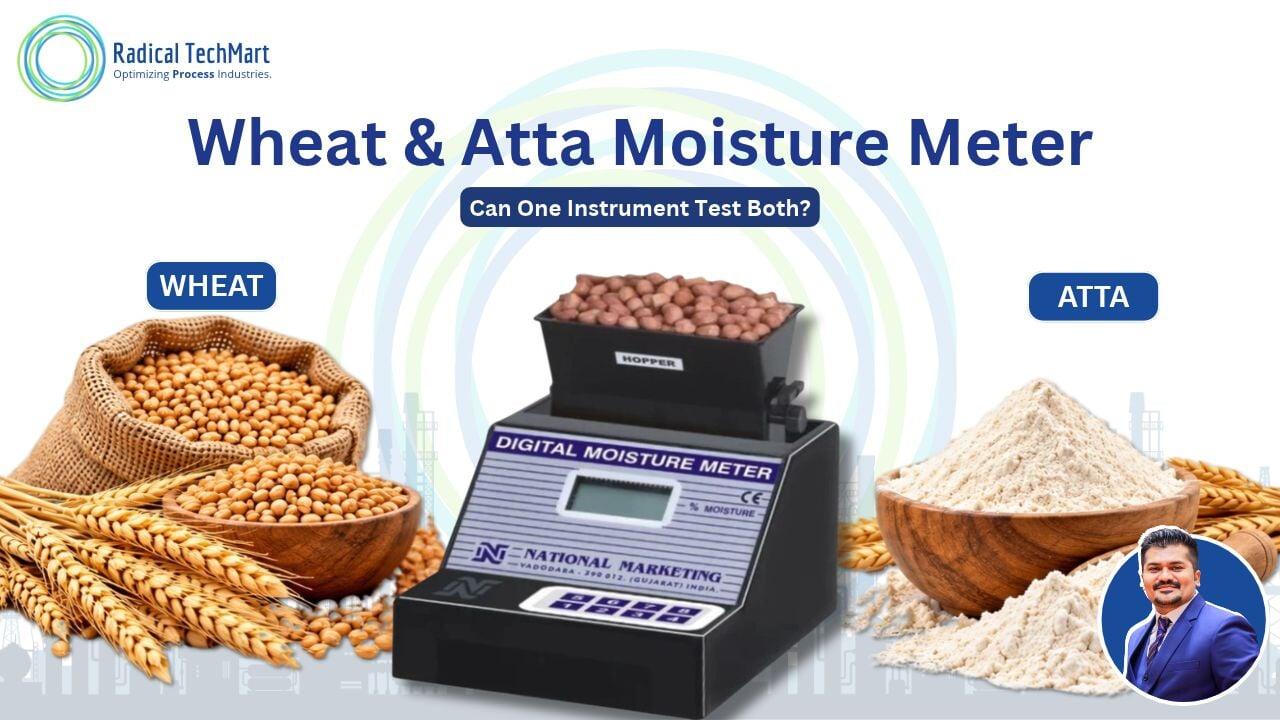
Can the Same Instrument Test Both Wheat and Atta?
A flour mill may receive several tonnes of wheat in the morning, check its moisture before grinding and then test the finished atta before packing.
At both stages, the quality team is measuring moisture. So a common purchasing question is:
Can the same moisture meter measure wheat grains and wheat atta, or does the flour mill need two separate instruments?
The answer is yes, one instrument can potentially handle both materials, but only if it supports separate calibrations for whole wheat and wheat atta.
This distinction is important because wheat and atta are physically different materials. Whole wheat has an intact grain structure, while atta is finely ground flour. Even when both originate from the same wheat, their physical characteristics affect how a moisture measuring instrument responds.
A digital moisture meter calibrated only for wheat grains should not automatically be assumed suitable for finished atta.
For flour mills, grain processors and food manufacturers, selecting the correct moisture meter for wheat and atta helps maintain a consistent testing process from raw material procurement through final product inspection.
Can One Moisture Meter Test Both Wheat and Atta?
Yes. The National DMM and DMA moisture meter product families include both Wheat (Kanak) and Wheat Atta in their supported material lists.
However, having both materials in the manufacturer's overall supported list does not mean every individual instrument is supplied with both calibrations.
The actual model must be configured with the required calibrations.
Requirement | Wheat Grain | Wheat Atta |
|---|---|---|
Material form | Whole grain | Ground flour |
Testing stage | Incoming raw material | After grinding |
Calibration required | Wheat calibration | Wheat atta calibration |
Main purpose | Procurement and grain storage quality | Milling and finished flour quality |
Can the same DMM/DMA instrument potentially test it? | Yes | Yes, with the appropriate calibration |
For example, if a flour mill needs to measure only whole wheat and wheat atta, it may consider a model with two stored item calibrations.
A DMM-2 or DMA-2 could be suitable, provided the supplier confirms that the instrument will be configured specifically for wheat and wheat atta.
The number in the model identifies the number of stored item calibrations, not a guarantee of which commodities are included.
Why Wheat and Atta Need Different Moisture Calibrations
A moisture meter does not identify moisture content simply by looking at the material.
The National DMM and DMA instruments use a measuring principle based on the dielectric constant of the material.
In simple terms, the instrument measures an electrical property of the sample and uses a calibration relationship to estimate moisture content.
The challenge is that different materials can behave differently during this measurement.
Whole wheat consists of individual grains. Atta is a fine powder produced by grinding those grains.
The particle structure, bulk density and packing characteristics can be different.
Because of these differences, applying a whole wheat calibration to atta may produce a moisture value that does not accurately represent the flour.
A Practical Flour Mill Example
Consider a flour mill receiving wheat for grinding.
The QC operator tests the incoming wheat using the correct wheat calibration.
After grinding, the operator collects an atta sample and tests it using the same instrument.
If the meter has a separate wheat atta calibration, the operator can select that calibration and carry out the test using the manufacturer's prescribed sampling procedure.
But if the operator leaves the instrument on the wheat setting while testing atta, the displayed moisture reading may be misleading.
This is a common compatibility issue that should be addressed during instrument selection.
The important buying question is not simply whether the meter can test wheat. It is whether the specific instrument has been calibrated for both whole wheat and wheat atta.
Where Moisture Testing Matters in a Flour Mill
Moisture measurement is useful at several stages of wheat processing.
Typical Flour Mill Moisture Testing Sequence
1. Wheat Receipt
Check incoming grain moisture.
2. Wheat Storage
Monitor grain condition before milling.
3. Conditioning
Check moisture after tempering, where applicable.
4. Finished Atta
Verify flour moisture before packing.
This is an illustrative quality control workflow. Actual sampling locations and acceptance limits depend on the mill's process and product specifications.
Incoming Wheat Inspection
Before accepting wheat, the procurement team may test moisture to check whether the lot meets the agreed purchasing conditions.
This is especially useful when wheat arrives from different suppliers, farms or storage locations.
Wheat Storage
Moisture affects storage decisions because grain condition influences the risk of deterioration during storage.
A moisture meter helps operators monitor grain samples and decide whether additional inspection or conditioning is necessary.
Wheat Conditioning Before Milling
Some milling processes involve adding controlled amounts of water before grinding.
Moisture measurement at this stage can support process consistency, but the correct calibration and sampling method must be selected for the conditioned grain.
Finished Atta Quality Control
After grinding, moisture testing helps the quality team evaluate the finished flour against its internal specification.
For flour manufacturers, this is particularly important when the finished product must remain consistent across different production batches.
National DMM vs DMA: Which Moisture Meter Should a Flour Mill Choose?
The National DMM and DMA series are both worth considering when a mill wants one instrument for wheat and atta.
The basic measurement principle is similar, but the operating features differ.
Feature | National DMM Series | National DMA Series |
|---|---|---|
Measurement principle | Dielectric constant | Dielectric constant |
Moisture range | 0 to 40% | 0 to 40% |
Sensitivity | 0.1% | 0.1% |
Listed accuracy | 0.2% | 0.2% |
Calibration operation | Regular/manual | Automatic calibration functions |
Display | 3.5 digit LCD | 16 × 2 alphanumeric LCD |
Temperature compensation | Automatic | Automatic |
Battery | Four pencil cells | Four pencil cells |
Approximate sample rate | One sample per minute | One sample per minute |
Weight | Less than 1 kg | Less than 1 kg |
The stated accuracy is a manufacturer specification and should be confirmed with the applicable test conditions.
National DMM Grain Moisture Meter for Wheat and Atta
For a smaller flour mill where the same trained operator regularly tests incoming wheat and finished atta, the DMM series may be sufficient.
Best for: Routine wheat and atta moisture testing where the operator is comfortable with regular calibration procedures.
Why This Model Makes Sense
The DMM series provides digital moisture measurement without requiring the additional operating functions of the DMA series.
For a flour mill testing just two materials, the DMM-2 is a logical model to evaluate because it can store two item calibrations.
The essential requirement is that the two selected calibrations must be for wheat and wheat atta.
Important Technical Specifications
Measurement range: 0 to 40%
Sensitivity: 0.1%
Listed accuracy: 0.2%
Automatic temperature compensation
Battery-operated portable instrument
Rugged ABS moulded construction
Models with different stored calibration capacities
Where It Is Commonly Used
Incoming wheat inspection
Flour mill raw material stores
Wheat procurement departments
Atta manufacturing units
Grain storage quality checking
Small food processing laboratories
Selection caution: Before purchasing, confirm that a wheat atta calibration is actually included in the selected DMM model. Do not assume the wheat setting can be used for both materials.
National DMA Grain Moisture Meter for Wheat and Atta
Consider a larger flour mill where different operators test raw materials and finished products during multiple shifts.
In this situation, the instrument needs to support the daily testing workflow, including selection of the correct material.
The DMA series is worth evaluating because it includes automatic calibration functions and a display capable of showing the selected crop or material name.
Best for: Flour mills and food processing units carrying out frequent moisture testing across several materials.
Why This Model Makes Sense
The DMA series offers additional calibration and operating features compared with the regular DMM models.
Its 16 × 2 alphanumeric LCD can display the selected item name, quantity and moisture reading. This can help operators identify which material calibration is selected before performing a measurement.
The manufacturer also specifies multipoint calibration and field calibration or correction functions.
For a flour mill where testing is performed throughout the day, these features may improve operating convenience.
Important Technical Specifications
Measurement range: 0 to 40%
Sensitivity: 0.1%
Listed accuracy: 0.2%
Automatic calibration functions
Multipoint calibration
Field calibration and correction
Automatic temperature compensation
16 × 2 alphanumeric LCD
Optional Bluetooth connectivity with Android application, depending on configuration
Where It Is Commonly Used
Wheat processing plants
Atta manufacturing units
Multi-shift flour mills
Food processing quality control
Grain procurement centres
Multi-commodity processing facilities
Selection caution: Automatic calibration does not mean the instrument automatically identifies whether the sample is wheat or atta. Confirm the actual operating and material selection procedure before purchasing.
After identifying the suitable series, buyers can compare the National DMM and DMA grain moisture meter models available at Radical TechMart.
What If the Flour Mill Also Tests Maida, Suji or Besan?
This is where choosing the right number of stored material calibrations becomes important.
A flour mill may initially need a meter for wheat and atta, but its quality control department may also handle maida, rava, suji, bran or other processed materials.
The National DMM and DMA product families identify several relevant materials.
Material | Included in Manufacturer's Supported List? |
|---|---|
Whole wheat | Yes |
Wheat atta | Yes |
Maida | Yes |
Wheat rava | Yes |
Wheat suji | Yes |
Wheat bran, fine | Yes |
Wheat bran, coarse | Yes |
Besan | Yes |
Maize flour | Yes |
Rice flour | Yes |
Soyabean flour | Yes |
However, the number of supported materials in the product family is not the number of calibrations available in every meter.
A model configured for two materials cannot be assumed to contain all the flour and grain calibrations listed above.
For a flour mill testing wheat, atta, maida and suji, a four-item model may be worth considering, provided the exact four calibrations are available and confirmed by the supplier.
This approach allows the buyer to select calibration capacity based on actual processing requirements instead of simply purchasing the highest-numbered model.
How to Check Wheat and Atta Moisture Correctly
A consistent sample testing procedure is just as important as selecting the correct instrument.
The following steps provide a practical workflow. Exact sample quantity, filling, compaction and operating instructions must follow the selected model's user manual.
Step 1: Collect a Representative Sample
For incoming wheat, sample the lot according to the mill's approved procedure. For atta, collect a representative sample from the relevant production stage.
Step 2: Check the Sample Condition
Avoid foreign material, contamination and inconsistent handling. Use the sampling procedure specified for the material.
Step 3: Select the Correct Calibration
Choose wheat for whole grains and wheat atta for finished flour.
Step 4: Prepare and Load the Sample
Follow the manufacturer's instructions for the selected material and instrument type.
Step 5: Take the Moisture Reading
Allow the instrument to complete its measurement and record the result.
Step 6: Repeat the Test Where Necessary
Multiple representative measurements can help assess variation within a larger lot or production batch.
Step 7: Record the Material and Reading Together
A useful QC record should identify whether the sample was wheat, atta or another material.
For critical quality decisions, periodically verify instrument readings against an appropriate reference method and the mill's quality control procedure.
Common Mistakes When Selecting a Wheat and Atta Moisture Meter
Mistake | Why It Creates a Problem |
|---|---|
Using whole wheat calibration for atta | The flour reading may be inaccurate |
Assuming every grain moisture meter supports flour | Some instruments may only support selected whole grains |
Buying a single-item model for two materials | The required second calibration may be unavailable |
Ignoring sample handling | Inconsistent material preparation can affect measurement |
Comparing meters only by price | Calibration compatibility may be more important |
Confusing sensitivity with accuracy | A small display increment does not guarantee equivalent measurement accuracy |
Assuming DMA identifies the material automatically | Material selection still needs to follow the instrument procedure |
Not verifying results periodically | Measurement errors may go unnoticed |
Do This, Not That
Do This | Not This |
|---|---|
Confirm separate wheat and atta calibrations | Use one calibration for both |
Select the model based on required materials | Select by model number alone |
Follow the correct sample preparation method | Test flour and grain using an assumed identical procedure |
Verify performance against a reference method | Depend only on the displayed number |
Choose DMA when its extra features are useful | Pay more simply because DMA is the newer or more advanced option |
Plan future materials before ordering | Buy an underspecified model that cannot support required calibrations |
Quick Selection Checklist for Flour Mills
Before ordering a moisture meter for wheat and atta, confirm:
Does the instrument support whole wheat?
Does it also support wheat atta?
Are separate calibrations available for both?
Is a two-item model sufficient?
Will the mill also test maida, suji, bran or other materials?
Is DMM regular calibration acceptable, or is DMA preferred?
Does the measurement range meet the mill's requirements?
Is the specified accuracy suitable for its QC process?
Can the operator follow the required sample preparation method?
Are a datasheet, operating instructions and calibration documentation available?
Have final price, availability and delivery requirements been confirmed?
Wheat and Atta Moisture Meter Price in India
Budget is often an important consideration, particularly for smaller flour mills.
Radical TechMart's published online listings show the following starting prices:
National DMM Series: ₹5,412
National DMA Series: ₹6,750
These are starting prices for the product families, not confirmed quotations for a model configured with both wheat and atta calibrations.
A buyer requiring both materials should request pricing for an appropriately configured two-item model.
For a mill that tests wheat and atta occasionally, DMM may offer a cost-effective solution.
For a mill with frequent testing and multiple operators, DMA may justify the additional investment through operating convenience.
The purchase decision should be based on the testing requirement, not simply the difference in listed prices.
Why Buy Wheat and Atta Moisture Meters from Radical TechMart?
A flour mill does not necessarily need two separate instruments merely because it tests whole wheat and finished atta.
It needs a meter that supports both materials correctly.
Radical TechMart provides National DMM and DMA moisture meter options for grain processing, agricultural storage and food-related quality inspection.
For an application involving wheat and atta, the first step is to confirm the exact material calibrations required.
A flour mill can share its material list, approximate daily testing frequency, preferred calibration type and budget so that a suitable configuration can be evaluated.
Buyers can explore the digital moisture meter range or review the DMM and DMA grain moisture meter selection guide for further technical information.
Final Thoughts
The answer to the question "Can the same moisture meter test wheat and atta?" is yes, provided the selected instrument has the correct calibration for each material.
National DMM and DMA moisture meters include wheat and wheat atta in their supported material families.
For a flour mill that tests these two materials, a two-item configuration may be sufficient. For mills processing additional products such as maida, suji, bran or besan, more stored calibrations may be required.
DMM is worth considering for straightforward testing, while DMA may be preferable when frequent operation and additional calibration functions are important.
The correct moisture meter for wheat and atta is not selected simply by the number on its model name. It is selected by matching its material calibrations, measurement performance and operating procedure to the actual flour milling process.
Frequently Asked Questions
1. Can the same moisture meter measure wheat and atta?
Yes. A suitable DMM or DMA model can test both whole wheat and wheat atta if the instrument is configured with separate calibrations for each material.
2. Can I use a wheat moisture meter to test wheat flour?
Not automatically. A meter calibrated only for whole wheat should not be used for atta unless the manufacturer confirms its flour testing compatibility and required calibration.
3. Which moisture meter is suitable for a flour mill?
National DMM and DMA are worth considering because their supported material lists include whole wheat, atta, maida, suji and other processed materials. The correct configuration depends on the mill's requirements.
4. Is DMM-2 sufficient for wheat and atta testing?
Potentially yes. A DMM-2 stores two item calibrations. Confirm that the supplier can provide the specific wheat and wheat atta calibrations before ordering.
5. What is the difference between DMM and DMA moisture meters?
DMM provides regular/manual calibration handling, while DMA offers automatic calibration functions, multipoint calibration, field correction and an alphanumeric display.
6. Can the same moisture meter test atta, maida and suji?
The National product family's supported list includes atta, maida and wheat suji. A particular instrument must have the corresponding calibrations for each material.
7. What is the measurement range of National DMM and DMA meters?
Both series specify a moisture measurement range of 0 to 40%, with 0.1% sensitivity and listed 0.2% accuracy.
8. What is the wheat and atta moisture meter price in India?
Published starting prices are ₹5,412 for the National DMM family and ₹6,750 for DMA. The final price depends on the selected model, calibration configuration and current commercial terms.