

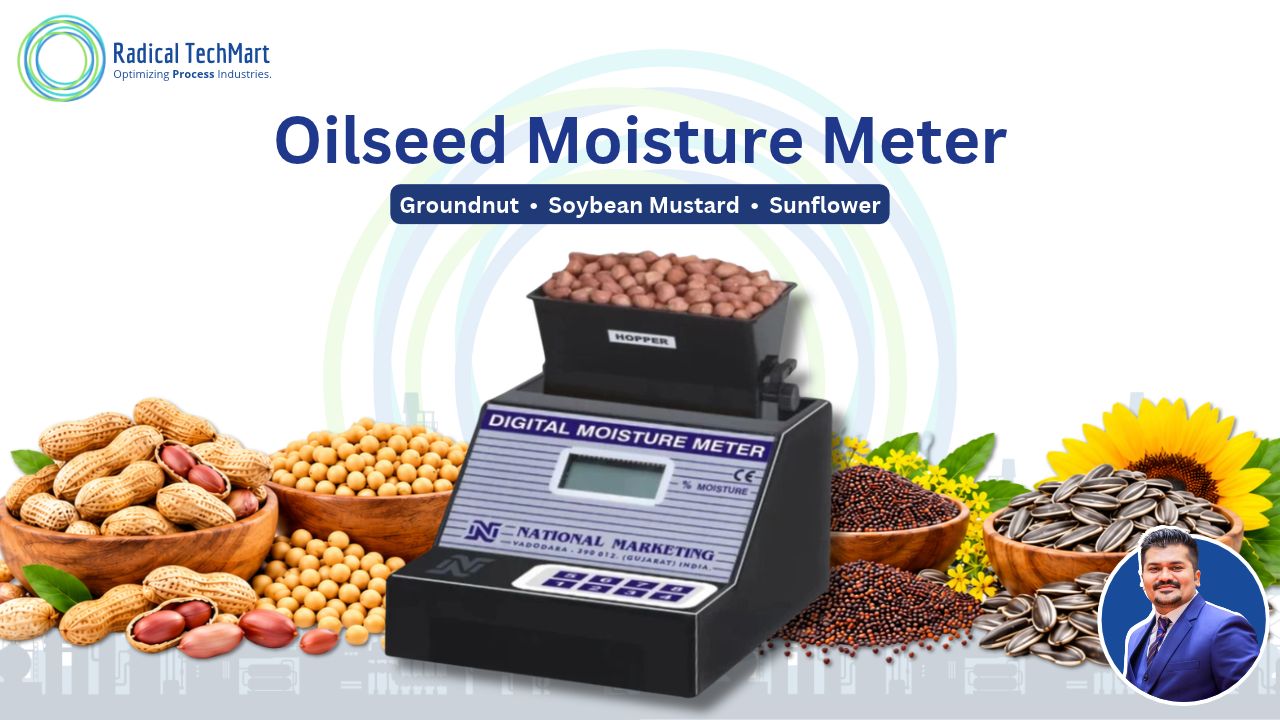
Moisture Meter for Groundnut, Soybean, Mustard and Sunflower Seeds
An oilseed trader may purchase groundnut from one supplier, soybean from another and mustard or sunflower seeds from different agricultural markets.
Before accepting these materials, the trader needs to know whether their moisture levels meet the agreed buying conditions.
The same requirement exists inside an edible oil processing plant. Incoming oilseeds must be checked before storage, cleaning, crushing or further processing.
But there is a common problem when selecting a moisture meter.
Can one digital moisture meter test groundnut, soybean, mustard and sunflower seeds, or does each oilseed require a separate instrument?
The answer is that one suitable moisture meter can potentially test all four, provided it has the correct calibration for each material.
This is important because different oilseeds have different physical properties. Their grain size, structure, density and oil content are not identical.
A meter calibrated for soybean should not automatically be used for mustard or groundnut without confirming the correct material setting.
For oilseed traders and processing plants, selecting the right moisture meter for groundnut, soybean, mustard and sunflower seeds helps make moisture testing more consistent across purchasing, storage and processing operations.
Can One Moisture Meter Test All Four Oilseeds?
Yes. The National DMM and DMA moisture meter families include all four materials in their supported oilseed lists.
These are:
Groundnut seed or peanuts
Soybean or soyabean
Mustard seed
Sunflower seed
However, there is an important distinction between a manufacturer's supported commodity list and the calibrations stored in a particular instrument.
A moisture meter configured for two commodities cannot be assumed to test four different oilseeds correctly.
For example, an oilseed trader who handles groundnut, soybean, mustard and sunflower may consider a four-item moisture meter.
A National DMM-4 or DMA-4 is a logical configuration to evaluate because four stored item calibrations are required.
Before purchasing, the buyer must confirm that the instrument can be supplied with the exact four calibrations needed.
Oilseed | Separate Calibration Required? | Typical Testing Purpose |
|---|---|---|
Groundnut seed | Yes | Procurement, storage and processing |
Soybean | Yes | Trading, warehouse inspection and soybean processing |
Mustard seed | Yes | Incoming material QC and oil mill processing |
Sunflower seed | Yes | Seed storage, procurement and oil extraction preparation |
This is the first point buyers should clarify before comparing prices or choosing between DMM and DMA.
Why Moisture Measurement Matters in Oilseed Trading
In oilseed trading, moisture is not simply a laboratory measurement.
It can influence the commercial value of a lot, storage decisions and the consistency of material supplied to processing plants.
Consider a trader purchasing a large consignment of groundnut.
If the moisture level is higher than the agreed acceptance specification, the buyer may need additional drying, segregation or storage precautions.
Similar concerns apply to soybean, mustard and sunflower seeds.
Moisture testing helps buyers evaluate whether the lot is suitable for acceptance, storage or further inspection.
For processing plants, inconsistent incoming material moisture can also create variation in the production workflow.
A moisture meter does not replace laboratory quality testing, but it provides a practical method for routine inspection and screening of agricultural commodities.
Why Groundnut, Soybean, Mustard and Sunflower Need Different Calibrations
The National DMM and DMA moisture meters operate on the principle of measuring the dielectric constant of the sample material.
In simple terms, moisture changes the electrical properties of agricultural materials.
The instrument uses its calibrated measurement relationship to estimate the moisture percentage.
However, the electrical response does not depend only on water. Material composition, packing and physical structure can also influence the measurement.
This is why different oilseeds require appropriate calibrations.
Groundnut kernels, soybean seeds, mustard seeds and sunflower seeds vary in size, structure and composition.
Even where two samples contain similar actual moisture percentages, their response to the measurement system may differ.
Using the wrong calibration can therefore produce a misleading result.
A Practical Example from an Oilseed Warehouse
Suppose a warehouse receives soybean and mustard on the same day.
The QC operator first tests soybean using the correct soybean calibration.
Later, the operator begins testing mustard but forgets to change the instrument's material setting.
The meter may still display a moisture percentage.
However, because the instrument remains configured for soybean, the result cannot be assumed accurate for mustard.
This is why correct crop selection is just as important as selecting the correct moisture meter.
Where Moisture Testing Is Used in an Oilseed Processing Plant
Moisture measurement is useful at several points between receiving agricultural material and feeding it into processing equipment.
Typical Oilseed Moisture Testing Workflow
1. Incoming Seed Inspection
Check moisture before accepting a lot.
2. Warehouse Storage
Monitor condition during storage.
3. Preprocessing
Check material before conditioning or crushing.
4. Quality Records
Document results by commodity and lot.
This is an illustrative workflow. Actual sampling points and acceptance limits depend on the processing plant and commodity specifications.
Incoming Oilseed Inspection
At procurement, moisture testing helps the purchase and QC teams evaluate the received lot against the agreed specifications.
This is useful when oilseeds arrive from multiple suppliers with different harvesting, drying or storage conditions.
Warehouse and Silo Storage
During storage, moisture is one factor affecting material condition.
For oilseeds, storage management also involves temperature, ventilation, cleanliness and the duration of storage.
A moisture meter supports routine quality checks, but it should not be considered a complete storage safety assessment.
Before Oil Extraction or Processing
Processing plants may need to control material conditions before crushing, pressing or other preparation steps.
Moisture measurement can help the quality department evaluate incoming material consistency.
The required moisture level should follow the plant's processing specifications rather than a universal setting applied to every oilseed.
Batch Quality Records
Recording moisture results by commodity, supplier and lot helps with traceability.
It also makes it easier to investigate differences in incoming material quality or processing behaviour.
Choosing a Moisture Meter for Each Oilseed
Although the same instrument family can support all four oilseeds, the exact material being measured must be confirmed before purchase.
Groundnut Moisture Meter
Groundnut traders and oil mills commonly handle materials at different stages, including groundnut pods, shelled kernels and processed groundnut products.
These materials should not automatically be treated as equivalent for moisture testing.
The National DMM and DMA product families include groundnut seed, roasted groundnut seed, groundnut pods and several groundnut-derived materials in their wider supported commodity lists.
Best for: Groundnut procurement, edible oil mills, seed storage, grading centres and agricultural quality inspection.
Why correct calibration matters: Groundnut pods and shelled kernels have different physical characteristics. A calibration intended for groundnut kernels should not be assumed suitable for unshelled pods.
Selection caution: Tell the supplier whether you need to test groundnut seeds, whole pods, roasted seeds or groundnut cake. Confirm the exact material calibration before ordering.
Soybean Moisture Meter
A soybean processing plant may receive seeds from several suppliers and store them before further processing.
Moisture testing at receipt and during storage helps the QC department evaluate lot condition.
The National product family lists soybean among its oilseeds. It also separately identifies soybean flour, soybean meal and soybean flakes in its wider material list.
Best for: Soybean traders, agricultural warehouses, soybean oil processors and seed procurement teams.
Why this model makes sense: A DMM or DMA configured for soybean provides a dedicated material calibration rather than relying on a general grain setting.
Selection caution: Soybean seed, soybean flour and soybean meal are different materials. Confirm the correct calibration for the material actually being tested.
Mustard Seed Moisture Meter
Mustard seeds are relatively small compared with soybean and groundnut.
For mustard traders and oil mills, sample preparation and use of the correct calibration are important during routine moisture testing.
Mustard seed is explicitly included in the National DMM and DMA supported oilseed lists.
Best for: Mustard seed traders, oil extraction units, agricultural markets, warehouses and procurement centres.
Why this model makes sense: A dedicated mustard seed calibration allows the instrument to estimate moisture using the calibration intended for that material.
Selection caution: Do not use soybean or sunflower calibration for mustard merely because all three materials are oilseeds.
Sunflower Seed Moisture Meter
Sunflower seeds are commonly handled in oilseed procurement, seed storage and edible oil processing operations.
A sunflower moisture meter helps with incoming material checks and ongoing storage quality inspection.
Sunflower seed is included in the National DMM and DMA supported material lists.
Best for: Sunflower seed traders, seed warehouses, edible oil processors, oil mills and commodity quality control departments.
Why this model makes sense: A dedicated sunflower calibration is appropriate for routine testing of the specified sunflower seed material.
Selection caution: Confirm whether the supplied calibration applies to the exact sunflower material being tested, particularly where the processor handles different seed forms or processed products.
DMM vs DMA: Which Moisture Meter Is Better for Oilseed Testing?
For oilseed buyers handling several commodities, both National DMM and DMA are worth considering.
The correct choice depends on testing frequency, calibration requirements and operator convenience.
Feature | National DMM | National DMA |
|---|---|---|
Measurement principle | Dielectric constant | Dielectric constant |
Measuring range | 0 to 40% | 0 to 40% |
Sensitivity | 0.1% | 0.1% |
Listed accuracy | 0.2% | 0.2% |
Calibration approach | Regular/manual | Automatic calibration functions |
Display | 3.5 digit LCD | 16 × 2 alphanumeric LCD |
Automatic temperature compensation | Yes | Yes |
Power | Four pencil cells | Four pencil cells |
Approximate sample rate | One sample per minute | One sample per minute |
Body construction | ABS moulded | ABS moulded |
The manufacturer also describes the DMM and DMA instruments as calibrated and tested according to IS 8824 Part 1:1978.
National DMM Moisture Meter for Oilseed Traders
A trader handling a fixed number of commodities may not need every additional function offered by the DMA series.
For example, a business that tests groundnut, soybean, mustard and sunflower every day could consider a DMM-4, subject to confirmation of the four specified calibrations.
Best for: Oilseed traders, procurement centres and smaller processing operations carrying out routine moisture checks.
Why this model makes sense:
The DMM series provides portable moisture measurement and automatic temperature compensation without requiring the additional operating features of DMA.
Its ability to store different material calibrations allows buyers to select an instrument according to the commodities they handle.
Important Technical Specifications:
Moisture measurement range: 0 to 40%
Listed accuracy: 0.2%
Sensitivity: 0.1%
Approximately one sample per minute
Automatic temperature compensation
Four pencil cell battery operation
Rugged ABS body
Weight less than 1 kg
Common applications: Groundnut trading, soybean procurement, mustard seed inspection, sunflower seed storage, agricultural mandis and oil mill raw material inspection.
Selection caution: The chosen model must contain all required material calibrations. Four-item capacity alone does not confirm the four selected oilseeds.
National DMA Moisture Meter for Oilseed Processing Plants
A larger processing plant may have several operators testing different oilseeds throughout the day.
In that environment, operation and calibration convenience can become important purchasing factors.
Best for: Multi-commodity oilseed processing facilities, high-frequency incoming material inspection and quality control departments.
Why this model makes sense:
The DMA series adds automatic calibration functions, multipoint calibration and field correction capabilities.
Its 16 × 2 alphanumeric LCD can display information such as the selected crop name, quantity and moisture percentage.
For a plant checking several commodities, showing the selected material name can help operators confirm the measurement setting before testing.
Important Technical Specifications:
Moisture range: 0 to 40%
Listed accuracy: 0.2%
Sensitivity: 0.1%
Automatic calibration functions
Multipoint calibration
Field calibration and correction
Automatic temperature compensation
16 × 2 alphanumeric LCD
Optional Bluetooth Low Energy connectivity with Android application, subject to configuration
Common applications: Edible oil mills, multi-commodity procurement centres, seed processing facilities, warehouse QC, agricultural commodity inspection and food processing operations.
Selection caution: Automatic calibration does not mean the instrument identifies the oilseed without operator input. The correct crop and testing procedure must still be confirmed.
Once the required number of calibrations is established, buyers can compare National DMM and DMA moisture meter models at Radical TechMart.
Which Model Should You Choose for Four Oilseeds?
An oilseed buyer handling exactly four seed types can begin by comparing DMM-4 and DMA-4.
Requirement | Model to Consider | Reason |
|---|---|---|
Routine testing of four oilseeds | DMM-4 | Four stored item calibrations |
Frequent testing of four oilseeds | DMA-4 | Automatic calibration and additional operating features |
Testing two specified oilseeds | DMM-2 or DMA-2 | Avoid unnecessary calibration capacity |
Testing oilseeds plus grains and pulses | Higher item-capacity model | Additional commodity calibrations may be required |
Multiple shifts with different operators | DMA series | Material name display and operating convenience |
The DMM-4 and DMA-4 recommendations assume the exact four required calibrations can be supplied.
For example, a plant handling groundnut, soybean, mustard, sunflower, sesame, castor and cottonseed would need a configuration with more than four stored items.
In such cases, the buyer should prepare a complete material list before requesting a quotation.
Oilseed Moisture Meter Price in India
The price of an oilseed moisture meter depends on the selected model, the number of stored calibrations and the additional features required.
Radical TechMart's published product listings show the following starting prices:
National DMM Series: ₹5,412
National DMA Series: ₹6,750
These are starting prices for the product families, not confirmed quotations for DMM-4 or DMA-4 configured with groundnut, soybean, mustard and sunflower calibrations.
Verify current prices, taxes, availability and calibration options before ordering.
A trader who tests only two oilseeds may not need to pay for an eight-item instrument.
Similarly, a processing plant carrying out frequent quality checks may find DMA worth evaluating because of its additional calibration features.
The sensible approach is to first define the required materials and testing conditions, then compare prices for configurations that meet those requirements.
How to Test Oilseed Moisture Correctly
Consistent sampling is essential for meaningful moisture readings.
The following workflow can be used as a general quality control approach. Exact sample quantities, loading and operating steps must follow the selected instrument's manual.
Step 1: Collect Representative Samples
Do not test only the visible surface of a large lot. Follow the approved sampling procedure for the consignment.
Step 2: Identify the Material Correctly
Confirm whether the sample is groundnut seed, soybean, mustard seed or sunflower seed.
Step 3: Select the Appropriate Calibration
Use the stored calibration intended for that exact material.
Step 4: Prepare the Sample According to the Manual
Follow the recommended procedure for sample condition, filling and measurement.
Step 5: Take the Moisture Reading
Allow the instrument to complete the test and record the result.
Step 6: Repeat Where Appropriate
Large or variable lots may require several representative measurements.
Step 7: Document the Result
Record the crop, lot identification, date and measured moisture value.
Where moisture readings affect contract acceptance or disputes, use an agreed reference method and documented verification procedures.
Common Mistakes When Buying an Oilseed Moisture Meter
Mistake | Why It Creates a Problem |
|---|---|
Buying a grain-only meter | The instrument may not support required oilseed calibrations |
Using one calibration for all oilseeds | Different materials can give misleading readings |
Ignoring seed form | Shelled groundnut and groundnut pods may require different calibrations |
Choosing too few stored items | Additional commodities cannot be tested without suitable calibration |
Assuming all DMA functions are automatic | The operator must still follow the correct procedure |
Testing unrepresentative samples | One reading may not reflect the whole lot |
Selecting only by price | The lowest-cost meter may not suit the application |
Not verifying readings | Incorrect measurements can affect commercial decisions |
Do This, Not That
Do This | Not This |
|---|---|
Confirm the four exact oilseed calibrations | Assume all oilseeds use one calibration |
Identify whether groundnut is shelled or unshelled | Treat all groundnut forms as identical |
Select model capacity based on material count | Buy a model without checking stored items |
Use representative lot samples | Test only one convenient surface sample |
Verify moisture readings periodically | Assume calibration never needs checking |
Compare DMM and DMA by operating requirements | Choose solely by the lowest listed price |
Quick Selection Checklist for Oilseed Traders and Processors
Before purchasing, confirm:
Are groundnut, soybean, mustard and sunflower all required?
Is each material available as a stored calibration?
Will the plant also test sesame, castor, cottonseed or other materials?
Does the meter need four or more calibration slots?
Is DMM regular calibration sufficient?
Would DMA automatic calibration improve the workflow?
Is the 0 to 40% moisture range suitable?
Is the specified accuracy acceptable?
Can the operators follow the sample preparation procedure?
Is a calibration certificate or reference verification required?
Have current pricing, availability and delivery terms been confirmed?
Why Buy Oilseed Moisture Meters from Radical TechMart?
An oilseed trader may ask for a moisture meter for soybean, while an oil processing plant may need one instrument for groundnut, mustard, sunflower and several other agricultural materials.
These are different purchase requirements.
At Radical TechMart, the selection process can begin with the exact material list, number of calibrations and testing frequency.
The National DMM and DMA product families offer options for multiple agricultural commodities.
Choosing the appropriate configuration can help buyers avoid paying for unnecessary features or receiving an instrument without the required material settings.
Radical TechMart can assist with product comparisons, technical specifications, model selection, pricing and availability.
Final Thoughts
A moisture meter for groundnut, soybean, mustard and sunflower seeds should be selected by confirming the exact commodity calibrations, not merely by choosing a model described as a grain moisture meter.
Both National DMM and DMA product families list all four oilseeds among their supported materials.
For a trader handling these four materials, DMM-4 may be worth considering if the correct calibrations are included.
For an oilseed processing plant carrying out frequent testing across multiple shifts, DMA-4 may be more convenient because of its additional calibration and display features.
The key is to match the instrument to the actual materials, testing procedure and quality requirements.
A moisture measurement is useful only when the correct sample, correct calibration and appropriate testing method are used together.
Frequently Asked Questions
1. Can one moisture meter test groundnut, soybean, mustard and sunflower seeds?
Yes. The National DMM and DMA product families support these four oilseeds. The selected instrument must contain the appropriate individual calibrations for all four materials.
2. Which moisture meter is suitable for an oilseed processing plant?
National DMM and DMA are suitable candidates for evaluation. DMM is worth considering for routine testing, while DMA offers additional calibration and operating features for frequent multi-commodity testing.
3. Is DMM-4 sufficient for testing four oilseeds?
A DMM-4 stores four item calibrations, so it may meet the requirement. Confirm that the supplier can provide groundnut, soybean, mustard and sunflower calibrations in that configuration.
4. Can a soybean moisture meter also test mustard seeds?
Only if the instrument supports the appropriate mustard seed calibration. A soybean-only calibration should not be used for mustard without manufacturer confirmation.
5. Can the same meter test groundnut pods and groundnut kernels?
Potentially, but the exact material calibrations must be checked. The manufacturer's wider commodity list identifies different groundnut forms, which should not be assumed to share one calibration.
6. What is the measuring range of National DMM and DMA moisture meters?
The technical specifications specify a 0 to 40% moisture measurement range, 0.1% sensitivity and listed 0.2% accuracy.
7. What is the oilseed moisture meter price in India?
The published starting prices on Radical TechMart are ₹5,412 for National DMM and ₹6,750 for National DMA. Prices for particular four-item configurations should be confirmed separately.
8. Can an oilseed moisture meter also test sesame, castor and cottonseed?
The National DMM and DMA supported commodity lists include sesame, castor and cottonseed. These materials require their appropriate calibrations within the selected instrument.