

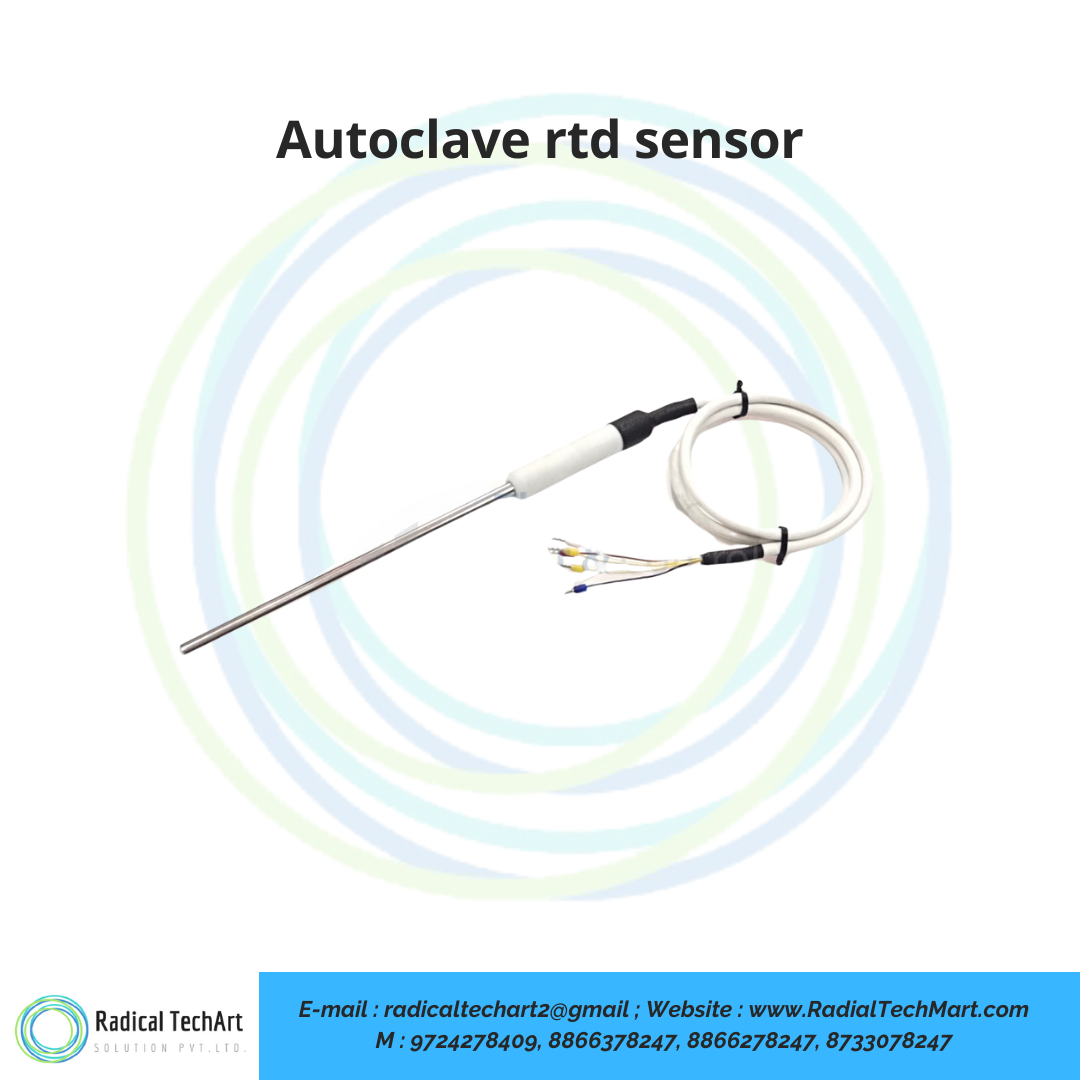
Autoclave Pt100 RTD Sensor with SS316L Probe
Autoclave Pt100 RTD Sensor is designed for accurate temperature measurement in autoclaves, sterilizers and high-pressure steam applications. It is suitable for pharmaceutical, medical, laboratory, food processing and industrial sterilization systems where stable temperature monitoring is required.
Customize
Share :
A. Product Overview
An Autoclave RTD Sensor is a temperature sensor specially designed for use in autoclaves and sterilization equipment. Autoclaves work under high temperature, high pressure and steam conditions, so they require a sensor that can provide accurate and stable temperature measurement in harsh environments.
This sensor uses a Pt100 RTD element, which is known for good accuracy, repeatability and long-term stability. The sensor is generally used to monitor and control temperature during sterilization cycles in pharmaceutical, medical, laboratory, food processing and industrial applications.
This autoclave RTD sensor can be customized with simplex or duplex Pt100 elements, different probe diameters, wire lengths and SS316L sheath material.
Key Specifications:
| Parameter | Details |
|---|---|
| Element | Pt100 Simplex and Duplex |
| Temperature Range | -50 to 150°C |
| Probe Diameter | 6 mm and 8 mm optional |
| Wire Insulation | Silicone |
| Wire Length | 1 meter to 10 meter |
| Sheath Material | SS316L |
B. Working Principle
The autoclave RTD sensor works on the principle of resistance change with temperature.
Inside the sensor, a Pt100 platinum element is used. Pt100 means the sensor has a resistance of 100 ohms at 0°C. When the temperature inside the autoclave increases, the resistance of the platinum element also increases in a predictable way.
This resistance change is measured by a temperature controller, indicator, transmitter, data logger or PLC system. The connected instrument converts the resistance value into a temperature reading.
In an autoclave, the RTD probe is exposed to steam, pressure and heat. The SS316L sheath protects the sensing element and helps the sensor provide reliable temperature measurement during sterilization cycles.
C. Why It Is Used
Autoclave RTD sensors are used because accurate temperature control is very important in sterilization and high-temperature steam processes.
They are used to:
Measure autoclave chamber temperature
Monitor sterilization temperature
Maintain correct process temperature
Improve sterilization reliability
Support validation and quality control
Protect products from under-heating or over-heating
Provide stable temperature feedback to controllers and PLC systems
Work reliably in steam, moisture and high-pressure conditions
In pharmaceutical and medical applications, even a small temperature variation can affect sterilization quality. That is why Pt100 RTD sensors are commonly preferred for autoclave temperature measurement.
D. Suitable Buyers
This product is suitable for:
Autoclave manufacturers
Sterilizer machine manufacturers
Pharmaceutical companies
Medical equipment manufacturers
Hospitals and laboratories
Food processing companies
Aerospace and research laboratories
Cleanroom equipment manufacturers
OEM machine manufacturers
Industrial automation companies
Panel builders and system integrators
Validation service providers
Maintenance teams in pharma and hospitals
Temperature control system suppliers
FAQ
1. What is an autoclave RTD sensor?
An autoclave RTD sensor is a temperature sensor used for measuring temperature inside autoclaves, steam sterilizers and high-pressure sterilization systems.
2. Which element is used in this sensor?
This sensor uses a Pt100 RTD element. It can be supplied in simplex and duplex options depending on the application requirement.
3. What is the temperature range of this autoclave RTD sensor?
The standard temperature range is -50 to 150°C, depending on sensor construction, cable insulation and application condition.
4. Why is Pt100 used in autoclave temperature sensors?
Pt100 is used because it offers good accuracy, stability and repeatability. It is suitable for precise temperature monitoring in sterilization applications.
5. What is the sheath material of this sensor?
The sheath material is SS316L, which is suitable for steam, moisture and hygienic industrial applications.
6. What probe diameter options are available?
The sensor is available with 6 mm and 8 mm probe diameter options.
7. Can the wire length be customized?
Yes, wire length can be customized from 1 meter to 10 meter as per installation requirement.
8. What is the difference between simplex and duplex RTD sensor?
A simplex RTD has one sensing element, while a duplex RTD has two sensing elements inside the same probe. Duplex sensors are useful where backup measurement or dual signal output is required.
9. Where is this sensor commonly used?
It is commonly used in pharmaceutical autoclaves, laboratory sterilizers, medical sterilization systems, food processing sterilizers and industrial steam sterilization equipment.
10. Can this sensor be connected to a temperature controller?
Yes, it can be connected to temperature controllers, indicators, transmitters, data loggers and PLC systems.
11. Is this sensor suitable for steam applications?
Yes, the sensor is designed for autoclave and steam sterilization applications where moisture, steam and pressure are present.
12. Why is accurate temperature measurement important in autoclaves?
Accurate temperature measurement ensures proper sterilization, process safety, product quality and compliance with quality standards in pharmaceutical, medical and laboratory applications.