

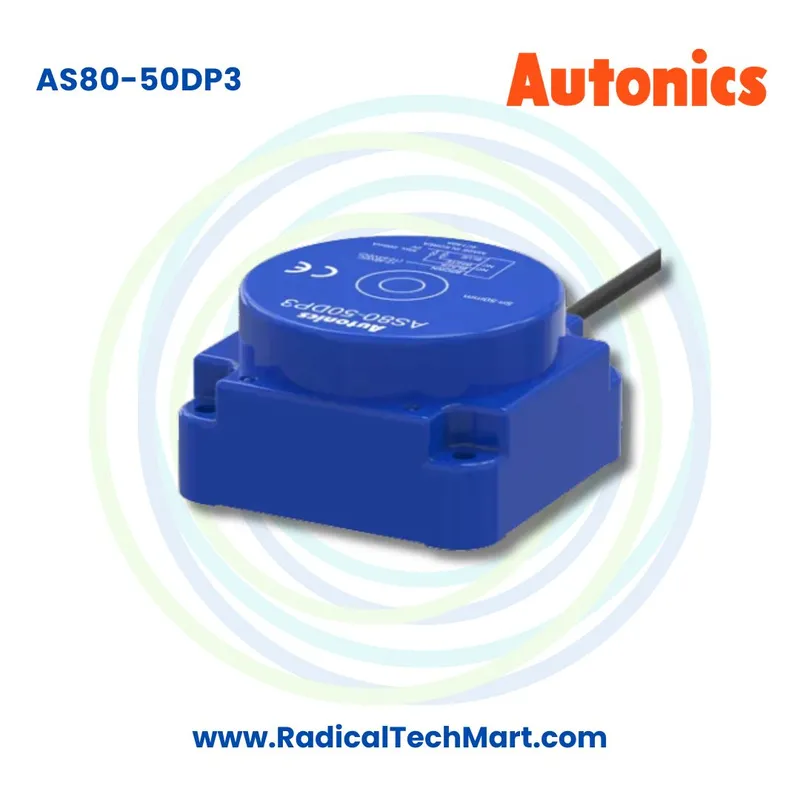
Autonics AS80-50DP3 50mm PNP Long Distance Proximity Sensor
The Autonics AS80-50DP3 is a rectangular long distance inductive proximity sensor designed for reliable non contact detection of metallic objects in industrial automation systems. It provides a 50 mm sensing distance, PNP Normally Open and Normally Closed outputs, 12 to 48 VDC power supply, 30 Hz response frequency, and IP67 protection. The sensor is suitable for conveyors, automated machinery, material handling systems, position detection, and industrial metal sensing applications.
Customize
Share :
A. Product Overview
The Autonics AS80-50DP3 is an industrial inductive proximity sensor designed for applications requiring a longer sensing distance than conventional proximity sensors.
Its rectangular 80 mm frame provides a sensing distance of up to 50 mm when used with the specified standard iron target. This allows metal objects to be detected without physical contact between the target and sensor.
The AS80-50DP3 uses a PNP output configuration and provides both Normally Open and Normally Closed outputs, giving machine designers greater flexibility when integrating the sensor with PLCs, controllers, relays, and automation equipment.
Key Specifications
Brand: Autonics
Model: AS80-50DP3
Product Type: Inductive Proximity Sensor
Sensor Type: Long Distance Proximity Sensor
Shape: Rectangular
Sensing Type: Upper Sensing Type
Frame Size: 80 mm
Sensing Distance: 50 mm
Recommended Setting Distance: 0 to 35 mm
Standard Sensing Target: 150 x 150 x 1 mm iron
Output Type: PNP
Output Operation: Normally Open and Normally Closed
Wiring Type: DC 4-wire
Rated Power Supply: 12 to 48 VDC
Operating Voltage Range: 10 to 65 VDC
Response Frequency: 30 Hz
Current Consumption: Maximum 20 mA
Control Output Capacity: Maximum 200 mA
Hysteresis: Maximum 15 percent of sensing distance
Residual Voltage: Maximum 2 V
Protection Rating: IP67
Operating Temperature: minus 25°C to 70°C
Storage Temperature: minus 30°C to 80°C
Operating Humidity: 35 to 95 percent RH
Approximate Weight: 470 g
The AS80-50DP3 is particularly useful where standard short range proximity sensors cannot provide enough clearance between the sensor and detected metal object.
B. Working Principle
The Autonics AS80-50DP3 works on the inductive proximity sensing principle.
An inductive proximity sensor generates an electromagnetic field around its sensing surface. When a metallic object enters this field, electrical currents called eddy currents are generated inside the metal target.
These currents change the condition of the sensor's internal oscillator. The electronic circuit detects this change and switches the output signal.
The basic working sequence is:
Power is supplied to the AS80-50DP3.
The sensor creates an electromagnetic detection field.
A metallic target approaches the sensing surface.
The metal interacts with the electromagnetic field.
The sensor detects the resulting change.
The internal switching circuit activates the PNP output.
The output signal can be sent to a PLC, relay, controller, or automation system.
Because detection is non contact, the sensor does not need to physically touch the object.
Example
Suppose a steel plate moves along a conveyor.
The AS80-50DP3 is installed above the conveyor and connected to a PLC.
When the steel plate enters the sensor's detection zone, the proximity sensor detects it and changes its output state. The PLC can then:
Stop the conveyor
Count the object
Activate another machine
Start a process
Trigger an alarm
Operate a pneumatic cylinder
Confirm that the component is correctly positioned
This makes proximity sensing extremely useful for automated manufacturing processes.
C. Why Is Autonics AS80-50DP3 Used?
The Autonics AS80-50DP3 long distance proximity sensor is used when metallic objects need to be detected reliably without physical contact.
Its key advantage is the 50 mm sensing distance, which allows greater clearance between the sensor and target.
This can be important where the detected object:
Moves rapidly
Vibrates
Cannot pass close to the sensor
Has positioning variation
Could physically damage a conventional mechanical limit switch
Needs to be detected without contact
Common Applications
The AS80-50DP3 can be used for:
Metal object detection
Machine position detection
Conveyor systems
Material handling systems
Automated production lines
Packaging machinery
Assembly machines
Steel processing equipment
Automotive manufacturing
Factory automation
Industrial machinery
Component presence detection
Position confirmation
Object counting
End position detection
Machine sequencing
Robotic automation systems
PLC based automation
Warehouse automation
Transfer machines
Why Use a Proximity Sensor Instead of a Mechanical Limit Switch?
A mechanical limit switch generally requires physical contact with the moving object.
An inductive proximity sensor detects metal without direct mechanical contact.
This can provide several practical advantages:
Reduced mechanical wear
No physical contact with the target
Suitable for repetitive machine cycles
Fast electronic switching
Easier integration with PLC systems
Better suitability for automated production
Reduced maintenance associated with mechanical contacts
D. Suitable Buyers
The Autonics AS80-50DP3 50mm PNP Proximity Sensor is suitable for:
Industrial automation companies
Machine manufacturers
OEM machine builders
Control panel manufacturers
System integrators
PLC programmers
Automation engineers
Electrical engineers
Factory maintenance teams
Manufacturing plants
Conveyor manufacturers
Packaging machine manufacturers
Material handling companies
Automotive equipment manufacturers
Steel processing industries
Production line manufacturers
Robotics integrators
Industrial equipment manufacturers
Process automation companies
Maintenance and replacement departments
It is especially suitable for users looking for a PNP long distance inductive proximity sensor with 50 mm sensing distance and simultaneous Normally Open and Normally Closed output.
Frequently Asked Questions
1. What is the Autonics AS80-50DP3?
The Autonics AS80-50DP3 is a rectangular inductive proximity sensor designed for long distance non contact detection of metallic objects in industrial automation applications.
2. What is the sensing distance of AS80-50DP3?
The rated sensing distance is 50 mm when used with the specified standard sensing target.
3. Is AS80-50DP3 a long distance proximity sensor?
Yes. The AS series is designed for long distance inductive sensing, and the AS80-50DP3 provides a sensing distance of up to 50 mm.
4. What type of objects can AS80-50DP3 detect?
It is an inductive sensor, so it is designed primarily for detecting metallic objects.
5. Can AS80-50DP3 detect plastic?
Inductive proximity sensors are designed for metallic target detection. Plastic itself is generally not an appropriate detection target for this sensor.
6. Can AS80-50DP3 detect iron?
Yes. Iron is a suitable target material.
The specified standard sensing target is 150 x 150 x 1 mm iron.
7. What output does the AS80-50DP3 have?
The sensor has a PNP output.
8. Is the AS80-50DP3 Normally Open or Normally Closed?
It provides both:
Normally Open output
Normally Closed output
This allows greater flexibility when integrating the sensor into an industrial control circuit.
9. Is AS80-50DP3 an NPN or PNP sensor?
The AS80-50DP3 is a PNP proximity sensor.
A different model should be selected when an NPN output is required.
10. What is the power supply of AS80-50DP3?
The rated power supply is 12 to 48 VDC.
11. What is the operating voltage range?
The operating voltage range extends approximately from 10 to 65 VDC.
12. How many wires does AS80-50DP3 use?
The AS80-50DP3 is a DC 4-wire proximity sensor.
13. What is the frame size of the sensor?
The sensing side uses an approximately 80 mm frame size.
14. What is the recommended setting distance?
The specified setting distance is approximately 0 to 35 mm.
For reliable industrial operation, the practical installation distance should be selected with appropriate margin rather than operating continuously at the absolute sensing limit.
15. What is the response frequency?
The response frequency is approximately 30 Hz.