

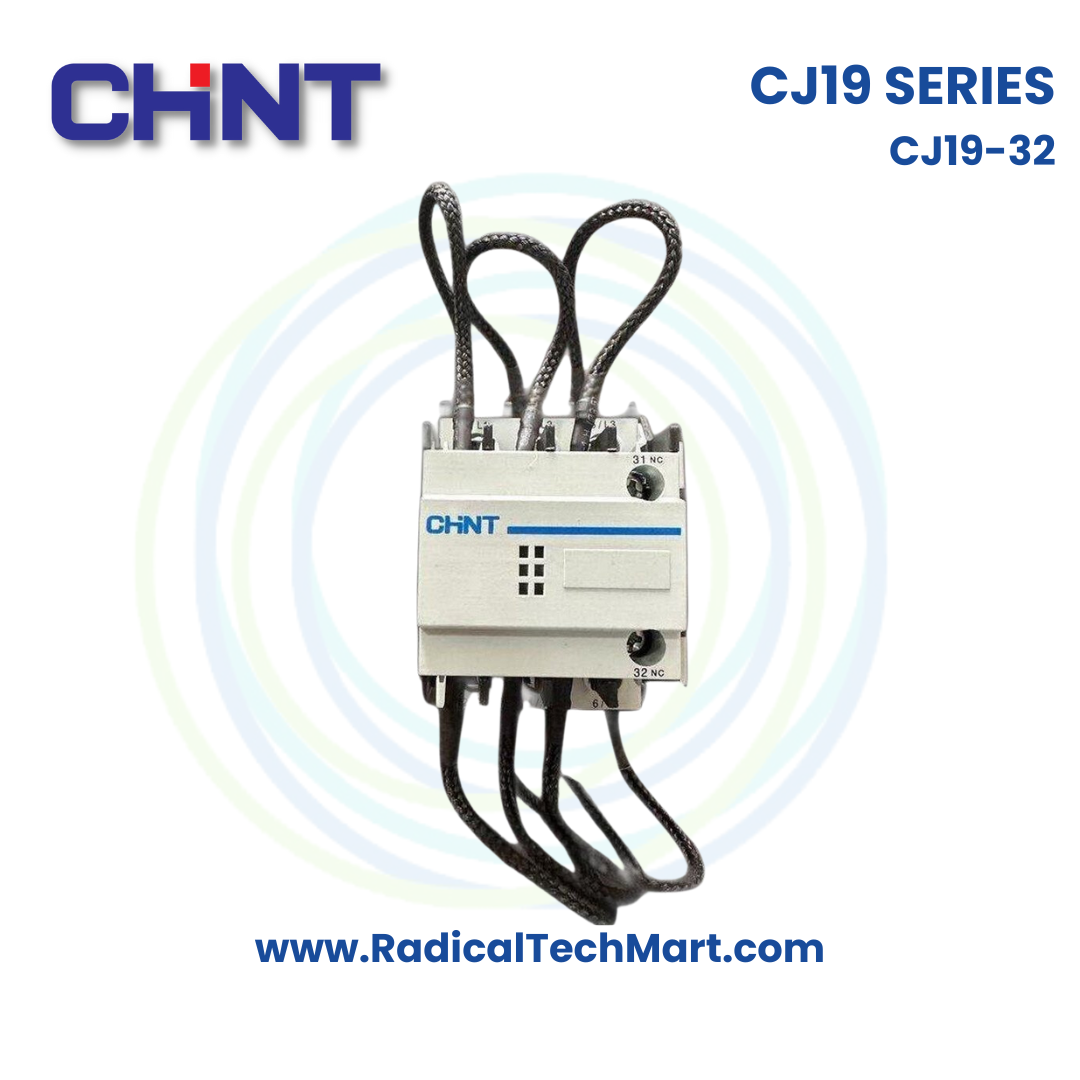


CJ19-32 Contactor Series
Customize
Share :
A. Product Overview
CHINT CJ19-32 is part of the CJ19 capacitor switching contactor series, specifically engineered for switching capacitor banks used in automatic power factor correction (APFC) systems. Unlike standard motor contactors, CJ19 contactors are designed to handle the high inrush currents that occur when capacitors are energized.
The CJ19-32 model is typically selected for medium-capacity capacitor steps in LT panels. It complies with IEC/EN 60947-4-1 and is suitable for AC 50/60 Hz systems with rated operating voltage up to 690 V. The contactor includes built-in auxiliary contacts and is compatible with standard panel mounting practices used in Indian industrial installations.
B. Working Principle
When a capacitor step is switched ON, a very high transient inrush current can flow, which can damage conventional contactors. The CJ19-32 uses a specially designed contact arrangement with damping resistors that limit inrush current during capacitor energization.
The pre-charge contacts close slightly before the main contacts, reducing peak current and protecting both the contactor and the capacitor. When switched OFF, the contactor safely disconnects the capacitor from the supply, allowing proper discharge through external resistors as per panel design.
C. Key Applications
Oil & Gas: Utility LT panels and non-process electrical rooms using APFC systems
Chemical & Process: Power factor correction panels for plant utilities and MCC incomers
Power & Utilities: LT substations and auxiliary distribution with capacitor banks
Pharma: Clean utility and facility LT panels with reactive power compensation
Food & Beverage: Manufacturing units with fluctuating reactive loads
Water & Wastewater: Pumping stations and treatment plants with APFC panels
HVAC & Utilities: Chiller plants, cooling tower panels, and centralized HVAC systems
D. Why Industries Use This Product
Poor power factor leads to higher current draw, transformer overloading, voltage drops, and penalties from utilities. Capacitor banks correct power factor, but improper switching can cause contact welding, capacitor failure, and frequent breakdowns.
Industries use the CJ19-32 because it is purpose-built for capacitor switching, significantly reducing inrush-related failures compared to standard AC-3 contactors. Incorrect selection or substitution with normal contactors can result in overheating, premature failure, and repeated downtime of APFC panels.
E. Suitable Buyers
OEMs manufacturing APFC and LT distribution panels
EPC contractors executing electrical infrastructure projects
Maintenance & Utilities teams for replacement in existing APFC panels
Plant engineering and procurement teams standardizing capacitor switching components
Retrofit projects upgrading older APFC systems with frequent contactor failures
Quick Answers
What is CHINT CJ19-32 Contactor?
It is a capacitor switching contactor designed specifically for switching power factor correction capacitors in APFC panels.
Where is CJ19-32 used?
Used in LT and APFC panels for controlling individual capacitor steps in industrial and commercial electrical systems.
Why is CJ19-32 required in industry?
It safely handles capacitor inrush currents, preventing damage to contactors and capacitors and improving APFC panel reliability.
Who typically uses CJ19-32 contactors?
Panel builders, EPC contractors, plant maintenance teams, and industrial procurement engineers.
FAQ Section
1) Can CJ19-32 be replaced with a normal motor contactor?
No. Standard AC-3 motor contactors are not designed for capacitor inrush currents. Using them can cause contact welding and early failure. CJ19 contactors are specifically designed for capacitor switching duty.
2) What capacitor ratings is CJ19-32 typically used for?
CJ19-32 is selected based on the kvar rating of the capacitor step and system voltage. Selection should always follow the capacitor manufacturer’s recommendations and APFC panel design guidelines.
3) Does CJ19-32 provide overload or short-circuit protection?
No. It is a switching device only. Short-circuit and overload protection must be provided using appropriate fuses or MCCBs in the APFC panel.
4) What mounting options are available for CJ19-32?
The CJ19-32 can be mounted using screws and is also compatible with DIN rail mounting, making it suitable for compact APFC panel layouts.
5) What are common reasons for CJ19 contactor failure?
Incorrect capacitor sizing, missing or failed discharge resistors, excessive switching frequency, poor ventilation, and loose terminations are common causes of failure in capacitor switching contactors.