

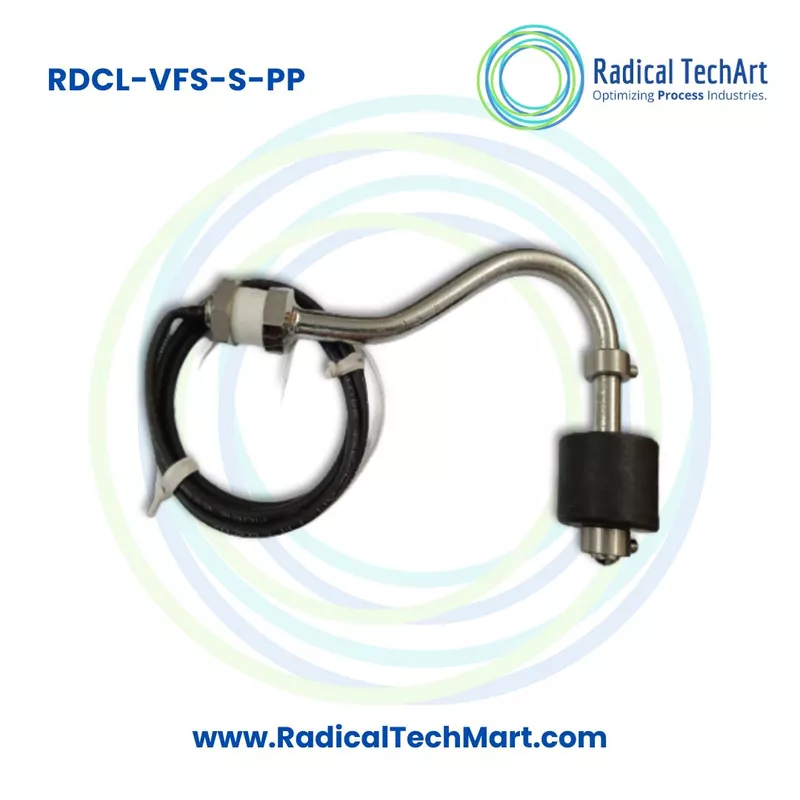


Compact Side Mount Vertical Operated SS Float Switch
Compact Side Mount Vertical Operated SS Float Switch is a compact stainless steel liquid level switch designed for side mounting in tanks, boilers, chillers, autoclaves and process vessels. It combines horizontal mounting with vertical float movement to provide accurate level switching in limited space applications.
Customize
Share :
A. Product Overview
The Compact Side Mount Vertical Operated SS Float Switch is used for reliable liquid level detection where a compact side mounted design is required. The switch is installed from the side of the tank, while the float operates vertically inside the tank. This design gives better switching accuracy compared to normal horizontal float switches and is suitable where the switching band needs to remain close to the tank wall.
The switch is available with stainless steel construction and can be supplied with SS 304, SS 316, SS 316L, Nylon or Polypropylene float options depending on the liquid and application requirement. It is commonly used in industrial chiller units, autoclaves, water treatment plants, boilers and process tanks.
Key Features:
Compact side mounted design for limited space applications
Vertical float movement for accurate level switching
Available in SS 304 and SS 316 stem material
SS 316L, Nylon and Polypropylene float options
Standard M10 mounting and customizable M16 option
Suitable for NO or NC switching logic
Can be customized for multiple switching requirements
Works close to the tank hole for compact tank installation
Suitable for water, compatible liquids, oils and selected process fluids
B. Working Principle
The Compact Side Mount Vertical Operated SS Float Switch works on a magnetic float and reed switch principle.
When the liquid level rises or falls inside the tank, the float moves vertically along the stem. A magnet inside the float activates the sealed reed switch inside the stem. When the float reaches the preset level, the reed switch changes its contact position and gives an electrical signal.
This signal can be used for:
High level alarm
Low level alarm
Pump start and stop control
Dry run protection
Overflow prevention
Boiler coil low level protection
Tank automation and process safety
The switching action can be configured as NO or NC depending on the control logic required. In many float switch designs, the switching logic can also be changed by reversing the float direction during installation, depending on the model design.
C. Why It Is Used
This float switch is used where tanks require accurate liquid level switching but have limited space for installation. Its side mounted construction makes it useful when top mounting is not possible or when the switching point must remain close to the tank wall.
It is used to prevent overflow, protect pumps from dry running, control tank filling, detect low liquid level and provide safety signals to control panels. The stainless steel construction makes it suitable for industrial environments where durability, temperature resistance and corrosion resistance are important.
Main reasons to use this product:
To monitor high and low liquid levels
To protect pumps from dry running
To prevent tank overflow
To automate filling and draining systems
To provide reliable switching in compact tanks
To use in boilers, chillers, autoclaves and process units
To get accurate level detection with vertical float operation
To install level switching near the side wall of the tank
To handle industrial liquid level control applications
D. Suitable Buyers
This product is suitable for buyers who need compact and reliable liquid level switching for tanks, vessels and industrial equipment.
Suitable buyers include:
Boiler manufacturers
Chiller manufacturers
Autoclave manufacturers
Water treatment plant manufacturers
Industrial process equipment manufacturers
OEM machine manufacturers
Panel builders and automation system integrators
Maintenance departments
Chemical process plants
Pharmaceutical plants
Food and beverage processing units
Pump automation companies
Tank manufacturers
Industrial utilities and plant engineering teams
FAQ
1. What is a Compact Side Mount Vertical Operated SS Float Switch?
A Compact Side Mount Vertical Operated SS Float Switch is a liquid level switch installed from the side of a tank, where the float moves vertically to detect high or low liquid level conditions.
2. Where is this float switch used?
It is used in chillers, boilers, autoclaves, water treatment plants, process tanks, storage tanks and industrial liquid level control systems.
3. What is the advantage of vertical operation in a side mounted float switch?
Vertical operation gives better switching accuracy and allows the switch to work close to the tank hole, making it suitable for compact tank designs.
4. Which materials are available for this float switch?
The stem is available in SS 304 and SS 316. Float options can include SS 316L, Nylon and Polypropylene depending on the liquid compatibility and application requirement.
5. Can this switch be used for high temperature applications?
Yes, stainless steel versions can be used for higher temperature applications. The temperature range depends on the float material and construction selected.
6. Can the mounting size be customized?
Yes, standard mounting is generally M10, and it can be customized to M16 or other process connection options such as TC fitting depending on the application.
7. What type of electrical switching does it provide?
It generally provides SPST switching with NO or NC contact options, suitable for connection with control panels, relays, contactors and automation systems.
8. Can it be used for pump protection?
Yes, it can be used for low level detection to protect pumps from dry running and for high level detection to prevent tank overflow.
9. Is this switch suitable for water treatment plants?
Yes, it is suitable for water treatment plants, industrial process units and other tank level sensing applications.
10. Can it be customized for different switching points?
Yes, versions with customized switching points can be supplied depending on stem material, tank design and user requirement.