

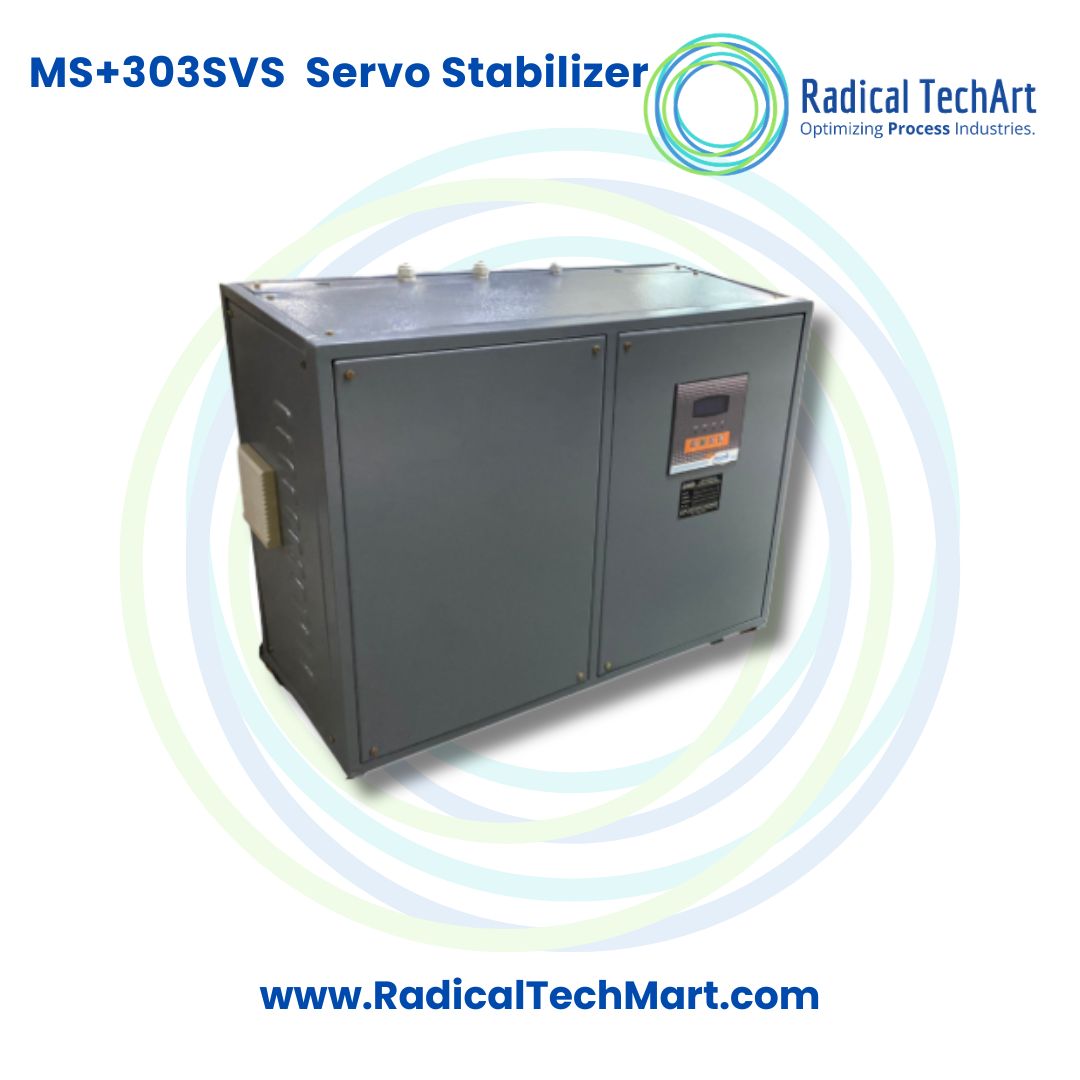
MS+303SVS-A Three-Phase Air-Cooled Servo Stabilizer
Customize
Share :
A. Product Overview
The COSMIC Plus MS 303SVS-A is a three-phase input and three-phase output air-cooled servo voltage stabilizer developed for equipment that requires a regulated and reliable three-phase power supply.
It uses a combination of electronic control circuits, variable transformers, servo motors and buck-boost transformers to continuously correct variations in the incoming mains voltage. The system monitors each phase and makes the required correction to maintain the selected output voltage.
The official product information lists three-phase air-cooled ratings from 10 kVA to 100 kVA. Available three-phase input ranges include 360 to 460 V AC, 380 to 480 V AC and 380 to 500 V AC. Output voltage options include 380 V, 400 V and 415 V AC, depending on the selected configuration.
Main Features
- Three-phase input and three-phase output
- Air-cooled construction
- Servo-based automatic voltage control
- Individual phase voltage correction
- Copper-wound dimmer for each phase
- Aluminium-wound buck-boost transformer for each phase
- Copper-wound buck-boost transformer available on request
- Automatic and manual operating facility for individual phases
- LCD display for operating information
- Voltage correction speed greater than 20 V per second
- Efficiency greater than 98 percent
- Response time of less than 10 milliseconds
- No significant effect on load power factor
- No waveform distortion
- Input and output voltage monitoring
- Frequency and error-code display
- Protection against abnormal voltage and phase-related faults
B. Working Principle
The COSMIC Plus MS 303SVS-A continuously monitors the incoming voltage on all three phases.
When the input voltage on any phase rises above or falls below the required level, the electronic control circuit detects the difference between the incoming voltage and the selected output voltage.
The controller then operates the servo motor associated with that phase. The servo motor adjusts the position of the variable transformer, also known as the dimmer. The voltage generated by the dimmer is transferred to the buck-boost transformer.
The buck-boost transformer performs one of two functions:
- It adds voltage when the incoming voltage is too low.
- It subtracts voltage when the incoming voltage is too high.
Because correction is available for individual phases, the stabilizer can regulate each phase according to its measured voltage condition. The corrected three-phase voltage is then supplied to the connected equipment.
The operating sequence can be understood as:
Fluctuating three-phase input → Voltage sensing circuit → Electronic controller → Servo motor → Variable transformer → Buck-boost transformer → Regulated three-phase output
The stabilizer provides a correction speed greater than 20 V per second, response time below 10 milliseconds and efficiency above 98 percent under the listed operating conditions.
C. Why It Is Used
Industrial machines and commercial electrical systems are normally designed to operate within a defined voltage range. Repeated undervoltage, overvoltage, phase imbalance or other supply abnormalities can affect equipment performance and operating reliability.
The COSMIC Plus MS 303SVS-A is used to provide regulated voltage between the incoming electrical supply and the connected load.
It helps users:
- Maintain stable three-phase output voltage
- Correct high and low incoming voltage
- Support reliable operation of industrial machinery
- Protect equipment against input undervoltage and overvoltage
- Protect connected loads against output undervoltage and overvoltage
- Detect phase reversal conditions
- prevent operation during single phasing
- Provide short-circuit protection
- Monitor input voltage, output voltage and frequency
- Identify operating errors through displayed error codes
- Reduce equipment interruptions associated with unstable voltage
- Support sensitive electronic controls and automation systems
- Improve operating consistency in production environments
The product is particularly relevant where the incoming three-phase supply frequently varies but connected machinery requires a stable 380 V, 400 V or 415 V AC supply.
D. Suitable Buyers
Engineering Units
Engineering workshops and manufacturing facilities can use the stabilizer for compatible machinery, testing equipment, control systems and production equipment operating on three-phase power.
CNC Machine Users
CNC machines contain motors, drives, controllers and electronic circuits that may require regulated voltage. The correct stabilizer rating should be selected according to the machine load, starting current and recommended operating voltage.
Pharmaceutical Units
Pharmaceutical manufacturers can consider the stabilizer for production machines, processing systems, laboratory equipment, packaging lines and compatible utility equipment.
Air-Conditioning Plants
The stabilizer may be used for compatible three-phase air-conditioning systems, compressors and supporting equipment after checking the starting current and total connected load.
Printing and Packaging Companies
Printing presses, packaging machines, labelling systems, control panels and production lines can benefit from a regulated three-phase supply.
Textile Mills
Textile plants can use the stabilizer for compatible spinning, weaving, processing, finishing and auxiliary machinery.
Cement Plants
Cement-processing units can consider the stabilizer for selected machinery, control equipment and electrical systems requiring stable three-phase voltage.
Food-Processing Units
It is suitable for compatible processing machines, packaging equipment, conveyors, refrigeration systems and production-line controls.
Plants and Factories
Factories experiencing frequent voltage fluctuations can install the stabilizer before selected equipment or a defined group of loads, subject to correct load calculation and system design.
Frequently Asked Questions
1. What is the COSMIC Plus MS 303SVS-A?
The COSMIC Plus MS 303SVS-A is a three-phase input and three-phase output air-cooled servo voltage stabilizer. It automatically corrects incoming voltage fluctuations and supplies regulated three-phase voltage to connected equipment.
2. What does three-phase input and three-phase output mean?
It means the stabilizer receives a three-phase AC supply and provides a regulated three-phase AC output. It is intended for compatible industrial and commercial equipment operating on three-phase power.
3. What capacity range is available?
The official product page lists the three-phase input and three-phase output air-cooled range from 10 kVA to 100 kVA. The required capacity should be selected according to the connected load, starting current and future load requirements.
4. What input voltage ranges are available?
The listed three-phase input options include:
- 360 to 460 V AC
- 380 to 480 V AC
- 380 to 500 V AC
The required input range should be selected after measuring the lowest and highest voltage available at the installation site.
5. What output voltages are available?
The official specifications list output voltage options of 380 V, 400 V and 415 V AC for three-phase applications. The required output should match the voltage rating of the connected equipment.
6. How does the servo stabilizer regulate voltage?
The stabilizer monitors the input voltage and compares it with the required output. When a deviation is detected, the controller operates a servo motor that adjusts the variable transformer. The buck-boost transformer then increases or decreases the voltage to produce the required output.
7. Does it correct each phase individually?
Yes. The product information specifies an individual-phase dimmer, buck-boost transformer and automatic or manual operating facility. This allows voltage correction to be performed for individual phases.
8. Is the MS 303SVS-A air-cooled?
Yes. It uses an air-cooled construction for heat dissipation and does not depend on transformer oil as its primary cooling medium.
9. What is its voltage correction speed?
The listed correction speed is greater than 20 V per second.
10. What is the response time?
The official specifications state a response time of less than 10 milliseconds.
11. What is the efficiency of the stabilizer?
The listed efficiency is greater than 98 percent under the specified operating conditions.
12. Does the stabilizer have an LCD display?
Yes. The LCD display supports monitoring of input voltage, output voltage, frequency and error codes.
13. What protection features are available?
The listed protection functions include:
- Input undervoltage protection
- Input overvoltage protection
- Output undervoltage protection
- Output overvoltage protection
- Single-phasing prevention
- Phase-reversal prevention
- Short-circuit protection
14. Does it show overload and phase-reversal indications?
Yes. The listed indications include input normal, output normal, phase reversal and overload status.
15. Can it be operated manually?
Yes. The stabilizer provides automatic and manual operating facilities for individual phases. Manual operation is useful during testing, servicing and controlled adjustment by qualified personnel.
16. Does it change the frequency of the power supply?
No. A servo voltage stabilizer regulates voltage rather than converting frequency. The official specifications list operation at 50 or 60 Hz and an operating frequency range of 47 to 53 Hz.
17. Does it provide power backup during a power failure?
No. The stabilizer regulates the available mains voltage. It does not provide battery backup when the incoming supply fails. An online UPS or another backup power system is required when uninterrupted power is needed.
18. Can it be used with CNC machinery?
Yes. CNC machinery is one of the listed application areas. However, the stabilizer capacity must be selected according to the machine rating, spindle and drive load, starting current, control-system requirements and actual site voltage range.
19. How should the correct kVA rating be selected?
The selection should consider:
- Total connected load
- Motor and compressor starting current
- Load power factor
- Minimum and maximum input voltage
- Required output voltage
- Continuous and intermittent loads
- Future load expansion
- Recommended safety margin
The stabilizer should not be selected only by adding the equipment nameplate ratings without checking starting conditions and operating characteristics.
20. What details should be shared before requesting a quotation?
The buyer should provide:
- Required capacity in kVA
- Equipment name and application
- Total connected load
- Minimum and maximum input voltage
- Required output voltage
- Load power factor
- Motor or compressor details
- Starting current, when applicable
- Indoor installation conditions
- Required protection functions
- Required quantity