

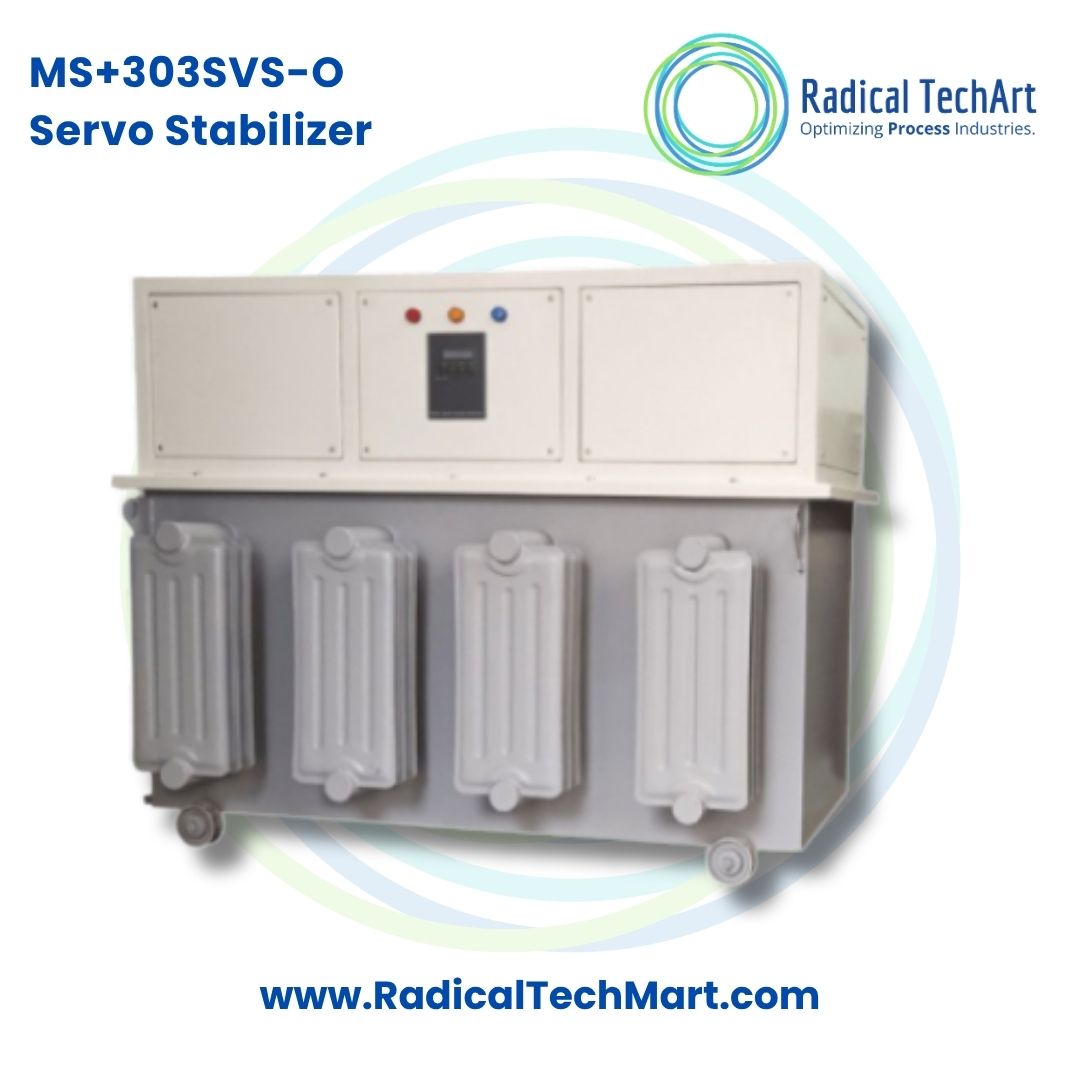
MS+303SVS-O Three-Phase Oil-Cooled Servo Stabilizer
The COSMIC Plus MS 303SVS-O Three-Phase Oil-Cooled Servo Stabilizer provides stable 400 V or 415 V three-phase output from a fluctuating three-phase electrical supply. Its servo-controlled buck-boost technology, oil-cooled construction, digital monitoring, manual bypass and electrical protection features make it suitable for demanding industrial machinery and high-capacity commercial loads.
Customize
Share :
A. Product Overview
The COSMIC Plus MS 303SVS-O is a three-phase input and three-phase output servo voltage stabilizer designed to protect industrial equipment from unstable mains voltage.
The stabilizer continuously monitors the incoming supply and automatically increases or decreases the voltage to maintain the required output. Oil cooling helps dissipate heat generated during continuous operation, making the model suitable for higher-capacity loads and demanding industrial environments.
COSMIC Plus oil-cooled stabilizers are available in multiple kVA ratings. The exact enclosure dimensions, transformer oil quantity and installation requirements vary according to the selected capacity.
Main Technical Features
- Three-phase input and three-phase output
- Rated input range of 360 to 480 V AC
- Regulated output selection of 400 V or 415 V AC
- Output regulation within 1 percent from no load to full load
- Servo-controlled buck-boost technology
- Response time of approximately 10 milliseconds
- Efficiency above 98 percent
- True reproduction of the incoming waveform
- Copper-wound dimmer
- Aluminium-wound buck-boost transformer
- Oil-cooled construction
- LCD and digital metering
- Manual bypass switch
- IP20 panel enclosure
- Audible noise below 50 dB at a distance of one metre
- Top-side incoming and outgoing cable entry
The stabilizer can withstand an overload of 110 percent for five minutes and 120 percent for 60 seconds without using the bypass.
Display and Monitoring
The LCD system displays:
- R to Y, Y to B and R to B input voltage
- R to Y, Y to B and R to B output voltage
- R to N, Y to N and B to N input voltage
- R to N, Y to N and B to N output voltage
- Supply frequency
- Operating logs with date and time
The listed protection functions include overload protection, overvoltage and undervoltage trip and phase-reversal protection.
B. Working Principle
The COSMIC Plus MS 303SVS-O operates by continuously sensing the incoming voltage on the three-phase power supply.
When the input voltage becomes higher or lower than the required level, the electronic control system identifies the deviation and sends a command to the servo motor. The servo motor adjusts the variable transformer, also known as the dimmer.
The dimmer supplies a correction voltage to the buck-boost transformer. The buck-boost transformer then performs one of two actions:
- It adds the required voltage when the incoming supply is low.
- It subtracts the excess voltage when the incoming supply is high.
The corrected voltage is then supplied to the connected three-phase equipment.
The operating sequence is:
Fluctuating three-phase input → Voltage sensing circuit → Electronic controller → Servo motor → Variable transformer → Buck-boost transformer → Regulated three-phase output
This closed-loop regulation process takes place automatically and provides a response time of approximately 10 milliseconds.
C. Why It Is Used
Three-phase industrial equipment is generally designed to operate within a specified voltage range. Persistent overvoltage, undervoltage and supply instability can lead to overheating, nuisance tripping, inaccurate machine operation and premature component failure.
The COSMIC Plus MS 303SVS-O is used to:
- Maintain a stable three-phase output voltage
- Correct high and low incoming voltage
- Protect machinery from abnormal voltage conditions
- Reduce unexpected shutdowns caused by voltage fluctuations
- Support reliable operation of motors, drives and control systems
- Improve the operating consistency of production machinery
- Reduce electrical stress on sensitive components
- Support continuous industrial operation
- Provide clear monitoring of phase voltages and frequency
- Allow maintenance operation through a manual bypass arrangement
- Improve heat dissipation in higher-capacity stabilizer applications
- Reduce equipment repair and replacement costs associated with unstable power
The oil-cooled design is particularly useful for applications involving continuous loads, higher kVA ratings and demanding operating conditions.
D. Suitable Buyers
CNC Machine Operators
Suitable for CNC machines, machining centres, controllers, servo drives and related production equipment requiring regulated three-phase voltage.
Manufacturing Plants
Suitable for factories operating production lines, industrial motors, control panels, automation systems and processing machinery.
Pharmaceutical Companies
Can be used for compatible production equipment, laboratory systems, packaging machinery and utility equipment operating on three-phase power.
Printing and Packaging Units
Suitable for printing presses, laminating machines, labelling systems, packaging machines and electronic production controls.
Textile Mills
Can support spinning, weaving, dyeing, processing and finishing equipment affected by unstable voltage.
Food-Processing Facilities
Suitable for processing machines, conveyors, packaging lines, refrigeration equipment and production-control systems.
Plastic and Rubber Industries
Can be considered for injection-moulding machines, extrusion equipment, hydraulic systems and associated control panels.
Cold Storage and Refrigeration Plants
Useful for compatible compressors, refrigeration systems, motors and control equipment after checking their starting-current requirements.
Engineering Workshops
Suitable for testing equipment, fabrication machinery, machine tools and other three-phase engineering loads.
Commercial and Institutional Facilities
Can be considered for selected three-phase electrical systems in hospitals, laboratories, hotels, office buildings and institutional facilities.
Frequently Asked Questions
1. What is the COSMIC Plus MS 303SVS-O?
The COSMIC Plus MS 303SVS-O is a three-phase input and three-phase output oil-cooled servo voltage stabilizer. It automatically corrects fluctuations in the incoming voltage and provides regulated power to connected equipment.
2. What does the letter O represent in MS 303SVS-O?
The letter O identifies the oil-cooled version of the servo voltage stabilizer.
3. What input voltage range does it support?
The referenced technical data sheets specify a rated three-phase input range of 360 to 480 V AC.
4. What output voltage does it provide?
The stabilizer can be configured to provide a regulated three-phase output of 400 V or 415 V AC, depending on the application and connected equipment.
5. How accurately does it regulate the output voltage?
The listed output regulation is within 1 percent from no load to full load.
6. How does an oil-cooled servo stabilizer work?
It monitors the input voltage and operates a servo motor whenever a voltage deviation is detected. The motor adjusts a variable transformer, and the buck-boost transformer adds or subtracts voltage to maintain the required output.
7. Why is oil cooling used?
Transformer oil absorbs and transfers heat generated inside the stabilizer. This supports effective heat dissipation during continuous operation and makes oil-cooled models suitable for higher-capacity loads.
8. Is the stabilizer suitable for continuous industrial operation?
Yes. Its oil-cooled construction, high efficiency and servo-controlled design make it suitable for continuous industrial applications, subject to proper capacity selection and installation conditions.
9. What is its efficiency?
The referenced technical specifications list efficiency above 98 percent.
10. What is the stabilizer’s response time?
The listed response time is approximately 10 milliseconds.
11. What overload capacity is available?
Without using the bypass, the stabilizer can withstand:
- 110 percent load for five minutes
- 120 percent load for 60 seconds
These values apply under the specified operating conditions.
12. What protection functions are provided?
The listed protections include:
- Overload protection
- Overvoltage trip
- Undervoltage trip
- Phase-reversal protection
The final protection configuration should be confirmed for the selected kVA rating.
13. Does it have a bypass facility?
Yes. The technical data sheets specify a manual bypass switch. This allows the load to be transferred to the mains supply during stabilizer maintenance, subject to safe incoming voltage conditions.
14. Does the stabilizer provide power backup?
No. A servo stabilizer regulates the available mains voltage but does not provide battery backup during a power failure. An online UPS, inverter or generator is required when backup power is needed.
15. Can it be used with CNC machines?
Yes. It can be considered for compatible CNC machines and machining centres. Capacity selection should account for the total machine load, spindle motor, servo drives, starting current and recommended voltage range.
16. How should the correct kVA rating be selected?
The required capacity should be calculated using:
- Total connected load
- Load power factor
- Motor and compressor starting current
- Minimum and maximum site voltage
- Required output voltage
- Continuous operating load
- Future expansion
- Recommended safety margin
17. Does the oil quantity remain the same for every rating?
No. Oil quantity varies according to capacity and construction. For example, the referenced technical sheets specify different oil quantities for 40 kVA, 60 kVA and 125 kVA models.
18. What site conditions should be considered?
The referenced specifications indicate:
- Minimum ambient temperature of 5 degrees Celsius
- Maximum ambient temperature of 40 degrees Celsius
- Installation altitude below 1000 metres above mean sea level
- Three-phase operating supply
19. What information should be provided before requesting a quotation?
The buyer should provide:
- Required capacity in kVA
- Equipment name and application
- Total connected load
- Minimum and maximum input voltage
- Required output voltage
- Motor and compressor details
- Starting current
- Load power factor
- Installation location
- Daily operating duration
- Required quantity