

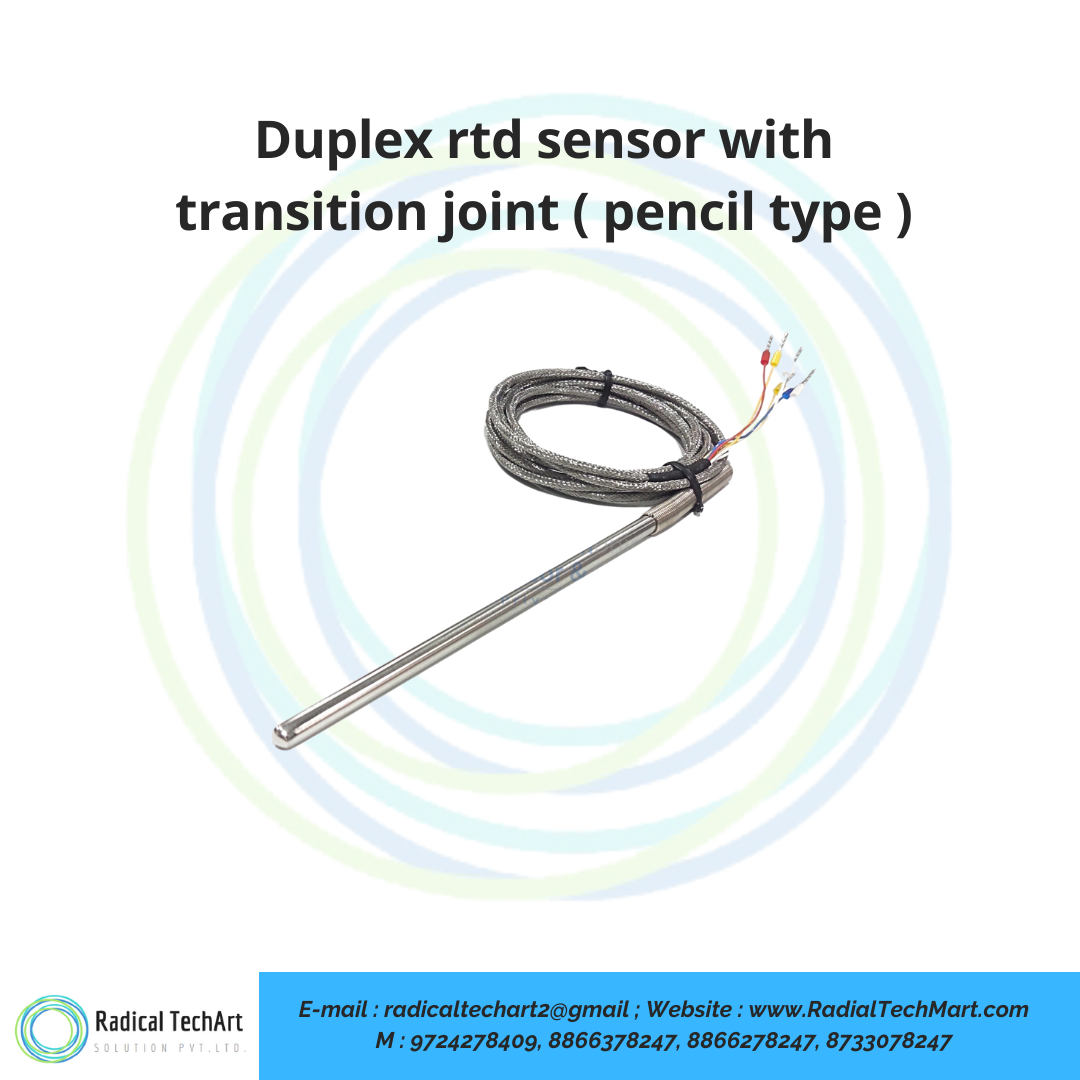
Duplex RTD Sensor with Transition Joint (Pencil Type)
Duplex RTD Sensor with Transition Joint Pencil Type is a Pt100 temperature sensor designed for accurate and reliable industrial temperature measurement. It has two RTD elements in one probe, allowing continuous monitoring even if one element fails. It is suitable for chemical, pharmaceutical, food, oil and gas, machinery and process industry applications.
Customize
Share :
A. Product Overview
A Duplex RTD Sensor with Transition Joint Pencil Type is an industrial temperature sensor used to measure temperature accurately in process equipment, pipelines, tanks, machinery and control systems.
The word “duplex” means the sensor has two Pt100 RTD elements inside a single probe. This gives backup protection in critical applications. If one RTD element fails or gives an incorrect reading, the second RTD element can be used without immediately removing or replacing the sensor.
The pencil type design means the probe is slim, straight and compact, making it easy to install in limited spaces or narrow insertion points. The transition joint connects the metal probe section with the flexible cable section and gives mechanical strength to the sensor.
This RTD sensor is commonly available with different wire configurations such as 4 wire, 6 wire and 8 wire depending on accuracy and control system requirement. It can also be supplied with different cable insulation options such as SS braided, Teflon and fiberglass.
B. Working Principle
A Duplex RTD Sensor works on the resistance temperature detection principle. The Pt100 element inside the sensor changes its electrical resistance as temperature changes.
In a Pt100 RTD sensor, the resistance is 100 ohms at 0°C. When temperature increases, the resistance of the platinum element also increases in a predictable and stable manner. This resistance change is measured by a temperature indicator, controller, transmitter, PLC or data acquisition system and converted into a temperature reading.
Because this is a duplex RTD sensor, it contains two separate Pt100 sensing elements. Both elements are placed inside one probe body. One element can be used for regular temperature measurement, while the second element can be used as a backup or for a separate monitoring system.
The transition joint helps protect the connection between the rigid probe and the flexible cable. It also improves the durability of the sensor in industrial environments where vibration, movement, heat and handling are common.
C. Why It Is Used
Duplex RTD Sensor with Transition Joint Pencil Type is used where reliable and accurate temperature measurement is important. In many industries, downtime can be costly. If a single element RTD fails, the system may need to be stopped for sensor replacement. With a duplex RTD sensor, the second element can continue temperature measurement until maintenance is planned.
It is mainly used for:
Accurate industrial temperature measurement.
Backup temperature sensing in critical processes.
Reducing downtime in continuous process applications.
Temperature monitoring in tanks, pipelines, vessels and machinery.
Applications where one sensor is required for control and another for indication or safety monitoring.
High accuracy measurement compared to many general-purpose temperature sensors.
It is suitable for process areas where temperature stability, reliability and repeatability are important.
D. Suitable Buyers
This product is suitable for buyers who need reliable industrial temperature sensing for process control and equipment monitoring.
Suitable buyers include:
Chemical plant maintenance teams.
Pharmaceutical manufacturing companies.
Food and beverage processing plants.
Oil and gas industry users.
Boiler and heater manufacturers.
Machinery manufacturers.
Panel builders and automation system integrators.
OEM machine manufacturers.
Process industry maintenance departments.
Temperature controller and transmitter users.
Industrial buyers looking for Pt100 RTD sensors with backup element protection.
This sensor is especially useful for buyers who cannot afford frequent shutdowns due to temperature sensor failure.
Frequently Asked Questions
1. What is a Duplex RTD Sensor?
A Duplex RTD Sensor is a temperature sensor that has two RTD elements inside one probe. It is used where backup temperature measurement is required in case one sensing element fails.
2. What does Pt100 mean in an RTD sensor?
Pt100 means the sensing element is made of platinum and has a resistance of 100 ohms at 0°C. Pt100 RTD sensors are widely used for accurate industrial temperature measurement.
3. What is the use of a transition joint in this RTD sensor?
The transition joint connects the stainless steel probe with the flexible cable. It provides mechanical support, protects the internal wire connection and improves sensor durability in industrial applications.
4. Where is a pencil type RTD sensor used?
A pencil type RTD sensor is used in applications where a slim and straight probe is required. It is commonly used in machines, process lines, tanks, pipelines, heating systems and industrial equipment.
5. What is the temperature range of this sensor?
The typical temperature range for this Duplex RTD Sensor with Transition Joint Pencil Type is around minus 70°C to 500°C, depending on probe material, cable insulation and application conditions.
6. What wire configurations are available?
This RTD sensor can be supplied in 4 wire, 6 wire and 8 wire configurations. The selection depends on the required accuracy and whether one or both RTD elements need to be connected.
7. Why should I choose a duplex RTD instead of a simplex RTD?
A simplex RTD has one sensing element, while a duplex RTD has two sensing elements. Duplex RTD sensors are preferred in critical applications because they provide backup temperature measurement and help reduce downtime.
8. Which cable insulation options are available?
Common cable insulation options include SS braided, Teflon and fiberglass. The right insulation depends on temperature, flexibility, mechanical protection and environmental conditions.
9. Can this RTD sensor be customized?
Yes, Duplex RTD Sensors with Transition Joint Pencil Type can usually be customized based on probe diameter, probe length, cable length, wire configuration, insulation type and process requirement.
10. In which industries is this sensor commonly used?
This sensor is commonly used in chemical, pharmaceutical, food and beverage, oil and gas, machinery, heating, process control and general industrial temperature measurement applications.