

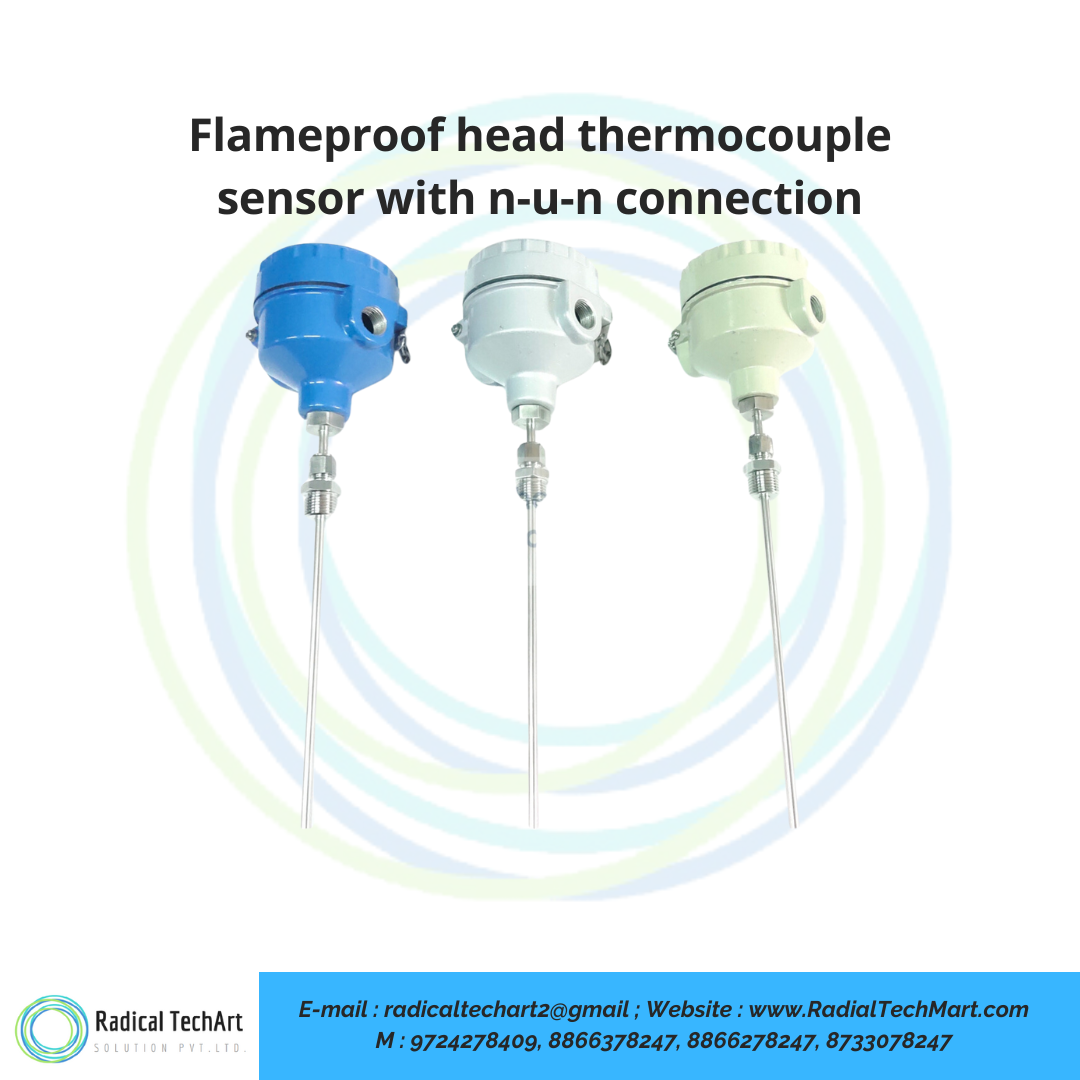
Flameproof Head Thermocouple Sensor with N-U-N Connection
Thermocouple with Nipple-Union-Nipple connection is an industrial temperature sensor designed for accurate and reliable temperature measurement in process applications. The N-U-N connection provides easy installation, secure fitting, and convenient removal for maintenance without disturbing the complete assembly. It is suitable for chemical, oil and gas, petrochemical, boiler, furnace, and general industrial temperature monitoring applications.
Customize
Share :
A. Product Overview
Thermocouple with Nipple-Union-Nipple connection is a temperature sensor used to measure high temperatures in industrial processes. The sensor consists of a thermocouple element, protective sheath, terminal head, and a nipple-union-nipple connection assembly.
The N-U-N connection includes two nipple fittings with a union in the middle. This design provides a strong and convenient connection point for the sensor. It allows easy installation, removal, and maintenance, especially in applications where the sensor may need periodic calibration or replacement.
This type of thermocouple is commonly used in process industries where temperature measurement is required in pipelines, tanks, furnaces, boilers, reactors, heaters, and industrial equipment. It can be supplied in different thermocouple types such as J type and K type, with simplex or duplex construction depending on the application requirement.
The sensor can be customized with different probe lengths, sheath diameters, process threads, and sheath materials as per site conditions.
B. Working Principle
A thermocouple works on the thermoelectric principle. It is made by joining two different metal wires at one end to form a sensing junction.
When this junction is exposed to heat, it generates a small voltage. This voltage changes according to the temperature at the sensing point. The generated signal is sent to a temperature indicator, controller, transmitter, or PLC system, where it is converted into a temperature reading.
In a Nipple-Union-Nipple connection, the union fitting allows the sensor assembly to be connected and disconnected easily. This makes installation and maintenance more practical in industrial field conditions.
If the sensor is supplied with a flameproof head, the head protects the electrical termination in hazardous areas and helps prevent ignition of the surrounding atmosphere.
C. Why It Is Used
Thermocouple with Nipple-Union-Nipple connection is used because it provides accurate temperature measurement, strong mechanical fitting, and easy maintenance.
In many industrial applications, temperature sensors need to be removed for checking, replacement, or calibration. A N-U-N connection makes this process easier because the union fitting allows the sensor to be disconnected without disturbing the complete process connection.
It is also suitable for high-temperature applications where RTD sensors may not be preferred. Thermocouples can handle higher temperature ranges and are commonly used in furnaces, boilers, ovens, heaters, reactors, and process equipment.
This sensor is selected when the application requires durability, simple installation, high-temperature measurement, and reliable performance in demanding industrial environments.
D. Suitable Buyers
This product is suitable for instrumentation engineers, maintenance engineers, plant operators, electrical contractors, panel builders, OEM machine manufacturers, boiler manufacturers, furnace manufacturers, and industrial purchase teams.
It is commonly purchased by industries such as chemical plants, oil and gas plants, petrochemical industries, refineries, power plants, boiler industries, furnace industries, metal processing units, pharmaceutical plants, food processing plants, and general process industries.
It is also useful for automation companies and system integrators who require reliable temperature sensors for process monitoring and control applications.
FAQ
1. What is a Thermocouple with Nipple-Union-Nipple connection?
A Thermocouple with Nipple-Union-Nipple connection is an industrial temperature sensor that uses a N-U-N fitting arrangement for secure installation and easy removal during maintenance.
2. What does N-U-N connection mean?
N-U-N means Nipple-Union-Nipple connection. It consists of two nipple fittings and one union fitting in the middle. This design provides a strong, removable, and service-friendly sensor connection.
3. Where is this thermocouple used?
It is used in boilers, furnaces, reactors, tanks, pipelines, heaters, ovens, chemical plants, oil and gas plants, refineries, and other process industry applications.
4. Which thermocouple types are available?
Common thermocouple types include J type and K type. The selection depends on the required temperature range, process condition, and application requirement.
5. What is the temperature range of this sensor?
The temperature range can vary depending on the thermocouple type and construction. Common ranges include 0 to 600 degrees Celsius and 0 to 1200 degrees Celsius.
6. What probe diameter options are available?
Common sheath diameter options include 6 mm, 8 mm, and 10 mm.
7. What probe length options are available?
Probe length can usually be customized from 50 mm to 5000 mm depending on the installation requirement.
8. Which thread connections are available?
The sensor can be supplied with 1/2 inch BSP and 1/2 inch NPT thread connections as per process requirement.
9. What is the benefit of Nipple-Union-Nipple connection?
The main benefit is easy installation and easy removal. It helps during maintenance, replacement, and calibration without disturbing the complete sensor assembly.
10. Can this sensor be used in hazardous areas?
Yes, when supplied with a flameproof head, this thermocouple can be used in hazardous areas where flameproof temperature measurement is required.
11. What is the difference between simplex and duplex thermocouple?
A simplex thermocouple has one sensing element, while a duplex thermocouple has two sensing elements inside the same probe. Duplex construction is used when two separate temperature signals are required from one sensor point.
12. Is this sensor suitable for industrial automation systems?
Yes, it can be connected with temperature indicators, controllers, transmitters, data loggers, PLC systems, and other industrial automation equipment.