

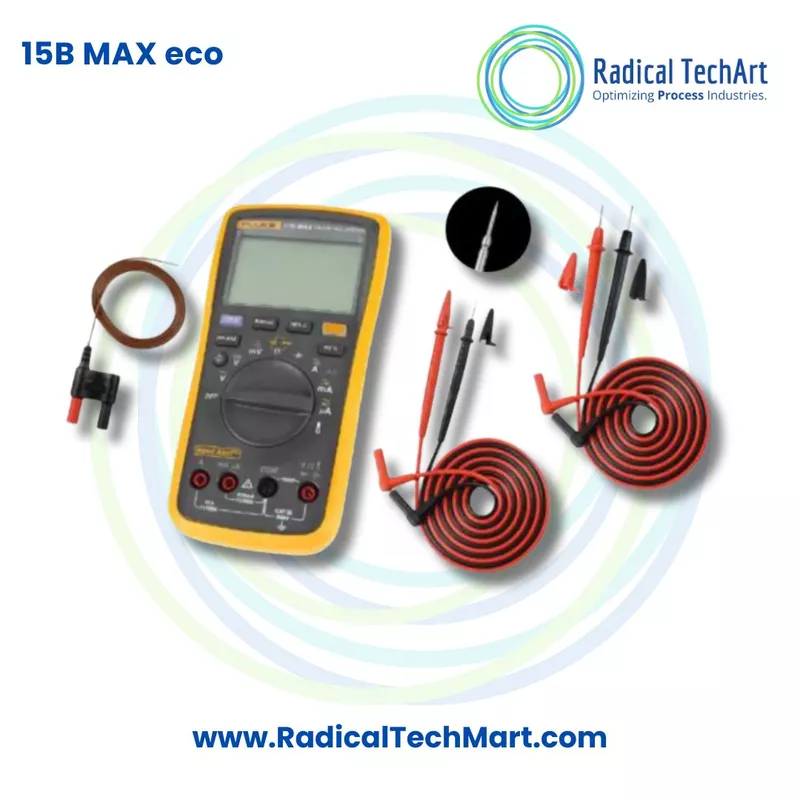


Fluke 15B MAX Digital Multimeter
The Fluke 15B MAX Digital Multimeter is a 6000-count handheld meter designed for electrical and electronic testing. It measures AC and DC voltage, AC and DC current, resistance, capacitance, diode condition and continuity. It also includes audible and visual input alerts, a backlit display and fine-tip test leads for circuit-board work. The meter carries a CAT III 600 V safety rating and is suitable for electricians, service engineers, industrial maintenance teams and electronics technicians.
Customize
Share :
A. Product Overview
The Fluke 15B MAX is an economical digital multimeter developed for routine electrical maintenance, troubleshooting and electronics testing.
It follows the familiar design of the earlier Fluke 15B series while adding improved usability features such as an Input Alert alarm, quick wake-up from sleep mode and fine test probes for accurate measurements on small electronic components and circuit boards.
Key measurement capabilities include:
- AC voltage up to 1000 V
- DC voltage up to 1000 V
- AC current up to 10 A
- DC current up to 10 A
- Resistance up to 40 megohms
- Capacitance up to 2000 microfarads
- Diode testing
- Continuity testing
- 6000-count LCD
- Backlight
- CAT III 600 V safety rating
The meter provides 0.5 percent plus 3 digits accuracy for DC voltage and 1.0 percent plus 3 digits accuracy for AC voltage under the specified operating conditions.
It operates on two AA batteries and offers a minimum battery life of approximately 500 hours. The meter measures about 183 mm by 91 mm by 49.5 mm and weighs approximately 455 grams.
B. Working Principle
The Fluke 15B MAX works by using internal electronic measurement circuits to detect electrical values through the connected test leads.
The user selects the required function using the rotary dial and connects the probes to the correct input terminals.
Voltage Measurement
For AC or DC voltage testing, the probes are connected across two points in a circuit. The meter measures the potential difference and displays the value on the LCD.
Current Measurement
For current measurement, the meter must be connected in series with the circuit so that the current flows through the meter. The correct current terminal must be selected according to the expected current range.
The current inputs are protected by fast-acting fuses rated for the relevant terminals.
Resistance Measurement
The meter applies a small internal test voltage across the component and calculates resistance from the resulting current flow. Resistance testing should be performed only on a de-energized circuit.
Continuity Testing
The continuity function checks whether a low-resistance electrical path exists. The continuity threshold is approximately 70 ohms. When the measured resistance is sufficiently low, the meter provides an audible indication.
Capacitance Measurement
For capacitance testing, the meter charges the connected capacitor internally and measures its electrical response. The Fluke 15B MAX supports capacitance values up to 2000 microfarads.
Diode Testing
The diode-test function applies a small forward voltage to the diode and displays the voltage drop. This helps determine whether a diode is functioning, open or shorted.
Input Alert Function
The audible and visual input alert warns the user when the test leads are inserted into an incorrect terminal for the selected function. This helps reduce connection errors and improves measurement safety.
C. Why the Fluke 15B MAX Is Used
The Fluke 15B MAX is used because it combines the essential functions required for electrical and electronics troubleshooting in one portable instrument.
Electrical Fault Detection
It can help identify:
- Incorrect supply voltage
- Open circuits
- Short circuits
- Broken wires
- Faulty switches
- Failed fuses
- High-resistance connections
- Defective diodes
- Abnormal current consumption
- Damaged capacitors
Electrical Installation Testing
Electricians can use it to verify voltage, wiring continuity and resistance during installation, repair and commissioning work.
Electronics and Circuit-Board Testing
The supplied fine-tip probes are designed to reach small terminals, component leads and closely spaced circuit-board test points. The product literature specifically shows these probes being used on electronic components and printed circuit boards.
Industrial Maintenance
Maintenance teams can use the meter to inspect control panels, machinery, power supplies, sensors, relays, motors and electrical control circuits.
Capacitor Testing
The 2000 microfarad capacitance range allows technicians to check many capacitors used in power supplies, control circuits, appliances, motors and electronic equipment.
Reduced Connection Errors
The Input Alert alarm provides both audible and visual warnings for incorrect lead connections, helping users avoid common mistakes when switching between voltage, resistance and current measurements.
Long Battery Operation
A minimum battery life of approximately 500 hours makes the meter suitable for regular field and workshop use without frequent battery replacement.
D. Suitable Buyers
Electricians
Suitable for voltage, current, resistance and continuity testing during electrical installation and repair work.
Industrial Maintenance Engineers
Useful for diagnosing faults in electrical panels, machinery, motors, power supplies and industrial control equipment.
Electronics Technicians
The fine-tip probes and capacitance, diode and resistance functions make it suitable for circuit-board and component testing.
Electrical Contractors
Suitable for routine testing during installation, commissioning and maintenance of commercial and industrial electrical systems.
Field Service Engineers
The portable design and broad measurement range make it suitable for on-site equipment servicing and troubleshooting.
Panel Builders
Useful for checking wiring continuity, power-supply voltage, relay circuits, resistance and component condition during control-panel assembly.
Appliance Repair Technicians
Can be used to test switches, fuses, capacitors, heating elements, wiring and electrical supply conditions in appliances.
Educational Institutes and Training Centres
Suitable for supervised practical training in voltage, current, resistance, continuity, diode and capacitance measurement.
Electronics Research and Development Personnel
The fine probes help users make measurements on compact circuit-board points and small electronic components.
Frequently Asked Questions
1. What does the Fluke 15B MAX measure?
It measures AC voltage, DC voltage, AC current, DC current, resistance, capacitance, diode condition and continuity.
2. What is the display count of the Fluke 15B MAX?
It has a 6000-count LCD that updates approximately three times per second.
3. What is the maximum voltage range?
The specified AC and DC voltage ranges extend up to 1000 V. However, the maximum voltage between any terminal and earth ground is 600 V, and users must always follow the meter’s CAT III 600 V safety rating and applicable safety procedures.
4. What is the maximum current range?
The meter can measure AC and DC current up to 10.00 A.
5. Can the Fluke 15B MAX measure capacitance?
Yes. It measures capacitance from 40 nF ranges up to a maximum range of 2000 microfarads.
6. Does it measure frequency?
The specification table lists frequency and duty-cycle functions for the Fluke 17B MAX, while these functions are marked as not available for the Fluke 15B MAX. Therefore, frequency measurement should not be advertised as a Fluke 15B MAX function.
7. Does the Fluke 15B MAX measure temperature?
No. The temperature function in the shared specification table applies to the Fluke 17B MAX and is marked as not available for the Fluke 15B MAX.
8. Does it have a continuity buzzer?
Yes. The continuity threshold is approximately 70 ohms.
9. What is the Input Alert feature?
Input Alert provides audible and visual warnings when the test leads are connected to an incorrect input terminal for the selected measurement function.
10. Is the Fluke 15B MAX suitable for circuit-board testing?
Yes. It is supplied in variants with fine-tip or extra-slim test leads that are suitable for small electronic components and closely spaced circuit-board test points.
11. What is the safety rating?
The Fluke 15B MAX is rated CAT III 600 V and Pollution Degree 2.
12. Does the meter have a backlight?
Yes. The Fluke 15B MAX includes a backlit display.
13. What batteries does it use?
It uses two AA batteries, also identified as IEC LR6 batteries.
14. What is its approximate battery life?
The specified minimum battery life is 500 hours.
15. What is the operating temperature range?
The specified operating temperature range is 0°C to 40°C.
16. What is the difference between Fluke 15B MAX-01 and Fluke 15B MAX-02?
The Fluke 15B MAX-01 includes TL75 test leads with two protective caps. The Fluke 15B MAX-02 includes TL31 extra-slim test leads with two protective caps. Both variants include two AA batteries.
17. What is included in the Fluke 15B MAX Kit?
The kit includes TL75 test leads, TL31 extra-slim test leads, protective caps, two AA batteries and safety information.
18. Can resistance be measured on a live circuit?
No. Resistance, continuity, diode and capacitance tests should be performed only after the circuit has been switched off, isolated and discharged.
19. Is it suitable for industrial electrical work?
Yes. Its CAT III 600 V rating, current measurement capability, input protection and common testing functions make it suitable for many industrial maintenance and commercial electrical applications when used within its specifications.
20. Can it be used for home electrical testing?
It can be used by properly trained users for suitable electrical measurements, but electrical work involves shock and arc hazards. The meter must be used within its voltage and measurement-category ratings with appropriate test leads and personal protective equipment.