

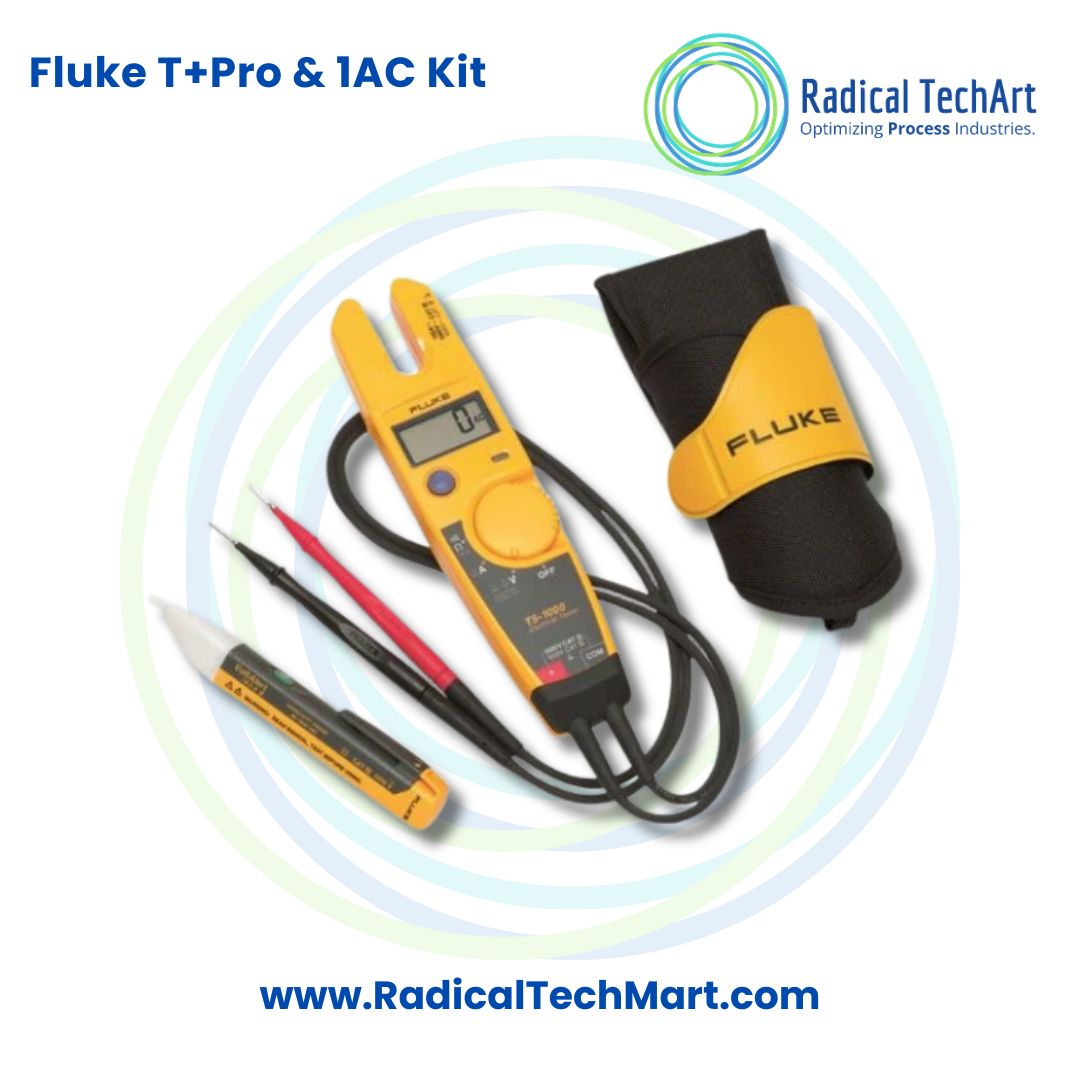


Fluke T+Pro and 1AC Kit
The Fluke T Plus Pro and 1AC Kit is a professional electrical testing combination designed for contact and non-contact voltage detection. It helps electricians measure AC and DC voltage, check continuity and resistance, test GFCI circuits, identify phase rotation and detect energized conductors during electrical installation, maintenance and troubleshooting work.
Customize
Share :
A. Product Overview
The Fluke T Plus Pro and 1AC Kit combines two practical electrical testing tools:
- Fluke T Plus Pro electrical tester for direct contact measurements
- Fluke 1AC non-contact voltage detector for preliminary energized-wire detection
The T Plus Pro measures AC and DC voltage from 12 V to 600 V. Voltage is indicated through an LED bar, backlit LCD display, audible beeper and vibration alert. The LED voltage indication continues to function even when the batteries are depleted, although battery-powered features such as the LCD, vibration, continuity and resistance measurement may become unavailable.
The tester can also check continuity, measure resistance up to 9.99 kiloohms, test GFCI circuits and indicate rotary field direction in three-phase electrical systems. A built-in flashlight helps users work inside control panels, distribution boards and other poorly illuminated locations.
The instrument is rated for CAT III 1000 V and CAT IV 600 V environments, making it suitable for professional electrical testing when used according to the manufacturer’s safety instructions.
B. Working Principle
Contact voltage measurement
The T Plus Pro uses two test probes that are connected across the circuit or electrical points being tested. Once the probes detect a complete circuit, the tester automatically switches on and selects the appropriate operating mode according to the voltage or resistance present.
For voltage testing, the tester electronically senses the potential difference between the two probes. It then indicates the measured voltage through:
- LED voltage level indicators
- Backlit numerical LCD
- Audible signal
- Vibration alert for voltages of 40 V and above
Different audible tones help distinguish AC voltage from DC voltage. The tester can measure up to 600 V AC or DC.
Continuity testing
For continuity testing, power must be disconnected from the circuit and stored electrical energy must be discharged. The tester passes a small test current through the circuit.
When the measured resistance is below the continuity threshold, the continuity LED illuminates and the beeper sounds. This helps determine whether wires, switches, fuses, connectors and circuit paths are electrically continuous.
Resistance measurement
When resistance mode is selected, the T Plus Pro measures electrical resistance and displays values up to 9.99 kiloohms. Resistance testing must only be performed on a de-energized circuit.
GFCI testing
The GFCI test function applies a controlled test current between phase and protective earth. A correctly operating GFCI should detect the fault condition and disconnect power to the circuit.
Rotary field direction testing
In a three-phase system, the tester compares the phase relationship between two connected phases. It then indicates whether the rotary field is turning in the right-hand or left-hand direction.
Non-contact voltage detection
The Fluke 1AC detector senses the electric field surrounding an energized AC conductor without requiring direct metallic contact. It is useful for preliminary voltage checks before confirming the circuit condition with the contact tester.
C. Why It Is Used
The Fluke T Plus Pro and 1AC Kit is used to improve the speed and convenience of routine electrical testing.
It can help users:
- Check whether an electrical circuit is energized
- Measure AC and DC voltage
- Identify approximate voltage levels using LED indicators
- Confirm voltage numerically on the LCD
- Detect voltage without direct contact
- Check continuity in wires and electrical components
- Measure low resistance values
- Test GFCI receptacles and circuits
- Check three-phase rotary field direction
- Troubleshoot switches, outlets, control circuits and distribution boards
- Work more effectively in dark panels using the built-in flashlight
- Receive visual, audible and vibration warnings during voltage testing
Because the contact tester and non-contact detector are supplied together, users can perform an initial non-contact check and then carry out a direct measurement using the T Plus Pro.
D. Suitable Buyers
The Fluke T Plus Pro and 1AC Kit is suitable for:
- Licensed electricians
- Electrical contractors
- Industrial maintenance technicians
- Facility maintenance teams
- Control panel technicians
- HVAC service technicians
- Building maintenance professionals
- Electrical inspection personnel
- Machine maintenance engineers
- Plant engineering teams
- Commercial electrical service companies
- Residential electrical service professionals
- Technical training institutes
- Electrical testing and troubleshooting teams
The manufacturer specifies that the tester should be used only by qualified personnel who understand electrical safety procedures.
Frequently Asked Questions
1. What is included in the Fluke T Plus Pro and 1AC Kit?
The kit combines the Fluke T Plus Pro contact electrical tester with a Fluke 1AC non-contact AC voltage detector. It provides both direct electrical measurement and preliminary non-contact voltage detection.
2. What voltage range can the Fluke T Plus Pro measure?
The T Plus Pro measures AC and DC voltage from 12 V to 600 V. Its maximum measurable voltage is 600 V AC or DC.
3. Can the tester indicate voltage without batteries?
Yes. The LED voltage bar and hazardous-voltage indication can operate with or without batteries. However, the LCD display, beeper, vibration, continuity test and resistance measurement require working batteries.
4. Does the Fluke T Plus Pro have an LCD display?
Yes. It has a backlit LCD that displays the measured voltage. The display also supports resistance readings, hold indication, low-battery status and phase-rotation indication.
5. Can it test continuity?
Yes. The tester provides LED and audible continuity indication. The circuit must be de-energized and capacitors must be discharged before continuity testing.
6. Can the T Plus Pro measure resistance?
Yes. It can measure resistance up to 9.99 kiloohms. Resistance testing must be performed only on a circuit with the power switched off.
7. Does it support GFCI testing?
Yes. The tester includes a GFCI trip-test function for checking compatible GFCI receptacles and circuits. The test intentionally attempts to disconnect circuit power, so it should be performed only by qualified personnel.
8. Can it check three-phase rotation?
Yes. The T Plus Pro can indicate right-hand or left-hand rotary field direction when connected phase to phase in a three-phase electrical system.
9. Does the tester provide a vibration alert?
Yes. The tester vibrates when it detects voltages of 40 V or higher, provided the batteries are functioning.
10. Is the Fluke 1AC detector a replacement for direct voltage measurement?
No. A non-contact voltage detector is intended for preliminary energized-conductor detection. The circuit condition should be confirmed using an appropriate contact tester before starting electrical work.
11. What are the electrical safety ratings?
The T Plus Pro is rated for CAT III 1000 V and CAT IV 600 V environments. Users must follow the specified voltage limits, duty cycle and electrical safety procedures.
12. Where can this kit be used?
It can be used for residential, commercial and industrial electrical maintenance, including outlets, control panels, distribution boards, building wiring, three-phase circuits and equipment troubleshooting.
13. Does the tester include a flashlight?
Yes. A built-in flashlight is provided for working inside dark panels, cabinets and equipment areas.
14. Can the tester be used on PLC control circuits?
It may be used for certain PLC-related voltage checks, but caution is required because testing relay-control voltages can unintentionally open or close a relay or switch. Only qualified personnel should perform such measurements.