

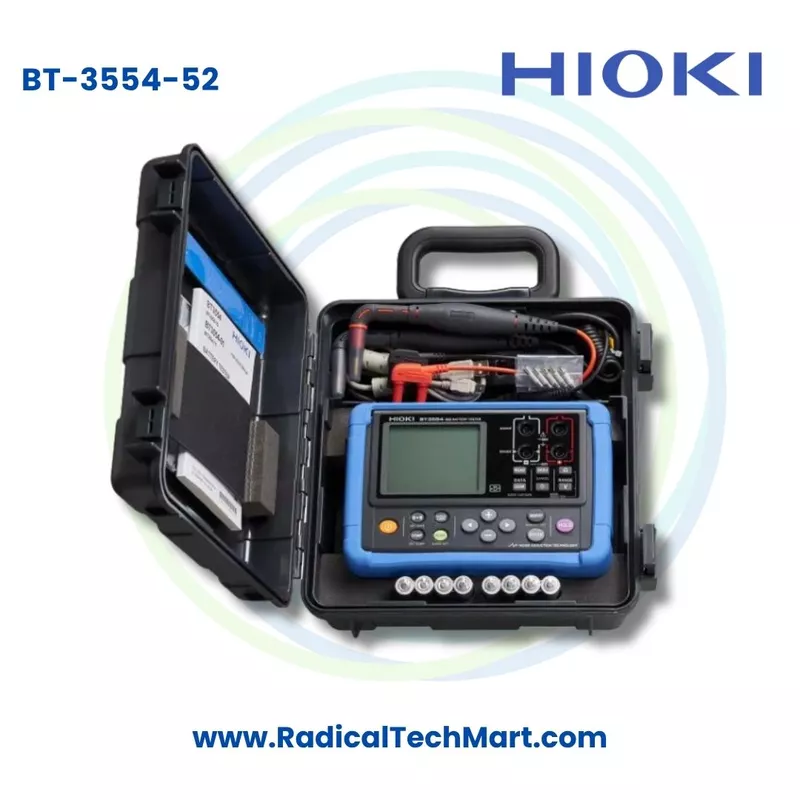


HIOKI Battery Testers
HIOKI Battery Testers are professional instruments designed for checking the condition and deterioration of UPS, VRLA, lead acid and backup batteries. Models such as BT3554-50, BT3554-51 and BT3554-52 measure battery internal resistance and voltage without requiring the battery to be disconnected from the system. They are widely used for preventive maintenance, battery health assessment and early detection of battery degradation.
Customize
Share :
A. Product Overview
HIOKI Battery Testers are portable diagnostic instruments developed for maintenance and condition assessment of stationary batteries used in UPS systems, data centers, telecom installations, industrial plants and emergency backup systems.
Popular models include:
• HIOKI BT3554-50 Battery Tester
• HIOKI BT3554-51 Battery Tester
• HIOKI BT3554-52 Portable Battery Tester
These instruments are designed to measure battery internal resistance and DC voltage. The BT3554 series helps maintenance personnel identify deteriorated batteries quickly using comparative measurements and PASS, WARNING and FAIL judgment functions.
Depending on the model and accessories, HIOKI Battery Testers may also support:
• Battery internal resistance measurement
• DC voltage measurement
• Temperature measurement
• PASS, WARNING and FAIL judgment
• Measurement data storage
• USB communication
• Optional Bluetooth communication
• GENNECT Cross integration
• HIOKI Z3210 Wireless Adapter compatibility
• HIOKI L2020 pin type test leads
The BT3554 series is particularly useful for testing lead acid, VRLA, UPS and stationary backup batteries without shutting down the equipment.
B. Working Principle
HIOKI Battery Testers evaluate battery condition mainly by measuring the battery's internal resistance and terminal voltage.
The tester applies a small AC test signal to the battery and measures its electrical response. From this response, the instrument calculates the battery's internal resistance.
As a battery deteriorates, its internal resistance generally changes. By comparing the measured resistance and voltage with established reference values, technicians can identify batteries that may require closer inspection or replacement.
The measurement process typically involves:
- Connecting the test leads to the battery terminals.
- Measuring internal resistance.
- Measuring DC battery voltage.
- Comparing the readings with reference or threshold values.
- Classifying the battery condition using PASS, WARNING or FAIL judgment settings.
The BT3554 series allows these measurements to be performed while the battery remains connected to the operating system, making routine maintenance faster and more practical.
C. Why HIOKI Battery Testers Are Used
HIOKI Battery Testers are used because battery failure can cause unexpected shutdowns of UPS systems, telecom equipment, data centers and industrial control systems.
Routine battery testing helps maintenance teams identify deterioration before a battery fails completely.
They are commonly used to:
• Check battery internal resistance
• Measure battery terminal voltage
• Detect deteriorating batteries
• Compare multiple batteries in a battery bank
• Identify abnormal batteries
• Perform preventive battery maintenance
• Reduce unexpected UPS battery failures
• Monitor battery condition over time
• Record battery inspection results
• Improve maintenance efficiency
• Support planned battery replacement
• Evaluate lead acid and VRLA battery health
Because the measurements can be performed without disconnecting the battery, technicians can inspect large battery banks more efficiently.
D. Suitable Buyers
HIOKI Battery Testers are suitable for:
• UPS maintenance companies
• Data centers
• Telecom companies
• Battery service providers
• Electrical maintenance engineers
• Facility management companies
• Industrial maintenance departments
• Power plants
• Substations
• Electrical contractors
• Battery manufacturers
• UPS manufacturers
• Battery dealers and distributors
• Solar power system maintenance teams
• Critical power service companies
• Hospitals
• Banks and financial institutions
• Server rooms
• Railway electrical maintenance teams
• Infrastructure companies
• Industrial automation companies
• Testing laboratories
• Preventive maintenance professionals
Frequently Asked Questions
1. What is a HIOKI Battery Tester?
A HIOKI Battery Tester is a portable instrument used to measure battery internal resistance and voltage to help evaluate the condition and deterioration of stationary batteries.
2. Which HIOKI battery tester models are available?
Common models include HIOKI BT3554-50, BT3554-51 and BT3554-52.
3. What type of batteries can HIOKI BT3554 testers check?
The BT3554 series is commonly used for lead acid, VRLA, UPS and stationary backup batteries.
4. What does a battery internal resistance tester measure?
It measures the electrical resistance inside a battery. Changes in internal resistance can help indicate battery deterioration or abnormal condition.
5. Can HIOKI Battery Testers measure battery voltage?
Yes. The BT3554 series can measure DC battery voltage along with internal resistance.
6. Do I need to disconnect the battery before testing?
No. One of the main advantages of the HIOKI BT3554 series is that battery testing can be performed while the battery remains connected to the system.
7. What does PASS, WARNING and FAIL mean?
These judgment functions allow technicians to set resistance and voltage thresholds. The tester then helps classify each battery according to the configured condition criteria.
8. What is the HIOKI BT3554-50 used for?
The BT3554-50 is designed for battery maintenance and condition assessment, particularly for UPS and stationary lead acid battery systems.
9. What is the HIOKI BT3554-51?
The BT3554-51 is a configuration of the BT3554 battery tester designed for professional battery inspection, internal resistance measurement and voltage testing.
10. What is special about the HIOKI BT3554-52?
The BT3554-52 is supplied with the HIOKI L2020 angled pin type lead, which is useful when measuring batteries where terminal access is limited.
11. What is the resistance measurement range of the BT3554 series?
The BT3554-52 provides four resistance ranges covering approximately 3 mΩ to 3 Ω, making it suitable for stationary battery condition testing.
12. What voltage ranges are available on the BT3554-52?
The BT3554-52 supports 6 V and 60 V DC voltage measurement ranges.
13. Does the HIOKI Battery Tester support Bluetooth?
Optional Bluetooth communication is available when a compatible HIOKI Z3210 Wireless Adapter is used with supported models.
14. What is GENNECT Cross?
GENNECT Cross is HIOKI software that can be used with compatible instruments for measurement data management, recording and analysis.
15. Can measurement data be stored in the battery tester?
Yes. The BT3554 series supports measurement data storage. The BT3554-52 can store up to 6000 sets of measurement data.
16. Can a HIOKI Battery Tester be used for UPS battery maintenance?
Yes. UPS battery inspection is one of the major applications of the BT3554 series. It allows maintenance teams to check battery resistance and voltage without shutting down the UPS battery system.
17. Is the BT3554 suitable for data center battery testing?
Yes. It is well suited for routine inspection of UPS battery banks used in data centers, server rooms and other critical power installations.
18. Can the HIOKI BT3554 detect a bad battery?
It can help identify batteries showing abnormal internal resistance or voltage compared with configured limits and neighboring batteries in the same battery bank.
19. Why is internal resistance important in battery maintenance?
Monitoring internal resistance helps technicians track changes in battery condition and identify batteries that may be deteriorating before complete failure occurs.
20. How do I choose between BT3554-50, BT3554-51 and BT3554-52?
Selection should be based on the required supplied accessories, test lead type, communication requirements and battery installation conditions. The BT3554-52 is particularly useful when an angled pin type L2020 lead is required for easier access to battery terminals.