

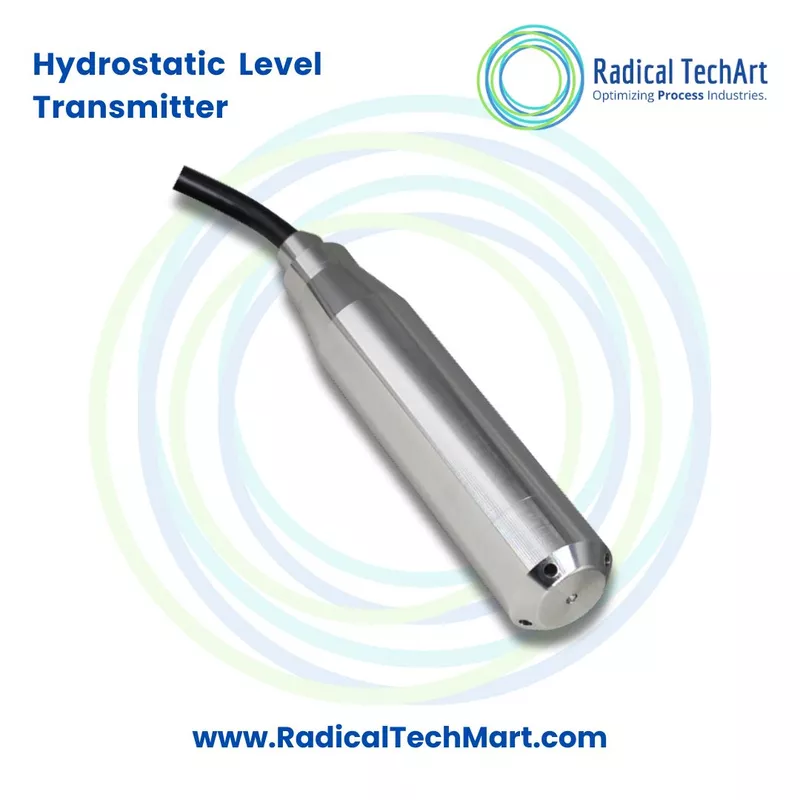
Submersible Hydrostatic Level Transmitter
Customize
Share :
A. Product Overview
The Hydrostatic Level Transmitter is designed for accurate and stable liquid level measurement in tanks, wells, sumps and reservoirs. It is suitable for non-corrosive liquids compatible with stainless steel and is commonly used where continuous level monitoring is required.
This transmitter comes with a submersible probe, durable cable and stainless steel body. The sensor uses a high precision diffused silicon core and digital circuit design to provide reliable measurement. Its 316L stainless steel isolation diaphragm makes it suitable for different liquid media, while the IP68 protection level helps the transmitter perform in submerged and harsh working conditions.
The transmitter supports multiple output options such as 4 to 20 mA, 0 to 10 V, 0 to 5 V and RS-485. It operates on 12 to 36 VDC power supply, with 24 VDC as the typical supply voltage. The product is available with an adjustable measuring range of 0 to 2 meters and can be customized as per application requirement.
B. Working Principle
The Hydrostatic Level Transmitter works on the principle of hydrostatic pressure. When the probe is submerged in liquid, the liquid column above the sensor creates pressure on the diaphragm. This pressure increases as the liquid level rises and decreases as the liquid level falls.
The internal sensing element converts this pressure into an electrical signal. This signal is then processed by the transmitter electronics and sent to a controller, PLC, indicator, data logger or monitoring system through standard outputs such as 4 to 20 mA, voltage output or RS-485.
In simple terms, the transmitter measures the pressure created by the liquid height and converts it into a level reading. This allows continuous and real-time monitoring of liquid level inside tanks and open containers.
C. Why It Is Used
The Hydrostatic Level Transmitter is used because it provides continuous, stable and accurate liquid level measurement without requiring moving parts. This makes it a dependable choice for water tanks, sewage systems, industrial tanks and process applications.
It is especially useful in applications where float switches or mechanical level devices may not provide enough accuracy or continuous output. The transmitter gives a proportional signal, which helps users monitor exact liquid level instead of only high level or low level point detection.
It is also preferred because of its compact submersible design, IP68 protection, stainless steel body, 316L diaphragm, reverse connection protection for current output and stable performance. The polyurethane cable and laser precision welding improve durability and reduce leakage risk.
D. Suitable Buyers
This Hydrostatic Level Transmitter is suitable for buyers who need reliable liquid level measurement for industrial, commercial and utility applications.
Suitable buyers include:
Water treatment plants
Wastewater treatment plants
Tank manufacturers
Industrial automation companies
Panel builders
System integrators
OEM machine manufacturers
Pump control panel manufacturers
Municipal water supply departments
Fire water tank users
Borewell and tube well monitoring users
Chemical and process industries using compatible non-corrosive liquids
Food and beverage plants with compatible liquid applications
Marine and diesel tank monitoring users
Maintenance teams in factories and utilities
EPC contractors and project engineers
FAQ
1. What is a Hydrostatic Level Transmitter?
A Hydrostatic Level Transmitter is a device used to measure liquid level by sensing the pressure created by the height of the liquid column. It converts this pressure into an electrical signal for level monitoring.
2. Where is a Hydrostatic Level Transmitter used?
It is used in water tanks, sumps, reservoirs, wells, wastewater tanks, process tanks, fire water tanks and industrial liquid storage systems.
3. What output signals are available in this transmitter?
The transmitter can provide 4 to 20 mA output as default. Other available output options include 0 to 10 V, 0 to 5 V and RS-485.
4. What power supply is required?
The transmitter works on 12 to 36 VDC power supply. The typical recommended supply is 24 VDC.
5. Is this transmitter suitable for submerged installation?
Yes, the transmitter is designed for submerged level measurement and comes with IP68 protection, making it suitable for tank and sump applications.
6. What is the measuring range of this transmitter?
The mentioned model has an adjustable measuring range of 0 to 2 meters. Other ranges can be selected based on application requirement.
7. What material is used in the transmitter?
The transmitter uses rubber, 304 stainless steel and 316 stainless steel as main materials. It also includes a 316L stainless steel isolation diaphragm.
8. Can it be used for corrosive liquids?
This model is suitable for non-corrosive liquids compatible with stainless steel. For corrosive liquids, material compatibility should be checked before selection.
9. Why is 4 to 20 mA output commonly used?
4 to 20 mA output is widely used in industrial automation because it is stable, reliable and suitable for long-distance signal transmission to PLC, indicator, controller or SCADA systems.
10. What are the main advantages of this Hydrostatic Level Transmitter?
The main advantages include precise measurement, stable performance, IP68 protection, 316L stainless steel diaphragm, polyurethane cable, laser welded structure, quick response, reverse connection protection for current output and long service life.
11. Can this transmitter be connected to a PLC or controller?
Yes, it can be connected to PLC, indicator, controller, data logger or measurement and control instruments using 4 to 20 mA, voltage output or RS-485 depending on the selected model.
12. Is grounding required during installation?
Yes, proper grounding is recommended. The shielded wire and grounding point should be effectively grounded to ensure stable operation and protection.