

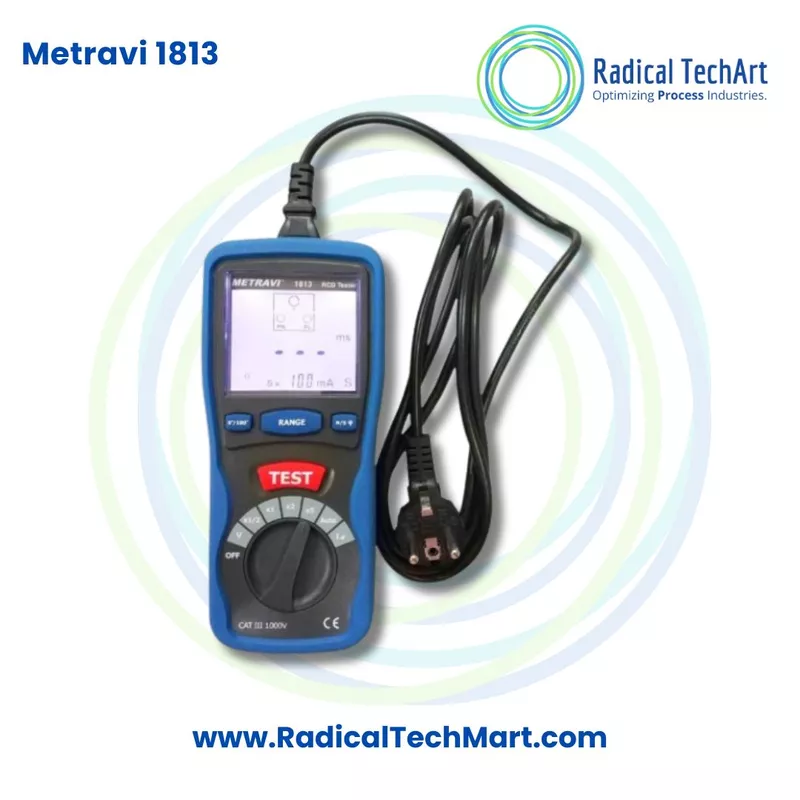


Metravi 1813 Digital ELCB RCD Tester
The Metravi 1813 Digital ELCB RCD Tester is a portable electrical safety testing instrument designed to measure the trip time and trip current of ELCB, RCCB and RCD protection devices. It supports nominal test currents from 10 mA to 1 A, multiple current multipliers, ramp testing, wiring-condition checks and testing on TT and TN electrical systems.
Customize
Share :
A. Product Overview
The Metravi 1813 is a digital differential circuit-breaker tester used to verify whether an ELCB, RCCB or RCD operates correctly under simulated leakage-current conditions. It measures the time taken by the protective device to trip and can also determine the current level at which tripping occurs.
The tester supports nominal current settings of 10 mA, 30 mA, 100 mA, 300 mA, 500 mA and 1 A. It can test normal and delayed RCD types and supports AC-type and A-type residual current devices.
A three-digit digital display provides measurement readings, while the built-in wiring-state test identifies conditions such as correct wiring, missing earth connection, polarity reversal and open neutral. The instrument operates on 230 V systems and is suitable for TT and TN network configurations.
Key capabilities include:
- Trip-time measurement
- Trip-current measurement
- Ramp testing
- Wiring-condition indication
- Testing at 0.5 times, 1 time, 2 times and 5 times the nominal current
- Testing of normal and delayed RCD devices
- Mains-voltage measurement
- CAT III 600 V measurement category
- Double-insulated construction
- IP40 protection
- Battery-powered portable operation
B. Working Principle
The Metravi 1813 works by applying a controlled residual or differential test current to the electrical circuit protected by an ELCB, RCCB or RCD.
Before testing begins, the instrument checks the wiring condition. It indicates whether the phase, neutral and earth connections are correctly connected. When an incorrect connection is detected, some test functions may be restricted. In a no-ground condition, only line-voltage measurement may be available.
The user selects the nominal rated current of the installed protective device, such as 30 mA or 100 mA. The tester then applies a test current at one of the available multiplier settings:
- 0.5 times the nominal current
- 1 time the nominal current
- 2 times the nominal current
- 5 times the nominal current
During a trip-time test, the instrument measures the time between the application of the test current and the operation of the protective device. The result is displayed in milliseconds.
During a ramp test, the tester gradually increases the current from approximately 0.4 times to 1.4 times the selected nominal current. This helps determine the approximate current at which the ELCB, RCCB or RCD trips.
C. Why Is the Metravi 1813 Used?
The Metravi 1813 is used to confirm that an earth-leakage protection device is installed correctly and responds within the required operating conditions.
ELCB, RCCB and RCD devices are designed to disconnect the electrical supply when leakage current is detected. However, a device may fail to operate correctly because of incorrect wiring, deterioration, mechanical problems, improper selection or installation issues.
Regular testing with the Metravi 1813 helps users:
- Check whether an RCD trips when leakage current is simulated
- Measure the actual tripping time of the protective device
- Determine the approximate tripping-current value
- Verify normal and delayed RCD operation
- Identify missing earth, polarity reversal and neutral-wiring problems
- Check the condition of electrical installations during inspection
- Support preventive electrical maintenance
- Improve confidence in shock-protection systems
- Document test results during commissioning and servicing
- Reduce the risk of leaving a defective protective device in service
The instrument is especially useful where electrical safety devices must be inspected during installation, commissioning, periodic maintenance or troubleshooting.
D. Suitable Buyers
The Metravi 1813 Digital ELCB RCD Tester is suitable for:
- Licensed electricians
- Electrical contractors
- Electrical maintenance engineers
- Electrical safety inspectors
- Facility-management companies
- Industrial maintenance departments
- Panel builders
- Electrical testing laboratories
- Building-maintenance technicians
- MEP contractors
- Installation and commissioning engineers
- Commercial property maintenance teams
- Factory electrical departments
- Hospitals and healthcare-facility maintenance teams
- Hotels, malls and office-building maintenance teams
- Educational institutes and technical-training centres
- Government electrical inspection departments
- Solar and renewable-energy installation contractors
- Electrical equipment dealers and service providers
Frequently Asked Questions
1. What is the Metravi 1813 used for?
The Metravi 1813 is used to test ELCB, RCCB and RCD devices by measuring their trip time and trip current. It also checks basic wiring conditions and mains voltage.
2. Which test-current ratings are supported?
The tester supports nominal test-current selections of 10 mA, 30 mA, 100 mA, 300 mA, 500 mA and 1 A.
3. Can the Metravi 1813 measure RCD trip time?
Yes. It measures the time taken by an RCD or RCCB to trip after the selected test current is applied. Trip-time results are displayed in milliseconds with 1 ms resolution.
4. Does the tester support ramp testing?
Yes. The ramp-test function gradually increases the applied current to determine the approximate current level at which the protective device trips.
5. What is the purpose of the 0.5 times test?
The 0.5 times test applies half of the selected nominal current. It is generally used to check that the protective device does not trip below its intended operating threshold.
6. What are the 1 time, 2 times and 5 times settings?
These settings apply the test current at one, two or five times the selected nominal rating. They help evaluate the protective device’s operating speed at different leakage-current levels.
7. Can the Metravi 1813 test delayed RCDs?
Yes. It is designed to test both normal and delayed RCD types.
8. Does it support Type AC and Type A RCD testing?
Yes. The catalogue specifies testing support for AC-type and A-type residual current devices.
9. Can it detect incorrect wiring?
Yes. The wiring-state function can indicate correct wiring, no-ground conditions, polarity reversal and open or hot-neutral conditions.
10. Can testing continue when there is no earth connection?
Testing functions may be limited when the wiring condition is incorrect. According to the catalogue, only line-voltage measurement is available when a no-ground condition exists.
11. Is the Metravi 1813 suitable for TT and TN systems?
Yes. The instrument is designed to operate on both TT and TN electrical systems.
12. What is the operating voltage?
The tester is designed for use with a nominal 230 V phase-to-neutral electrical supply at 50 Hz or 60 Hz.
13. What is the mains-voltage measurement resolution?
The mains-voltage measurement resolution is 1 V.
14. What safety category does the tester have?
The Metravi 1813 is rated CAT III 600 V and features double insulation. The catalogue also lists IEC 61010-1 and IEC 61557-6 among its applicable standards.
15. Is the tester battery operated?
Yes. It is powered by six 1.5 V AA batteries, making it suitable for portable field testing.
16. What is the protection rating of the instrument?
The tester has an IP40 protection rating.
17. What are the dimensions and weight?
The approximate dimensions are 92 mm wide, 200 mm long and 50 mm high. The instrument weighs approximately 700 grams.
18. Where can the Metravi 1813 be used?
It can be used in industrial plants, commercial buildings, electrical panels, offices, hospitals, hotels, shopping centres, educational institutions and other installations protected by ELCB, RCCB or RCD devices.
19. Is the Metravi 1813 a leakage-current clamp meter?
No. It is an ELCB and RCD functional tester. It applies a controlled test current and measures the protective device’s response. It is not designed to replace a leakage-current clamp meter.
20. Should ELCB and RCD testing be performed by a qualified person?
Yes. Testing may intentionally trip the protective device and interrupt the electrical supply. It should be carried out by a trained electrician or qualified electrical professional using appropriate safety procedures.