

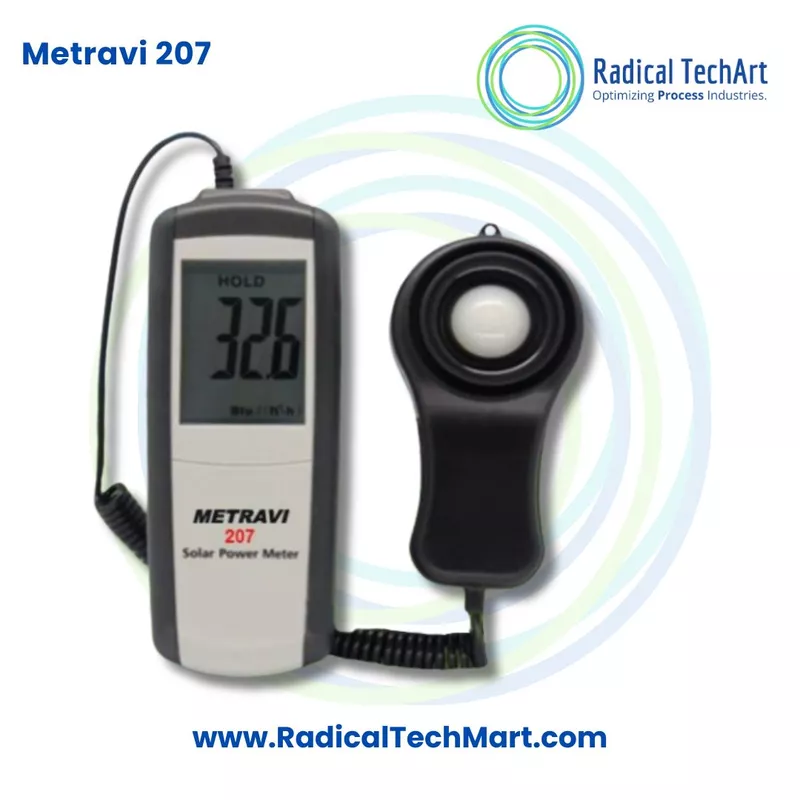


Metravi 207 Solar Power and Sunlight Meter
Customize
Share :
A. Product Overview
The Metravi 207 is a handheld solar power meter used to measure the intensity of sunlight falling on a surface. It helps users evaluate the available solar radiation at a particular location and compare sunlight levels at different times, positions and panel angles.
The instrument consists of a portable display unit and an external sunlight sensor connected by a flexible cable. The external sensor can be positioned toward the sunlight while the measured value is viewed on the meter’s backlit LCD.
The Metravi 207 offers a maximum measurement range of:
- 1999 W/m²
- 634 BTU per square foot per hour
It displays solar power in either watts per square metre or BTU per square foot per hour. The selectable units make the meter suitable for different engineering, maintenance and environmental measurement requirements.
Main Features
- Solar radiation measurement up to 1999 W/m²
- Measurement up to 634 BTU per square foot per hour
- High accuracy and rapid response
- Approximately 0.25-second sampling time
- Data hold function
- Maximum and minimum value recording
- Manual scale selection
- Selectable measurement units
- Backlit 3½-digit LCD
- Maximum display reading of 1999
- Low-battery indication
- Over-range indication
- Direct reading without manual adjustment
- Compact handheld construction
The catalogue specifies a resolution of 1 W/m² or 1 BTU per square foot per hour. The instrument measures approximately 162 × 63 × 28 mm and weighs about 250 grams.
B. Working Principle
The Metravi 207 works by using a light-sensitive solar radiation sensor to detect sunlight falling on its sensing surface.
When the sensor is directed toward the sunlight, the incoming solar radiation produces an electrical response inside the sensor. The meter processes this signal and converts it into a solar irradiance value.
The measured result is then displayed in one of the following units:
- Watts per square metre
- BTU per square foot per hour
Watts per square metre indicates the amount of solar power falling on one square metre of surface area. A higher reading indicates stronger incident sunlight, while a lower reading indicates weaker sunlight, shading, cloud cover or an unfavourable sensor angle.
For proper comparative measurements, the sensor should be kept clean and positioned consistently. When evaluating solar panels, the sensor should generally be aligned with the same orientation and tilt as the panel surface.
The meter samples the input approximately every 0.25 seconds, allowing it to respond quickly to changing sunlight conditions. The data hold function freezes a displayed reading, while the maximum and minimum functions help identify the highest and lowest sunlight levels recorded during an observation period.
C. Why It Is Used
The Metravi 207 Solar Power and Sunlight Meter is used to measure and compare the intensity of available solar radiation.
Solar Panel Installation
It helps installers check sunlight levels at a proposed solar panel location before or during installation.
Solar Panel Orientation
The meter can be used to compare irradiance at different panel angles and directions. This helps identify the position receiving stronger sunlight at the time of testing.
Photovoltaic System Inspection
Solar technicians can compare measured sunlight levels with the electrical performance of a photovoltaic system. This can help determine whether reduced output is associated with low irradiance or may require further electrical inspection.
Shading Assessment
The meter helps identify areas affected by nearby buildings, trees, equipment or other obstructions that reduce sunlight exposure.
Solar-Site Surveys
It can be used during preliminary surveys of rooftops, open land and industrial sites to compare available sunlight at different locations.
Maintenance and Troubleshooting
Maintenance personnel can use irradiance readings while inspecting solar panels, arrays and photovoltaic installations.
Environmental and Educational Testing
The instrument can be used to study changes in sunlight intensity caused by time of day, weather, seasonal conditions, location and surface orientation.
Research and Laboratory Use
Researchers and laboratory personnel can use the meter for basic solar radiation measurements, comparative experiments and renewable-energy studies.
It is important to understand that the Metravi 207 measures incident sunlight. It does not directly measure solar panel voltage, current, electrical power output or energy generation. Those electrical parameters require suitable photovoltaic testing instruments or electrical meters.
D. Suitable Buyers
Solar Panel Installers
Suitable for checking solar irradiance during photovoltaic panel installation, alignment and commissioning.
Solar EPC Companies
Useful for engineering, procurement and construction teams conducting site evaluations and installation checks.
Photovoltaic Maintenance Teams
Suitable for comparing sunlight conditions with the observed performance of solar arrays.
Solar Energy Consultants
Useful for preliminary solar-site assessment and comparative irradiance measurements.
Electrical Contractors
Suitable for contractors involved in rooftop solar installations and renewable-energy projects.
Facility Management Teams
Useful for monitoring sunlight conditions around commercial, institutional and industrial solar installations.
Renewable-Energy Companies
Suitable for technical teams working with photovoltaic systems and solar energy projects.
Educational Institutes
Useful for practical demonstrations involving solar radiation, photovoltaic technology and renewable energy.
Research Laboratories
Suitable for comparative sunlight measurement and solar-energy experiments.
Environmental Professionals
Useful for field studies involving sunlight intensity and environmental conditions.
Agriculture and Greenhouse Professionals
The meter may be used for comparative sunlight studies in greenhouses, farms and plant-growing areas where light exposure is relevant.
Frequently Asked Questions
1. What does the Metravi 207 measure?
The Metravi 207 measures solar radiation or sunlight intensity falling on its sensor.
2. What is the measurement range of the Metravi 207?
The meter measures sunlight up to 1999 W/m² or 634 BTU per square foot per hour.
3. What does W/m² mean?
W/m² means watts per square metre. It represents the amount of solar power falling on one square metre of surface area.
4. Can the measurement unit be changed?
Yes. The instrument supports readings in watts per square metre and BTU per square foot per hour.
5. What is the resolution of the solar power meter?
The specified resolution is 1 W/m² or 1 BTU per square foot per hour.
6. How quickly does the meter take readings?
The Metravi 207 has an approximate sampling time of 0.25 seconds, allowing a rapid response to changing sunlight conditions.
7. Does the Metravi 207 have a data hold function?
Yes. The data hold function freezes the displayed measurement so it can be recorded conveniently.
8. Can it record maximum and minimum sunlight values?
Yes. The meter includes maximum and minimum value functions for identifying changes in solar radiation during a measurement period.
9. Does the display have a backlight?
Yes. It has a backlit 3½-digit LCD with a maximum reading of 1999.
10. Does the meter require manual adjustment before taking a reading?
The catalogue describes it as a direct-reading instrument that does not require measurement adjustments before normal use.
11. How is the Metravi 207 used?
Position the sunlight sensor toward the light source or align it with the surface being assessed. Select the required unit and scale, then read the solar irradiance value on the display.
12. Can it be used to select a solar panel location?
Yes. It can compare sunlight levels at different rooftop or ground locations. However, a complete solar-site assessment should also consider seasonal variation, long-term shading, weather data, structural conditions and installation requirements.
13. Can the meter help determine the best solar panel angle?
It can compare instantaneous solar irradiance at different angles. Long-term panel-angle selection should also consider geographic location, season and solar-path data.
14. Does it measure solar panel output power?
No. It measures sunlight falling on a surface. It does not directly measure the electrical voltage, current or output power produced by a solar panel.
15. Can it be used for solar panel troubleshooting?
Yes. Technicians can compare irradiance readings with panel or inverter performance. If sunlight is adequate but electrical output is unexpectedly low, further electrical and system testing may be required.
16. What happens if the measurement exceeds the selected range?
The display shows “OL” when the input exceeds the instrument’s measurement capacity.
17. What is the recommended operating environment?
The specified operating temperature is 5°C to 40°C with relative humidity below 80 percent.
18. Is the Metravi 207 portable?
Yes. Its compact handheld body, external sensor and approximate weight of 250 grams make it suitable for field measurements.
19. Can it measure sunlight through glass?
It can measure the radiation reaching the sensor through glass, but the reading may be lower because glass can absorb or reflect part of the incident solar radiation.
20. Who should buy the Metravi 207 Solar Power Meter?
It is suitable for solar installers, photovoltaic technicians, EPC companies, electrical contractors, energy consultants, maintenance teams, laboratories, educational institutes and renewable-energy professionals.