

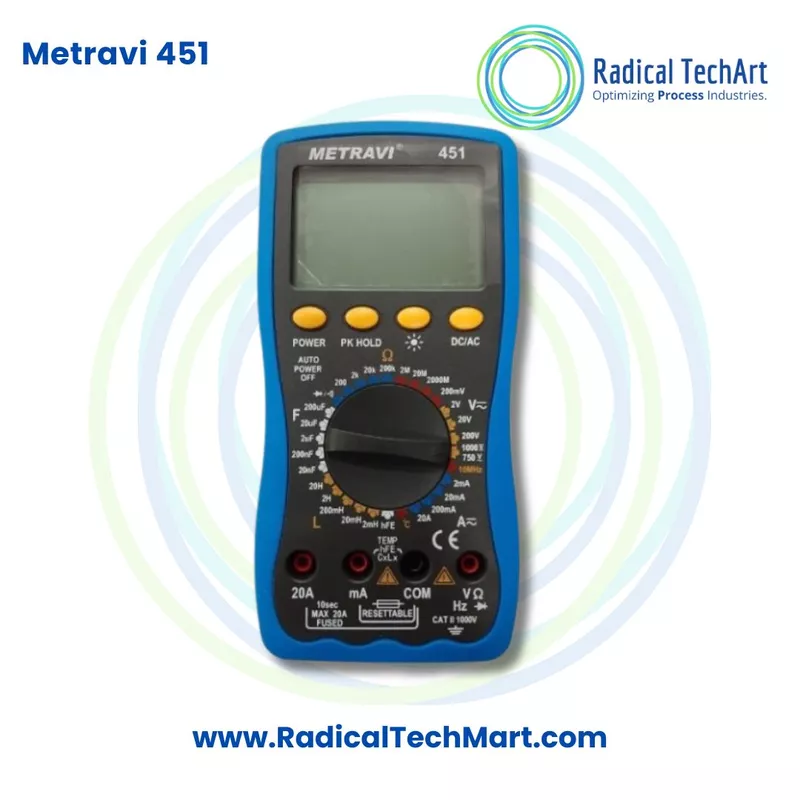


Metravi 451 Digital LCR Multimeter
The Metravi 451 Digital LCR Multimeter is a multifunction handheld testing instrument designed to measure inductance, capacitance, resistance, frequency, temperature, AC and DC voltage and AC and DC current. It also supports diode testing, audible continuity testing, transistor hFE testing and Peak Hold, making it suitable for electrical servicing, electronics repair, laboratory testing and industrial maintenance.
Customize
Share :
A. Product Overview
The Metravi 451 Digital LCR Multimeter combines the functions of a digital multimeter, inductance meter, capacitance meter and resistance meter in one portable instrument. It is designed for technicians who need to test electrical circuits and electronic components without carrying multiple separate meters.
The instrument has a 1999-count LCD display with automatic polarity indication. It uses dual-integrating analogue-to-digital conversion and provides an approximate sampling rate of three readings per second.
Main Measurement Functions
- DC voltage up to 1000 V
- AC voltage up to 750 V
- AC current up to 20 A
- DC current up to 20 A
- Resistance from 200 ohms up to 2000 megaohms
- Capacitance from 20 nanofarads up to 200 microfarads
- Inductance from 2 millihenries up to 20 henries
- Frequency from 2 kilohertz up to 10 megahertz
- Temperature from minus 20 degrees Celsius up to 1000 degrees Celsius
- Diode testing
- Audible continuity testing
- NPN and PNP transistor hFE testing
The Metravi 451 also includes Peak Hold, low-battery indication and overload protection for supported measuring ranges. It operates using one 9 V battery and is designed for portable field and laboratory use.
B. Working Principle
Voltage Measurement
For voltage measurement, the test leads are connected across the electrical source or component. The multimeter detects the potential difference between the two test points and displays the measured AC or DC voltage.
The correct AC or DC voltage range must be selected before connecting the test leads.
Current Measurement
For current measurement, the meter is connected in series with the circuit so that current passes through the multimeter. The internal measuring circuit detects the voltage drop across a calibrated resistance and converts it into a current reading.
The correct input terminal and range must be selected, especially when measuring higher current.
Resistance Measurement
The meter applies a small internal test voltage to the component. It measures the resulting current flow and calculates the resistance according to Ohm’s law.
Resistance should only be measured when the circuit is switched off and fully de-energized.
Capacitance Measurement
During capacitance testing, the meter applies a controlled electrical signal to the capacitor. It evaluates the capacitor’s charging behaviour and calculates the capacitance value.
The capacitor must be safely discharged before measurement.
Inductance Measurement
The Metravi 451 applies an internal test signal to the inductor or coil. It measures the component’s opposition to the changing current and calculates its inductance.
The catalogue specifies a 100 Hz testing frequency for inductance measurement.
Frequency Measurement
The multimeter counts the number of electrical signal cycles occurring during a defined period and displays the result in hertz, kilohertz or megahertz.
Temperature Measurement
A compatible thermocouple probe converts temperature into a small electrical voltage. The meter processes this signal and displays the corresponding temperature value.
The meter supports a specified temperature range from minus 20 degrees Celsius to 1000 degrees Celsius. However, the catalogue indicates that the supplied banana-plug thermocouple may have a more limited operating range of minus 20 degrees Celsius to 250 degrees Celsius.
Diode and Continuity Testing
In diode mode, the meter applies a small current to the diode and displays its approximate forward-voltage drop.
In continuity mode, the meter checks whether a low-resistance electrical path exists. An audible buzzer sounds when the resistance is below the specified threshold.
Transistor Testing
The built-in transistor testing socket allows the user to check the approximate current gain of compatible NPN and PNP transistors. The meter displays an hFE value between 0 and 1000 under the specified test conditions.
C. Why the Metravi 451 Digital LCR Multimeter Is Used
The Metravi 451 is used because it combines several electrical and electronic component-testing functions in one handheld meter.
It can help technicians:
- Measure inductors, coils and chokes
- Test capacitors used in electronic circuits
- Check resistors and high-resistance components
- Measure AC and DC voltage
- Measure AC and DC current
- Check signal frequency
- Measure temperature with a thermocouple probe
- Test diodes for forward-voltage condition
- Check wires, switches, fuses and circuit tracks for continuity
- Test the approximate current gain of NPN and PNP transistors
- Troubleshoot electronic circuit boards
- Inspect electrical equipment during servicing
- Perform laboratory experiments and component verification
The wide combination of LCR and multimeter functions reduces the need to purchase and carry separate inductance, capacitance, resistance and electrical measuring instruments.
D. Suitable Buyers
The Metravi 451 Digital LCR Multimeter is suitable for:
- Electronics repair technicians
- Electrical maintenance professionals
- Industrial service engineers
- Research and development laboratories
- Electronics manufacturing companies
- Quality-control departments
- Printed circuit board repair technicians
- Instrumentation engineers
- Electrical contractors
- Technical training institutes
- Engineering colleges
- Appliance service centres
- Transformer and coil manufacturers
- Motor rewinding workshops
- Original equipment manufacturers
- Hobbyists and electronics developers
Frequently Asked Questions
1. What is the Metravi 451 Digital LCR Multimeter?
The Metravi 451 is a multifunction meter used to measure inductance, capacitance, resistance, frequency, temperature, voltage and current. It also supports diode, continuity and transistor testing.
2. What does LCR mean?
LCR refers to inductance, capacitance and resistance. These are three important electrical properties commonly measured when testing electronic components and circuits.
3. What is the inductance range of the Metravi 451?
The Metravi 451 measures inductance from 2 millihenries up to 20 henries.
4. What is the capacitance range of the Metravi 451?
The meter measures capacitance from 20 nanofarads up to 200 microfarads.
5. What is the maximum resistance range?
The catalogue lists resistance measurement ranges extending up to 2000 megaohms.
6. Can the Metravi 451 measure AC and DC voltage?
Yes. It measures DC voltage up to 1000 V and AC voltage up to 750 V.
7. Can it measure AC and DC current?
Yes. The Metravi 451 measures both AC and DC current up to 20 A.
8. Can the Metravi 451 measure frequency?
Yes. It measures frequency from 2 kilohertz up to 10 megahertz.
9. Can the meter measure temperature?
Yes. The meter supports temperature measurement from minus 20 degrees Celsius up to 1000 degrees Celsius with a suitable thermocouple.
The operating range of the included thermocouple may be lower than the meter’s complete measurement range.
10. Does the Metravi 451 have a continuity buzzer?
Yes. The audible continuity function sounds a buzzer when the measured resistance is below the specified threshold.
11. Can it test diodes?
Yes. The diode-testing function displays the approximate forward-voltage drop of a diode.
12. Can the Metravi 451 test transistors?
Yes. It supports approximate hFE testing of compatible NPN and PNP transistors through the transistor testing socket.
13. What is the Peak Hold function?
Peak Hold captures and retains a peak measured value on the display. It is useful when the measured signal changes quickly or cannot be continuously observed.
14. Is the Metravi 451 suitable for electronics repair?
Yes. Its inductance, capacitance, resistance, diode, continuity, transistor and frequency functions make it suitable for electronic circuit testing and repair.
15. Can resistance be measured on a live circuit?
No. Resistance, continuity, capacitance, inductance and diode measurements should only be performed after the circuit has been switched off and de-energized.
16. Should a capacitor be discharged before testing?
Yes. A capacitor must be safely and completely discharged before connecting it to the meter. A charged capacitor can damage the instrument and create an electrical safety risk.
17. Does the Metravi 451 have automatic range selection?
The catalogue shows manually selectable measuring ranges through the rotary selector. The appropriate function and range should be selected before testing.
18. What type of battery does the Metravi 451 use?
The meter operates using one 9 V battery, typically a 6F22 battery or an equivalent model.
19. Is it suitable for laboratory use?
Yes. It can be used in laboratories, technical institutes, research departments and electronics development environments for component testing and general electrical measurements.
20. Can it replace a dedicated professional LCR meter?
The Metravi 451 is suitable for general component testing, servicing and educational applications. Applications requiring advanced test frequencies, extremely high precision, component sorting or automated laboratory analysis may require a dedicated benchtop LCR meter.