

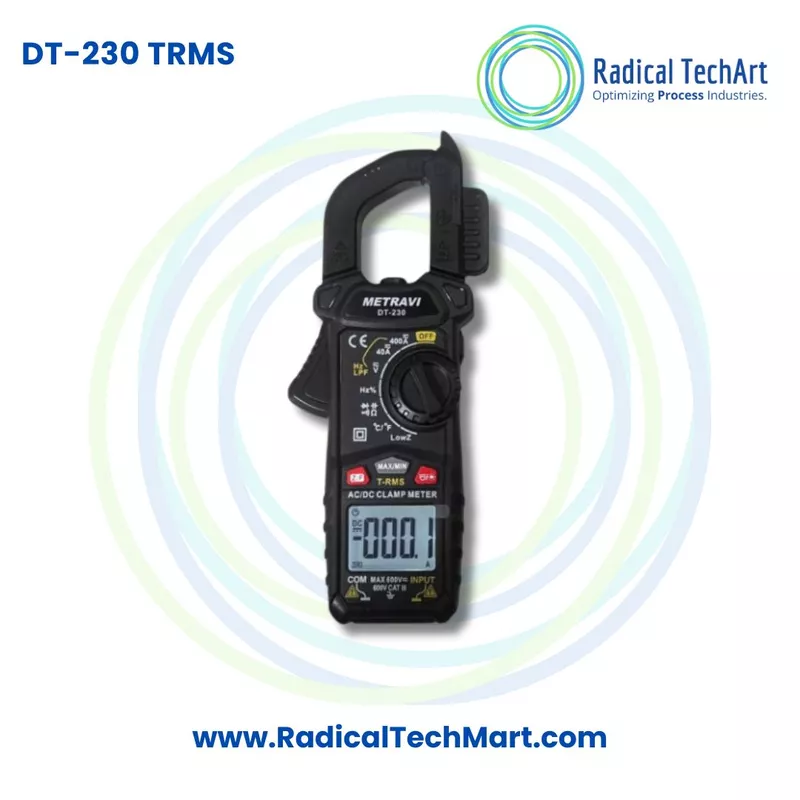
Metravi DT-230 Digital TRMS AC/DC Clamp Meter 2024 Model
The Metravi DT-230 Digital TRMS AC and DC Clamp Meter is a multifunction electrical measuring instrument designed for electricians, technicians and industrial maintenance professionals. It measures AC and DC current up to 400 A, voltage up to 600 V, resistance, capacitance, frequency, duty cycle and temperature. It also supports NCV detection, continuity testing, diode testing, Low Z measurement and Low Pass Filter functions.
Download Catalogue here!!
Customize
Share :
A. Product Overview
The Metravi DT-230 is a battery-operated Digital True RMS Clamp Meter designed for electrical testing, troubleshooting and preventive maintenance. Its clamp-type construction allows AC and DC current to be measured by placing the jaw around a single conductor, reducing the need to disconnect the circuit for routine current checks.
The DT-230 features a 3999-count backlit LCD display, automatic range selection, data hold, maximum and minimum recording, auto power-off, low-battery indication and a built-in LED flashlight for working in poorly illuminated areas.
Main Measuring Functions
- AC current measurement up to 400 A
- DC current measurement up to 400 A
- AC voltage measurement up to 600 V
- DC voltage measurement up to 600 V
- Resistance measurement up to 40 megaohms
- Capacitance measurement up to 100 millifarads
- Frequency measurement up to 10 MHz
- Duty-cycle measurement from 1 to 99 percent
- Temperature measurement from minus 20 degrees Celsius to 1000 degrees Celsius
- Non-contact voltage detection
- Live-wire indication
- Continuity testing
- Diode testing
Main Features
- True RMS measurement
- Automatic range selection
- 3999-count backlit display
- Low Pass Filter
- Low Z voltage measurement
- Data-hold function
- Maximum and minimum recording
- Built-in LED flashlight
- Auto power-off
- Low-battery indication
- CAT III 600 V safety category
The manufacturer’s catalogue states that the meter conforms to the listed EN electrical measurement and safety standards and is rated for CAT III 600 V applications.
B. Working Principle
Current Measurement
When electrical current flows through a conductor, it generates a magnetic field around the conductor. The DT-230 clamp jaw detects this magnetic field and converts it into a current reading.
The jaw must be placed around only one conductor. Clamping the phase and neutral conductors together can cause their magnetic fields to cancel each other, producing an incorrect or near-zero reading.
True RMS Measurement
The True RMS function calculates the effective value of an AC waveform. This makes the meter more suitable for measuring distorted or non-sinusoidal electrical signals commonly produced by variable-frequency drives, switching power supplies, electronic equipment and other nonlinear loads.
Voltage and Electrical Parameter Measurement
For voltage, resistance, capacitance, frequency, continuity, diode and temperature measurements, the appropriate test leads or temperature probe are connected to the meter. The internal electronic circuit processes the measured signal and displays the result on the LCD.
Non-Contact Voltage Detection
The NCV function detects the presence of an AC electric field without requiring direct metallic contact with the conductor. It can be used as an initial indication that a cable, socket or conductor may be live.
Low Z Measurement
The Low Z function reduces the meter’s input impedance during voltage testing. This helps suppress misleading ghost voltages caused by capacitive coupling in nearby wiring.
Low Pass Filter
The Low Pass Filter reduces high-frequency components present in electrically noisy signals. It can help obtain more stable measurements when checking motor drives and circuits containing switching waveforms.
C. Why the Metravi DT-230 Is Used
The Metravi DT-230 is used to perform multiple electrical measurements with one portable instrument. It is particularly useful when technicians need to measure current without disconnecting the conductor.
The meter can be used for:
- Checking AC and DC current consumption
- Measuring supply and control voltages
- Diagnosing electrical circuit problems
- Testing continuity in cables, switches and connections
- Checking diodes and electronic components
- Measuring resistance and capacitance
- Testing frequency and duty cycle
- Measuring surface or equipment temperature with a compatible probe
- Detecting the possible presence of live voltage
- Checking motor, drive and industrial electrical systems
- Identifying intermittent readings using maximum and minimum recording
- Reducing false voltage readings with the Low Z function
Its combination of True RMS, AC and DC current measurement, NCV, Low Z and Low Pass Filter functions makes it suitable for both standard electrical work and industrial troubleshooting.
D. Suitable Buyers
The Metravi DT-230 Digital TRMS AC and DC Clamp Meter is suitable for:
- Professional electricians
- Electrical contractors
- Industrial maintenance engineers
- Plant maintenance technicians
- Control-panel manufacturers
- HVAC and refrigeration technicians
- Motor and pump service technicians
- Solar-power installation technicians
- Battery and inverter service professionals
- Variable-frequency drive technicians
- Electrical testing and commissioning teams
- Facility-management departments
- Technical institutes and training laboratories
- Original equipment manufacturers
- Electrical service centres
Frequently Asked Questions
1. What is the maximum current range of the Metravi DT-230?
The Metravi DT-230 can measure AC and DC current up to 400 A.
2. What is the maximum voltage range of the DT-230?
It can measure AC and DC voltage up to 600 V.
3. Is the Metravi DT-230 a True RMS clamp meter?
Yes. It supports True RMS measurement for AC voltage and AC current, making it suitable for both sinusoidal and distorted electrical waveforms.
4. Can the DT-230 measure DC current through its clamp jaw?
Yes. The DT-230 supports both AC and DC clamp-current measurement up to 400 A.
5. Can the DT-230 measure temperature?
Yes. According to the catalogue, its temperature range is from minus 20 degrees Celsius to 1000 degrees Celsius. Actual measurement performance may also depend on the temperature probe being used.
6. What is NCV detection?
NCV means non-contact voltage detection. It provides an indication of the possible presence of AC voltage without requiring the test probe to touch the conductor directly. It should not be treated as a substitute for proper voltage verification.
7. What is the purpose of the Low Z function?
The Low Z function lowers the meter’s input impedance to help eliminate ghost voltages caused by capacitive coupling between nearby conductors.
8. What is the purpose of the Low Pass Filter?
The Low Pass Filter helps reduce high-frequency electrical noise from the measured signal. It can be useful while testing circuits connected to variable-frequency drives and other switching equipment.
9. Does the meter have continuity and diode-testing functions?
Yes. The meter supports both continuity and diode testing. During continuity testing, the buzzer operates when the measured resistance is below the specified threshold.
10. Can the DT-230 measure resistance and capacitance?
Yes. It measures resistance up to 40 megaohms and capacitance up to 100 millifarads.
11. Does the Metravi DT-230 have automatic ranging?
Yes. It is an auto-ranging meter, so the instrument automatically selects an appropriate measurement range for supported functions.
12. Does the meter have a backlit display?
Yes. It has a 3999-count backlit LCD display for improved visibility in low-light working areas.
13. Can maximum and minimum readings be recorded?
Yes. The maximum and minimum recording function can capture the highest and lowest measured values during a test.
14. Is the DT-230 suitable for industrial electrical work?
Yes. Its True RMS capability, 400 A current range, 600 V voltage range, Low Z function, Low Pass Filter and CAT III 600 V rating make it suitable for many industrial maintenance and electrical troubleshooting applications.
15. Can multiple wires be placed inside the clamp jaw?
For normal current measurement, the clamp should be placed around only one conductor. Placing both outgoing and returning conductors inside the jaw can result in an inaccurate or near-zero reading.
16. Can resistance or capacitance be measured on a live circuit?
No. The circuit should be de-energized and capacitors should be safely discharged before measuring resistance, continuity, diode condition or capacitance. Always follow the manufacturer’s operating and safety instructions.