

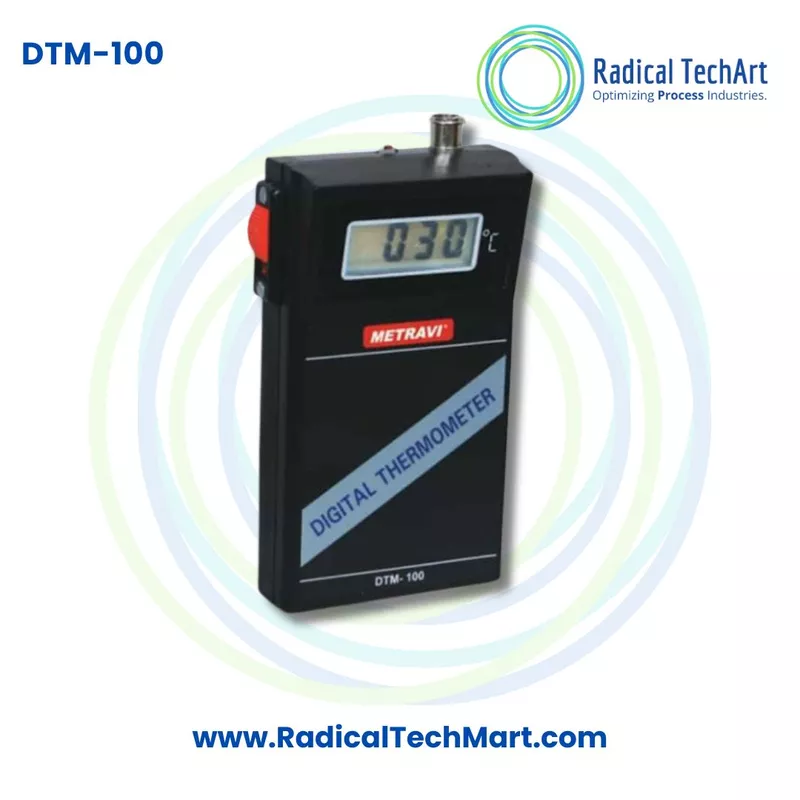


Metravi DTM-100 Industrial Digital Thermometer
Customize
Share :
A. Product Overview
The Metravi DTM-100 is a general-purpose industrial digital thermometer designed for portable temperature measurement in maintenance, manufacturing, laboratories and process applications.
It uses an external temperature sensor to measure the temperature of surfaces, liquids, air, machinery and industrial processes. The thermometer can be ordered for use with PT-100 RTD, J-type thermocouple or K-type thermocouple inputs.
The selected sensor configuration determines the available measuring range, resolution and application suitability. The instrument features a 3½-digit LCD, low-battery indication, sensor-open indication and automatic cold-junction compensation for thermocouple inputs.
Main Features
- Compact and lightweight handheld design
- Compatible with PT-100 RTD sensors
- Compatible with J-type thermocouples
- Compatible with K-type thermocouples
- Temperature measurement up to 1200°C
- 3½-digit digital LCD
- Low-battery indication
- Sensor-open indication
- Automatic cold-junction compensation for thermocouples
- 9V DC battery operation
- Suitable for industrial and general-purpose temperature measurement
Available Input and Temperature Range Configurations
| Input configuration | Sensor type | Temperature range |
|---|---|---|
| P1 | PT-100 RTD with 0.1°C resolution | Minus 100.0°C to 199.9°C |
| P2 | PT-100 RTD with 1°C resolution | Minus 200°C to 400°C |
| J | J-type iron and constantan thermocouple | Minus 50°C to 600°C |
| K | K-type chromel and alumel thermocouple | Minus 50°C to 1200°C |
The catalogue specifies an accuracy of approximately ±0.2 percent for PT-100 RTD configurations and ±1 percent for J-type and K-type thermocouple configurations.
General Specifications
- Display: 3½-digit LCD
- Thermocouple cold-junction compensation: Automatic
- Sensor-open indication: Displayed by “1” at the most significant digit
- Operating temperature: 0°C to 50°C at relative humidity below 80 percent
- Power supply: 9V DC dry battery
- Approximate continuous battery life: 8 hours
- Dimensions: 145 x 80 x 30 mm
- Approximate weight: 200 grams
B. Working Principle
The Metravi DTM-100 works by receiving an electrical signal from a compatible external temperature sensor.
With a PT-100 RTD Sensor
A PT-100 sensor changes its electrical resistance according to temperature. The thermometer measures this resistance and converts it into a temperature reading displayed in degrees Celsius.
PT-100 RTD sensors are commonly selected when good measurement stability, repeatability and accuracy are required.
With a J-Type or K-Type Thermocouple
A thermocouple produces a small voltage when there is a temperature difference between its measuring junction and reference junction. The DTM-100 measures this voltage and converts it into a temperature value.
The thermometer uses automatic cold-junction compensation to account for the temperature at the thermocouple connection point. This helps provide a more accurate temperature reading.
The K-type configuration supports the widest temperature range and can measure up to 1200°C. The J-type configuration is suitable for measurements up to 600°C.
C. Why the Metravi DTM-100 Is Used
The Metravi DTM-100 is used when a portable and dependable instrument is required for direct contact temperature measurement.
It can be used to:
- Measure industrial process temperatures
- Check machinery and equipment temperature
- Measure the temperature of surfaces and components
- Monitor liquid temperature using an immersion probe
- Check furnace, heater and oven temperatures
- Measure refrigeration and cooling-system temperatures
- Test laboratory samples and equipment
- Inspect production processes
- Compare temperature conditions during maintenance
- Carry out field temperature measurements
- Measure high temperatures using a suitable K-type thermocouple
- Perform accurate lower-range measurements using a PT-100 RTD sensor
Its interchangeable sensor options allow the thermometer to be selected for different temperature ranges and applications instead of using one fixed probe for every measurement.
D. Suitable Buyers
The Metravi DTM-100 Industrial Digital Thermometer is suitable for:
- Industrial maintenance engineers
- Electrical maintenance teams
- Mechanical maintenance technicians
- HVAC service professionals
- Refrigeration technicians
- Laboratory technicians
- Quality-control departments
- Manufacturing plants
- Process industries
- Boiler and furnace maintenance teams
- Heating-equipment manufacturers
- Food-processing facilities
- Pharmaceutical production facilities
- Research and testing laboratories
- Technical institutes
- Instrumentation dealers
- Industrial equipment suppliers
- Original equipment manufacturers
Frequently Asked Questions
1. What is the Metravi DTM-100?
The Metravi DTM-100 is a portable industrial digital thermometer designed for contact temperature measurement using an external PT-100 RTD, J-type thermocouple or K-type thermocouple sensor.
2. Is the temperature sensor included with the DTM-100?
No. The sensor or thermocouple is an optional accessory and is available at an additional cost. The required sensor type, temperature range and probe dimensions should be specified while ordering.
3. Which temperature sensors are compatible with the DTM-100?
The thermometer is available in configurations compatible with PT-100 RTD sensors, J-type thermocouples and K-type thermocouples.
4. What is the maximum temperature range of the Metravi DTM-100?
The K-type thermocouple configuration can measure temperatures from minus 50°C to 1200°C.
5. What is the PT-100 measurement range?
The available PT-100 configurations include minus 100.0°C to 199.9°C with 0.1°C resolution and minus 200°C to 400°C with 1°C resolution.
6. What is the J-type thermocouple range?
The J-type thermocouple configuration measures from minus 50°C to 600°C.
7. What is the K-type thermocouple range?
The K-type thermocouple configuration measures from minus 50°C to 1200°C.
8. Which sensor should be selected for high-temperature measurement?
A compatible K-type thermocouple configuration is generally selected for high-temperature measurement because it supports temperatures up to 1200°C.
9. Which sensor should be selected for better accuracy?
A PT-100 RTD configuration is suitable when greater accuracy and measurement stability are required within the supported temperature range. The catalogue specifies approximately ±0.2 percent accuracy for PT-100 configurations.
10. Does the DTM-100 have cold-junction compensation?
Yes. Automatic cold-junction compensation is provided for J-type and K-type thermocouple inputs.
11. What does the sensor-open indication mean?
The sensor-open indication alerts the user when the connected sensor is disconnected, damaged or not making a proper electrical connection.
12. Does the thermometer have a low-battery indicator?
Yes. The LCD provides a low-battery indication to inform the user when the 9V battery should be replaced.
13. Can the DTM-100 measure liquid temperature?
Yes. It can measure liquid temperature when used with a compatible immersion probe suitable for the liquid, temperature range and process conditions.
14. Can it measure surface temperature?
Yes. A suitable surface-contact RTD or thermocouple probe can be connected for measuring pipes, plates, machinery and other surfaces.
15. Can it be used for furnace and oven temperature measurement?
Yes. The K-type version can be used for furnace, oven and heating applications when connected to a compatible high-temperature thermocouple probe.
16. Is the DTM-100 suitable for HVAC and refrigeration applications?
Yes. It can be used to measure air, pipe, duct, coil and refrigeration-system temperatures with an appropriate sensor.
17. Is the thermometer battery operated?
Yes. It operates using a 9V DC dry battery and has an approximate continuous battery life of eight hours.
18. How should the correct DTM-100 configuration be selected?
The configuration should be selected according to the required temperature range, measurement accuracy, sensor type, probe dimensions, installation method and application environment.
19. Can one sensor configuration cover every listed temperature range?
No. Each input configuration has a defined sensor type and temperature range. The correct DTM-100 variant and compatible sensor must be selected while placing the order.
20. What information should be provided when ordering the sensor?
The buyer should specify the sensor type, temperature range, probe diameter, probe length, cable length, process connection and the material or environment in which the temperature will be measured.