

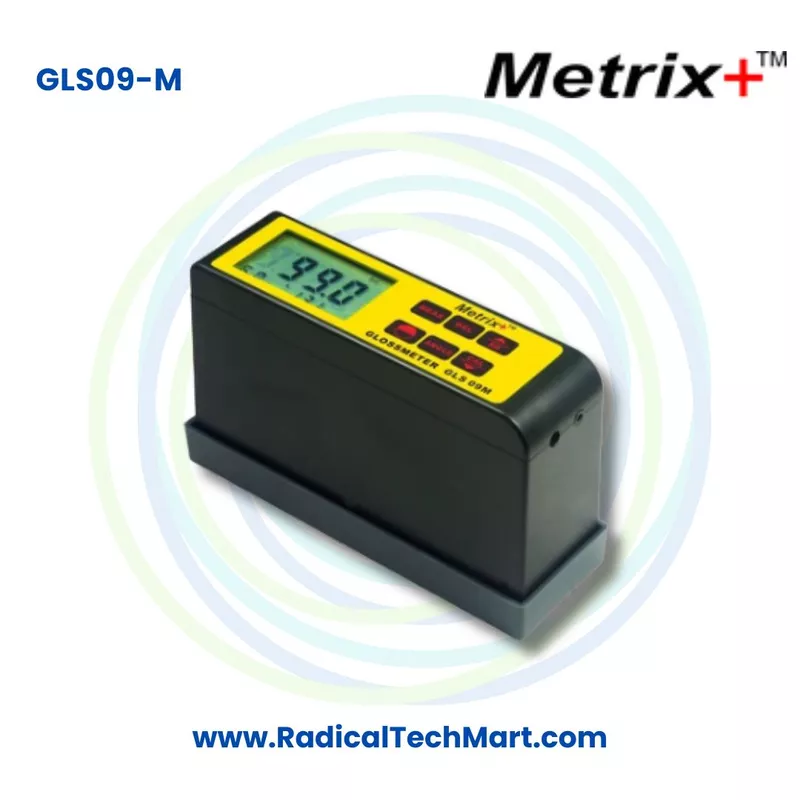
Metrix+ GLS 09M Tri Angle Gloss Meter 20° 60° 85°
The Metrix Plus GLS 09M Digital Gloss Meter is a portable multi angle gloss measurement instrument designed for checking the surface gloss of paints, coatings, plastics, metals, paper, ceramics, automotive finishes and other manufactured surfaces. It supports 20°, 60° and 85° measuring angles, covers a 0.1 to 200 GU range, provides 0.1 GU resolution, stores up to 254 sets of readings and offers both single and continuous measurement modes.
Customize
Share :
A. Product Overview
The Metrix Plus GLS 09M Tri Angle Gloss Meter is designed to measure the specular reflection, or gloss, of a surface. It provides three measurement geometries in one portable instrument, allowing users to evaluate surfaces ranging from low gloss and matte finishes to medium and higher gloss finishes.
The GLS 09M is particularly suitable for industrial quality control where manufacturers need to maintain consistent surface appearance across different batches, products or production processes.
Key Features
• Model: Metrix Plus GLS 09M
• Instrument type: Digital multi angle gloss meter
• Measuring angles: 20°, 60° and 85°
• Measuring range: 0.1 to 200 GU
• Resolution: 0.1 GU
• Specified accuracy: 1.0 GU
• Repeatability: 0.5 GU
• Measuring area: 7 x 14 mm elliptical area
• Display: Backlit LCD
• Data storage: Up to 254 measurement sets
• Measurement modes: Single and continuous
• Simple calibration procedure
• Memory storage and recall
• Optional PC interface
• Power supply: 3.7 V rechargeable lithium ion battery
• Dimensions: Approximately 140 x 45 x 75 mm
• Weight: Approximately 305 g including battery
• Operating temperature: 0 to 40 degrees Celsius
• Operating humidity: Less than 85 percent RH
The combination of 20°, 60° and 85° measurement angles makes the GLS 09M more versatile than a basic single angle gloss meter.
B. Working Principle
The GLS 09M Gloss Meter works using the principle of specular reflection.
The instrument projects a controlled beam of light onto the test surface at a fixed angle. It then measures the amount of light reflected from that surface at an equal but opposite angle.
The amount of reflected light is converted into a numerical gloss value expressed in Gloss Units, or GU.
In simple terms:
A highly reflective and polished surface produces a higher gloss reading.
A rough or matte surface produces a lower gloss reading.
The GLS 09M provides three measuring geometries:
20° Measurement
The 20° geometry is generally useful for evaluating surfaces with relatively high gloss where greater differentiation between glossy finishes is required.
60° Measurement
The 60° geometry is commonly used for general purpose gloss measurement and medium gloss surfaces.
85° Measurement
The 85° geometry is useful for evaluating low gloss and matte surfaces.
Having all three angles in one instrument allows the operator to choose the appropriate geometry according to the surface being inspected.
C. Why Is the GLS 09M Used?
Visual inspection alone can be subjective. Two surfaces may appear similar to the human eye while having measurable differences in their gloss level.
The Metrix Plus GLS 09M provides an objective numerical measurement that helps manufacturers establish and maintain defined surface quality standards.
It can be used to:
• Measure surface gloss
• Maintain consistent product appearance
• Compare production batches
• Check paint quality
• Inspect coating uniformity
• Monitor polishing processes
• Check plastic surface finish
• Inspect automotive paint finishes
• Evaluate printed surfaces
• Compare samples with approved reference standards
• Detect variations in surface finishing
• Perform incoming quality inspection
• Perform production line quality control
• Conduct final product inspection
• Record measurement results for quality documentation
The manufacturer lists applications across paints and coatings, additives, inks, plastics, aerospace, automotive manufacturing and automotive refinishing. Other product literature also identifies applications including paper, printing, metals, electroplating, electronics, ceramics, furniture, granite and marble.
D. Suitable Buyers
The Metrix Plus GLS 09M Tri Angle Gloss Meter is suitable for:
• Paint manufacturers
• Coating manufacturers
• Automotive manufacturers
• Automotive refinishing workshops
• Plastic manufacturers
• Injection moulding companies
• Printing companies
• Ink manufacturers
• Paper manufacturers
• Packaging industries
• Metal finishing companies
• Electroplating industries
• Electronics manufacturers
• Ceramic manufacturers
• Furniture manufacturers
• Granite and marble processors
• Aerospace manufacturers
• Powder coating companies
• Surface treatment companies
• Quality control departments
• Quality assurance departments
• Paint laboratories
• Coating laboratories
• Material testing laboratories
• Research and development departments
• Inspection agencies
• Manufacturing plants
Frequently Asked Questions
1. What is the Metrix Plus GLS 09M?
The Metrix Plus GLS 09M is a portable digital tri angle gloss meter designed for measuring surface gloss using 20°, 60° and 85° measurement geometries.
2. What does the GLS 09M measure?
It measures specular surface gloss, which indicates how strongly a surface reflects light in a mirror-like direction.
3. What is the measuring range of the GLS 09M?
The specified measuring range is 0.1 to 200 Gloss Units.
4. What measuring angles does the GLS 09M support?
The instrument supports:
• 20°
• 60°
• 85°
This makes it suitable for different levels of surface gloss.
5. What is the resolution of the GLS 09M?
The specified resolution is 0.1 GU.
6. What does GU mean in a gloss meter?
GU stands for Gloss Unit. It is the measurement unit commonly used to express the level of specular gloss measured from a surface.
7. What is the 20° gloss measurement used for?
The 20° geometry is generally used when greater differentiation between relatively high gloss surfaces is required.
8. What is the 60° gloss measurement used for?
The 60° geometry is commonly used for general purpose gloss evaluation and medium gloss surfaces.
9. What is the 85° gloss measurement used for?
The 85° geometry is generally used for low gloss and matte surfaces.
10. Can the GLS 09M measure paint gloss?
Yes. Paint and coating inspection is one of the main applications of the GLS 09M.
11. Can the GLS 09M be used for automotive paint?
Yes. Automotive manufacturing and automotive refinishing are specifically listed among its applications.
12. Can it measure plastic surfaces?
Yes. The GLS 09M can be used for suitable plastic surfaces where gloss and surface finish need to be evaluated.
13. Can it be used for coatings?
Yes. It is suitable for surface gloss inspection of paints and coatings.
14. Can the GLS 09M be used for printing applications?
Yes. Product literature lists paper, paper printing and ink among applications for the GLS 09M.
15. Can it test metal surfaces?
Yes. It can be used on suitable finished metal surfaces where gloss measurement is required.