

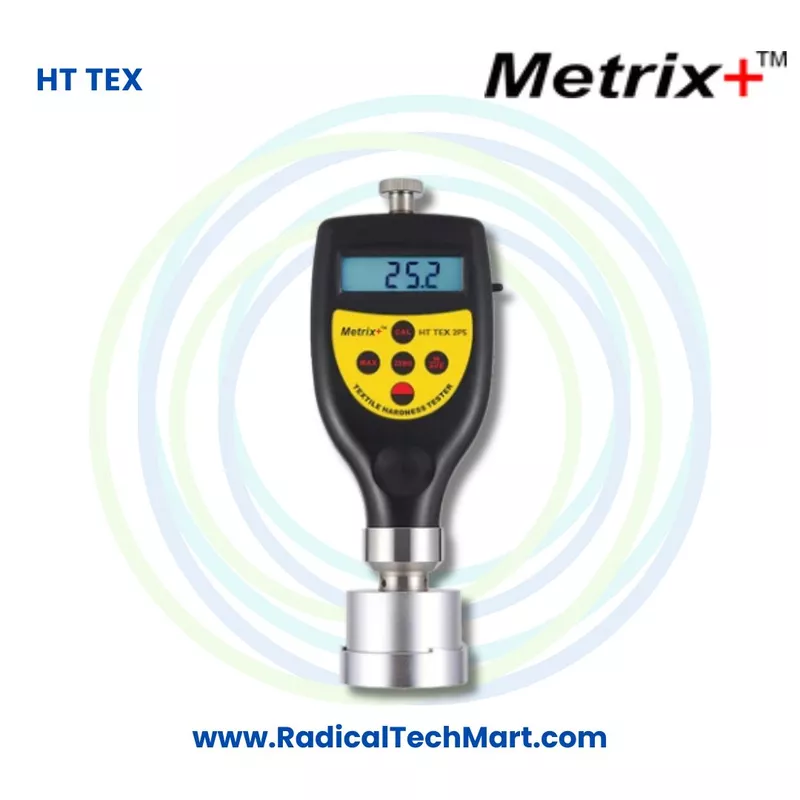
Metrix+ HT TEX Textile Bobbin Hardness Tester for Yarn and Fiber Packages
The Metrix Plus HT TEX Textile Hardness Tester is a portable digital instrument designed to measure the winding density and hardness of textile bobbins, beams, spools, cones and dye packages. It uses a spring load and penetration depth measuring principle and is available with different ball indenters for closely wound, loosely wound and very loosely wound textile packages. It is suitable for yarn manufacturers, spinning mills, textile laboratories and quality control departments.
Customize
Share :
A. Product Overview
The Metrix Plus HT TEX Textile Bobbin Hardness Tester is designed specifically for measuring the hardness or winding density of textile packages.
Consistent package hardness is important in textile manufacturing because variations in winding density can affect unwinding, dye penetration, package stability and downstream processing.
The HT TEX series is available in three models for different types of textile packages:
Model | Indenter | Suitable Application |
HT TEX 2P5 | 2.5 mm diameter ball | Closely wound bobbins of synthetic and finished fibers and filaments |
HT TEX 5 | 5 mm diameter ball | Loosely wound synthetic fibers and closely wound natural fibers, yarns and threads |
HT TEX 10 | 10 mm diameter ball | Very loosely wound bobbins of thick yarn, including carpet yarn |
Main Specifications
Measurement Range: 10 to 90 H
Display Range: 0 to 100 H
Resolution: 0.1 H
Accuracy: approximately 1 H
Depth of Indentation: 0 to 2.5 mm
Test Pressure: approximately 12.5 N
Measuring Spring Force: 0.55 to 8.065 N
Operating Temperature: 0 to 40 degrees Celsius
Operating Humidity: Less than 80 percent RH
Dimensions: 177 x 65 x 45 mm
Approximate Weight: 285 g
Power Supply: 2 AAA batteries
The tester also provides average calculation and maximum data hold functions. Optional data logging is available through a PC interface with USB and software or Bluetooth.
B. Working Principle
The HT TEX Textile Hardness Tester works using a spring load and penetration depth principle.
The measuring probe is pressed against the surface of the textile bobbin, yarn package or spool. A controlled spring force pushes the ball indenter into the package.
The textile package resists this penetration depending on how tightly or loosely the material has been wound.
The basic process is:
Place probe on textile package → Apply controlled spring pressure → Ball indenter penetrates package → Resistance and penetration depth are measured → Hardness value is displayed
A tightly wound package generally provides greater resistance to penetration, while a loosely wound package allows greater penetration.
The principle is similar to the method used in Shore hardness testing of rubber.
C. Why Is the HT TEX Used?
1. Measuring Yarn Package Hardness
The primary purpose of the HT TEX is to measure the hardness and winding density of textile packages such as bobbins, cones and spools.
2. Checking Winding Consistency
It helps manufacturers determine whether yarn has been wound consistently across different packages.
3. Quality Control in Spinning Mills
Regular hardness measurements allow quality control teams to identify packages that are excessively tight or loose.
4. Maintaining Consistent Dye Packages
Winding density can influence how evenly dye penetrates into a textile package. Hardness measurement helps maintain more consistent package preparation.
5. Comparing Different Bobbins
The instrument can be used to compare the hardness of multiple bobbins manufactured under the same process.
6. Monitoring Winding Machines
Measurements can help operators evaluate whether winding equipment is producing packages with consistent hardness.
7. Testing Different Yarn Types
Different HT TEX models are available for synthetic fibers, natural fibers, filaments, threads and thick yarns.
8. Textile Process Optimization
By monitoring package hardness, manufacturers can adjust winding conditions to achieve more consistent production.
D. Convertible Probe Design
An important feature of the HT TEX is its convertible measuring probe.
For bobbins with a diameter of less than 400 mm, the curved end of the probe is used.
The curved probe has a working face diameter of approximately 55 mm.
For bobbins with a diameter of more than 400 mm, the flat end is used.
The flat probe has a working face diameter of approximately 45 mm.
This design allows the same instrument to be used with different sizes of textile packages.
E. Suitable Buyers
The Metrix Plus HT TEX is suitable for companies involved in yarn production, winding, textile processing and textile quality control.
Typical buyers include:
Spinning Mills
For checking yarn bobbin and cone winding hardness.
Yarn Manufacturers
For maintaining consistency between different yarn packages.
Synthetic Fiber Manufacturers
For testing closely and loosely wound synthetic fiber packages.
Natural Fiber Processors
For measuring hardness of packages containing natural fibers and yarns.
Textile Dyeing Units
For checking dye package winding density before processing.
Textile Quality Control Departments
For routine inspection of yarn cones, bobbins and spools.
Textile Testing Laboratories
For package hardness and winding density testing.
Carpet Yarn Manufacturers
The HT TEX 10 is particularly suitable for very loosely wound thick yarns such as carpet yarn.
Thread Manufacturers
For testing tightly wound thread packages.
Textile Machinery Manufacturers
For evaluating the performance and consistency of winding machinery.
Research Institutes and Textile Colleges
For laboratory studies involving yarn package density and textile winding characteristics.
Frequently Asked Questions
1. What is the Metrix Plus HT TEX?
The Metrix Plus HT TEX is a digital textile hardness tester used to measure the winding density or hardness of bobbins, beams, spools, cones, dye packages and similar textile packages.
2. What does a textile bobbin hardness tester measure?
It measures the resistance of a textile package to penetration, allowing the user to evaluate how tightly or loosely the yarn, fiber or filament has been wound.
3. What is the measurement range of the HT TEX?
The measurement range is 10 to 90 H, with a display range of 0 to 100 H.
4. What is the resolution of the HT TEX?
The instrument has a resolution of 0.1 H.
5. What HT TEX models are available?
Three versions are available:
HT TEX 2P5
HT TEX 5
HT TEX 10
They use different ball indenter diameters for different textile package densities.
6. What is HT TEX 2P5 used for?
HT TEX 2P5 uses a 2.5 mm diameter ball indenter and is suitable for closely wound bobbins containing synthetic fibers, finished fibers and filaments.
7. What is HT TEX 5 used for?
HT TEX 5 uses a 5 mm diameter ball indenter and is suitable for loosely wound synthetic fibers and closely wound natural fibers, yarns and threads.
8. What is HT TEX 10 used for?
HT TEX 10 uses a 10 mm diameter ball indenter and is designed for very loosely wound packages containing thick yarns, including carpet yarns.
9. Can it measure yarn cone hardness?
Yes. The HT TEX can be used for measuring the hardness or winding density of yarn cones and similar textile packages.
10. Can it measure bobbin hardness?
Yes. Bobbin hardness measurement is one of the primary applications of the HT TEX series.
11. Can it test textile spools?
Yes. The tester can be used on textile spools where the package and winding characteristics are appropriate for the selected model.
12. Can HT TEX be used for dye packages?
Yes. Dye packages are specifically among the applications for which the instrument is designed.
13. How does the HT TEX Textile Hardness Tester work?
The instrument uses a controlled spring load to press a ball indenter into the textile package. The resistance against penetration and resulting penetration depth are used to determine package hardness.