

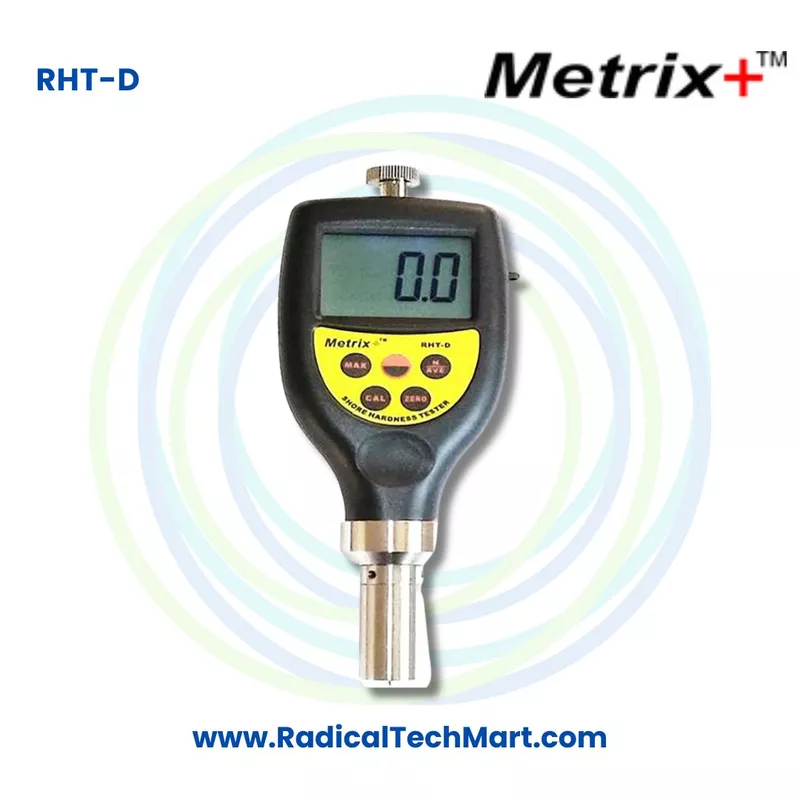
Metrix+ RHT-D Shore D Hardness Tester Durometer
The Metrix Plus RHT-D Shore D Hardness Tester is a portable digital durometer designed for measuring the hardness of hard rubber, thermoplastics, thermosets, rigid plastics and hard elastomer materials. It offers a 0 to 100 hardness measuring range, 0.1H resolution, backlit LCD display, average value function, maximum data hold and inbuilt software calibration. Its integrated probe and lightweight construction make it suitable for laboratory, production and quality inspection applications.
Customize
Share :
A. Product Overview
The Metrix Plus RHT-D Digital Rubber Hardness Tester is a Shore D hardness testing instrument used for evaluating harder rubber, plastics and polymer materials.
The Shore D scale is commonly used for materials that are harder than those normally measured using Shore A hardness testers. The RHT-D is therefore suitable for materials such as:
• Hard rubber
• Hard elastomers
• Thermoplastic elastomers
• Thermoplastics
• Thermosetting plastics
• Rigid plastics
• Hard polymer components
The tester features an integrated probe and a compact handheld design for convenient field and production floor measurements.
Key Features
• Model: RHT-D
• Hardness scale: Shore D
• Measuring range: 0 to 100, with recommended measurement range approximately 10 to 90H
• Resolution: 0.1H
• Accuracy: Better than approximately 1H
• Display: Backlit LCD
• Average value calculation
• Maximum data hold function
• Automatic power off
• Low battery indication
• Metric to imperial conversion
• Inbuilt software calibration
• Integrated measurement probe
• Portable and lightweight design
• Operating temperature: 0 to 50 degrees Celsius
• Power supply: Two 1.5 V AAA batteries
• Approximate dimensions: 170 x 63 x 24 mm
• Approximate weight: 310 g excluding batteries
B. Working Principle
The RHT-D Shore D Hardness Tester works on the indentation principle.
The instrument contains a specially designed indenter that is loaded by a calibrated spring. During measurement, the indenter is pressed against the surface of the test material.
The hardness reading depends on how deeply the indenter penetrates the material under the specified spring force.
In simple terms:
Greater penetration indicates a softer material.
Lower penetration indicates a harder material.
For Shore D measurement, the RHT-D uses a hardened steel indenter with a conical tip. The instrument converts the penetration depth into a Shore D hardness value and displays the reading on its digital LCD screen.
C. Why Is the RHT-D Used?
The RHT-D is used to verify whether hard rubber, plastic and polymer components have the required hardness for their intended application.
Hardness testing is important because material hardness can affect:
• Wear resistance
• Flexibility
• Rigidity
• Mechanical strength
• Durability
• Compression characteristics
• Manufacturing consistency
• Product quality
Manufacturers can use the RHT-D to compare batches, inspect incoming materials and verify finished components.
Typical applications include:
• Hard rubber component testing
• Plastic component hardness inspection
• Thermoplastic testing
• Thermoset material testing
• Polymer quality control
• Production line inspection
• Incoming raw material inspection
• Research and development testing
• Supplier quality verification
• Finished product inspection
The instrument is especially useful when quick Shore D measurements are required without using a large laboratory hardness testing machine.
D. Suitable Buyers
The Metrix Plus RHT-D Shore D Hardness Tester is suitable for:
• Rubber product manufacturers
• Plastic product manufacturers
• Polymer manufacturers
• Injection moulding companies
• Plastic moulding industries
• Rubber moulding companies
• Automotive component manufacturers
• Industrial component manufacturers
• Cable and polymer industries
• Gasket and sealing component manufacturers
• Plastic pipe manufacturers
• Research and development laboratories
• Material testing laboratories
• Quality control departments
• Quality assurance departments
• Inspection agencies
• Educational institutions
• Industrial testing laboratories
• Engineering companies
• Production and manufacturing plants
Frequently Asked Questions
1. What is the Metrix Plus RHT-D?
The Metrix Plus RHT-D is a digital Shore D hardness tester designed for measuring the hardness of hard rubber, rigid plastics, thermoplastics, thermosets and hard elastomers.
2. What hardness scale does the RHT-D use?
The RHT-D uses the Shore D hardness scale.
3. What is the measuring range of the RHT-D?
The instrument has a measuring scale of approximately 0 to 100, with a specified working range of approximately 10 to 90H.
4. What is the resolution of the RHT-D?
The RHT-D has a resolution of 0.1H, allowing small changes in material hardness to be observed.
5. What materials can be tested using the RHT-D?
It can be used for hard rubber, rigid plastics, thermoplastics, thermosets, hard elastomers and similar polymer materials.
6. Can the RHT-D test hard rubber?
Yes. Hard rubber is one of the primary applications of a Shore D hardness tester.
7. Can it be used for plastic hardness testing?
Yes. The RHT-D is suitable for harder plastics and rigid thermoplastic materials.
8. Can it test soft rubber?
For softer rubber and elastomer materials, a Shore A hardness tester is generally more appropriate. The RHT-D is intended for harder materials.
9. What is the difference between Shore A and Shore D hardness testing?
Shore A is generally used for softer rubber and elastomers. Shore D is typically used for harder rubber, hard elastomers and rigid plastics.
10. How does the RHT-D measure hardness?
A spring loaded indenter is pressed into the material. The instrument measures the depth of penetration and converts it into a Shore D hardness reading.
11. Does the RHT-D have a digital display?
Yes. It features a backlit LCD display for easy reading of measurement results.
12. Does the RHT-D have a maximum hold function?
Yes. The instrument includes a maximum data hold function for retaining the highest measured value.
13. Does it calculate average hardness?
Yes. The RHT-D provides an average value function that can help when multiple measurements are taken on the same material.
14. Does the tester have automatic power off?
Yes. Automatic power off is included to help conserve battery power.
15. Does the RHT-D provide low battery indication?
Yes. A low battery indication feature alerts the operator when the battery requires replacement.