

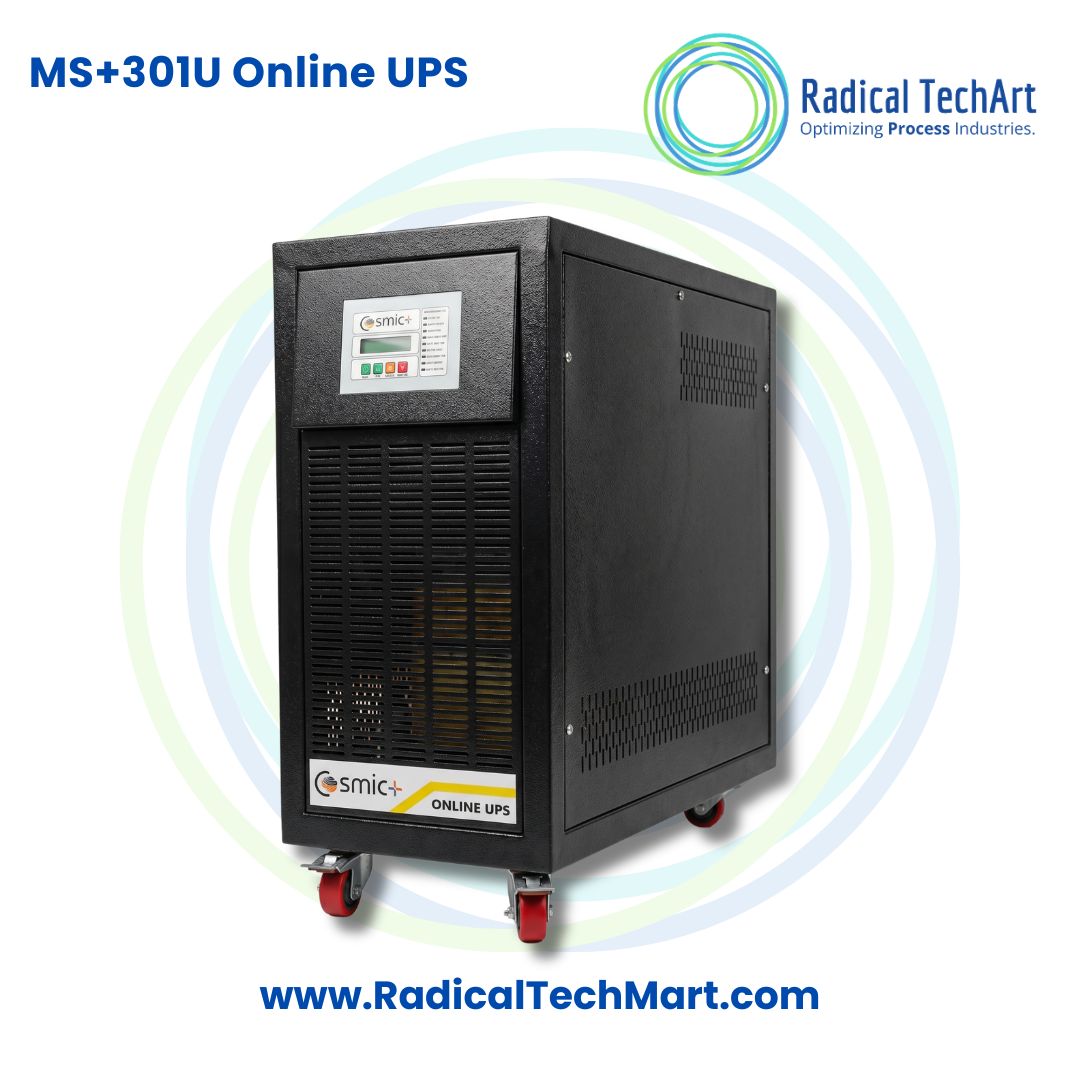
MS+301U Online UPS – 3 Phase Input and 1 Phase Output UPS
Customize
Share :
A. Product Overview
The COSMIC+ MS+301U Online UPS is an industrial online power backup system with a three-phase input and single-phase output configuration. It is intended for installations where a three-phase electrical supply is available but the connected critical equipment requires stable single-phase power.
The UPS uses DSP-based IGBT PWM double-conversion technology. In this design, the connected load is continuously supplied through the inverter instead of being transferred to the inverter only after a power failure. This provides uninterrupted operation and protects sensitive equipment from supply disturbances.
The MS+301 series is offered in power ratings from 10 kVA to 30 kVA, making it suitable for medium-capacity industrial and commercial power backup requirements.
Main Product Features
- Three-phase input and single-phase output
- Capacity range from 10 kVA to 30 kVA
- DSP-controlled operating system
- IGBT PWM double-conversion technology
- High-frequency switching design
- Isolated output configuration
- No transfer time during mains failure
- 50 Hz output frequency with published stability of plus or minus 0.1 Hz
- IP20 protection for indoor installation
- Battery charging support
- Published battery recharging time of approximately 8 to 10 hours
- Optional static switch
- Optional hot standby arrangement
- Optional SNMP communication
- Designed for industrial and commercial applications
These published specifications apply to the COSMIC online UPS range. Final construction, battery voltage, backup duration, bypass arrangement and communication options should be confirmed for the selected MS+301U rating before ordering.
B. Working Principle
The COSMIC+ MS+301U operates on the online double-conversion principle.
Step 1: Three-Phase AC Input
The UPS receives three-phase AC power from the main electrical supply. This allows the system to distribute its input demand across the available phases.
Step 2: AC to DC Conversion
The rectifier section converts the incoming three-phase AC supply into DC power. This DC power is used to operate the inverter and charge the connected battery bank.
Step 3: DC Link and Battery Support
The DC section acts as the common power link between the rectifier, battery bank and inverter. During normal operation, the rectifier maintains this DC supply while also managing battery charging.
Step 4: DC to Single-Phase AC Conversion
The IGBT-based inverter converts the DC power into a controlled single-phase AC output. The connected equipment therefore receives power through the inverter during normal mains operation.
Step 5: Operation During Mains Failure
When the mains supply fails or moves outside the acceptable operating range, the battery bank continues providing DC power to the inverter. Since the load is already being powered through the inverter, there is no conventional switching delay between the mains supply and battery operation. The published transfer time is nil.
Step 6: Mains Restoration
When the incoming supply returns to an acceptable condition, the rectifier resumes supplying the inverter and begins recharging the battery bank. The connected load continues operating through the controlled inverter output.
This double-conversion process helps isolate the critical load from raw mains disturbances such as voltage fluctuations, spikes, surges and frequency variations.
C. Why It Is Used
1. To Prevent Operational Shutdowns
A sudden power failure can stop production equipment, reset controllers, interrupt server operations and disrupt communication systems. The MS+301U provides battery-supported power to keep critical systems operational.
2. To Provide No-Delay Power Backup
The load is continuously supplied through the inverter. Therefore, the UPS does not require the conventional transfer period associated with offline and line-interactive UPS systems.
3. To Convert Three-Phase Supply into Stable Single-Phase Output
Many industrial sites have a three-phase input supply, while servers, instruments, laboratory equipment and control systems may require single-phase power. The MS+301U provides the required three-phase input and single-phase output configuration.
4. To Protect Sensitive Electronic Equipment
Industrial computers, PLC systems, communication devices, servers and electronic instruments can be affected by unstable voltage and electrical disturbances. The online double-conversion design provides a controlled electrical supply to the connected load.
5. To Support Medium-Capacity Critical Loads
With capacities from 10 kVA to 30 kVA, the MS+301U can support larger critical load groups than small single-phase UPS systems. The final rating must be selected according to the actual load, power factor, starting current and future expansion requirement.
6. To Improve Power Quality
The rectifier and inverter stages reconstruct the output supply instead of directly passing the raw mains voltage to the connected load. This helps reduce the effect of voltage variation, electrical noise and other incoming power disturbances.
7. To Enable Centralised Power Backup
A properly selected MS+301U can provide backup to multiple compatible devices through one central UPS system. This can simplify power management for control rooms, server areas, laboratories and industrial systems.
8. To Support Remote Monitoring
SNMP communication is available as an optional feature. When selected and integrated with compatible software, it can support network-based UPS monitoring and status supervision.
D. Suitable Buyers
COSMIC+ manufactures power products for industrial, commercial and infrastructure applications. Its published customer sectors include manufacturing, healthcare, corporate offices, banking, telecommunications, education, data centres, automation, government and renewable energy.
Manufacturing Industries
Suitable for production control systems, industrial computers, machine controllers, PLC panels and other critical manufacturing equipment.
Industrial Automation Companies
Can be used to protect automation controllers, supervisory systems, operator workstations, industrial communication devices and monitoring systems.
Data Centres and Server Rooms
Suitable for servers, storage systems, networking switches, communication racks and other single-phase IT loads operating at facilities with three-phase input power.
Hospitals and Healthcare Facilities
Can support compatible laboratory, monitoring, diagnostic and information technology equipment requiring stable power. UPS capacity and compatibility must be verified for the specific medical load.
Pharmaceutical and Chemical Industries
Suitable for process instruments, laboratory equipment, automation systems, data recording systems and quality-control equipment.
Research and Testing Laboratories
Can be used for analytical instruments, computers, data acquisition systems, testing equipment and other voltage-sensitive loads.
Telecommunications Companies
Suitable for networking equipment, communication systems, monitoring panels and related infrastructure.
Banks and Financial Institutions
Can support servers, networking systems, transaction equipment, security systems and other essential electronic loads.
Educational Institutions
Suitable for computer laboratories, research facilities, campus servers, communication systems and institutional data centres.
System Integrators
Useful for automation, IT and electrical system integrators designing centralised power backup systems for customers.
Electrical Contractors and Consultants
Suitable for professionals selecting and installing UPS systems for industrial buildings, laboratories, server rooms and commercial facilities.
Frequently Asked Questions
1. What is the COSMIC+ MS+301U Online UPS?
The COSMIC+ MS+301U is a DSP-controlled, IGBT PWM double-conversion online UPS with three-phase input and single-phase output. It is designed to supply continuous and regulated power to critical industrial and commercial equipment.
2. What is the input and output phase configuration?
The UPS accepts a three-phase input supply and provides a single-phase output supply.
3. What capacities are available in the MS+301 series?
The published MS+301 series capacity range is from 10 kVA to 30 kVA.
4. Is the MS+301U an online double-conversion UPS?
Yes. It uses DSP-based IGBT PWM double-conversion technology.
5. What is the transfer time during a power failure?
The published transfer time is nil because the connected load is continuously powered through the inverter.
6. How is it different from an offline UPS?
An offline UPS normally transfers the load to its inverter after detecting a mains failure. The MS+301U continuously operates through its rectifier and inverter stages, providing no-delay battery support and greater isolation from incoming supply disturbances.
7. Can the MS+301U be used for single-phase equipment?
Yes. Its output is single phase, making it suitable for compatible single-phase equipment within the selected UPS capacity.
8. Why does the UPS use a three-phase input?
A three-phase input is commonly available at industrial and commercial facilities. It also allows a higher-capacity UPS to draw power through a three-phase electrical system while supplying critical single-phase loads.
9. Does the UPS provide an isolated output?
The published COSMIC online UPS specifications describe an isolated output configuration. The exact transformer construction should be confirmed for the selected rating and order configuration.
10. What type of batteries can be used?
The battery bank depends on the selected UPS capacity, DC bus voltage and required backup duration. The manufacturer supplies UPS battery solutions including SMF, VRLA and tubular battery options.
11. How much backup time does the MS+301U provide?
Backup time is not fixed. It depends on:
- Total connected load
- Battery quantity
- Battery voltage
- Battery ampere-hour capacity
- Battery age and condition
- Required discharge limit
- UPS operating efficiency
The required backup duration must be specified before the battery bank is selected.
12. What is the battery recharging time?
The published recharge time for the COSMIC online UPS range is approximately 8 to 10 hours. Actual charging time can vary according to battery capacity, discharge level and charger configuration.
13. Does it support SNMP communication?
SNMP is listed as an optional feature. It should be specified while ordering when network-based monitoring is required.
14. Is a static bypass available?
A static switch is available as an optional feature. The required bypass configuration should be confirmed before placing the order.
15. Is a hot standby arrangement available?
Hot standby is listed as an optional configuration for the COSMIC online UPS range. It may be considered where additional system availability is required.
16. Can it be used for industrial automation systems?
Yes. It is suitable for compatible PLC systems, industrial computers, SCADA workstations, automation panels, controllers and communication equipment.
17. Can it be used for servers and data centres?
Yes. The manufacturer lists data centres among the industries served. The UPS rating and battery bank must be selected based on the actual server and networking load.
18. Is it suitable for medical equipment?
It may be used for compatible healthcare, laboratory and medical support equipment requiring stable power. Equipment compatibility, leakage requirements, redundancy and relevant safety standards must be verified before selection.
19. Is the UPS suitable for indoor installation?
The published enclosure protection is IP20 and the listed usage is indoor. It should be installed in a clean, ventilated electrical or UPS room protected from water, excessive dust and corrosive conditions.
20. What information is required to select the correct MS+301U UPS?
The following details should be provided:
- Total connected load in watts or kVA
- Load power factor
- Type of connected equipment
- Starting or surge current
- Available three-phase input voltage
- Required single-phase output voltage
- Required backup duration
- Battery type preference
- Existing battery bank details, when applicable
- Static bypass requirement
- Manual bypass requirement
- SNMP or communication requirement
- Redundancy requirement
- Installation location and ambient conditions
- Required quantity