

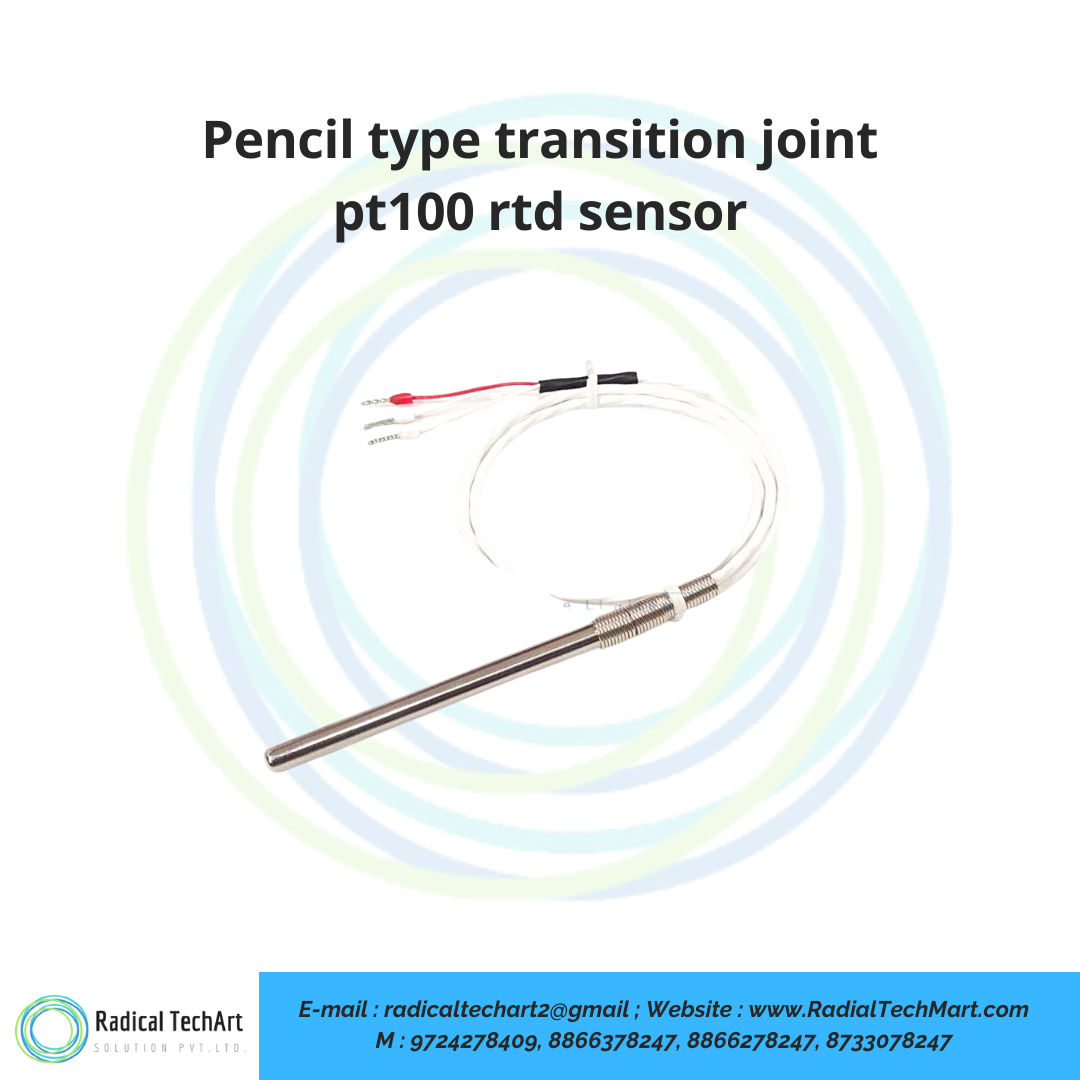
Pencil Type Transition Joint PT100 RTD Temperature Sensor
Customize
Share :
A. Product Overview
A Pencil Type Transition Joint Pt100 RTD Sensor is an industrial temperature sensor used to measure process temperature with high accuracy and long-term stability. The sensor uses a platinum resistance element known as Pt100, which has a resistance value of 100 ohms at 0 degrees Celsius.
The pencil type design makes the sensor compact and suitable for applications where direct insertion or fixed-point temperature measurement is required. The transition joint is the connection area between the sensing probe and the cable or process connection. This joint is designed to provide mechanical strength, protection and reliable signal transfer during temperature measurement.
These sensors are commonly made using stainless steel or other suitable materials depending on the process condition. For high temperature, corrosive or demanding environments, materials such as stainless steel or Inconel can be used for better durability and process compatibility.
B. Working Principle
The Pt100 RTD sensor works on the resistance temperature detection principle. The platinum sensing element changes its electrical resistance as the temperature changes.
At 0 degrees Celsius, the Pt100 element has a resistance of 100 ohms. As the temperature increases, the resistance of the platinum element also increases in a predictable manner. This change in resistance is measured by a temperature indicator, controller, transmitter or data acquisition system and converted into a temperature reading.
The transition joint helps protect the connection between the RTD element and the cable. It also supports stable signal transmission, especially in industrial environments where vibration, heat and mechanical stress may be present.
C. Why It Is Used
Pencil Type Transition Joint Pt100 RTD Sensors are used because they provide accurate, stable and repeatable temperature measurement in industrial and commercial applications.
They are preferred for the following reasons:
- High accuracy compared to many other temperature sensing technologies
- Stable performance over a wide temperature range
- Suitable for HVAC, manufacturing and laboratory applications
- Compact pencil type design for easy installation
- Reliable platinum sensing element
- Durable construction for industrial use
- Suitable for process temperature monitoring and control
- Can be customized as per probe length, diameter, cable length and material requirement
This type of sensor is useful wherever precise temperature monitoring is important for quality, safety, process control or equipment performance.
D. Suitable Buyers
This Pencil Type Transition Joint Pt100 RTD Sensor is suitable for:
- HVAC contractors and system integrators
- Manufacturing plants
- Laboratory equipment manufacturers
- Process industries
- Machine manufacturers
- Automation panel builders
- Pharmaceutical industries
- Food and beverage processing units
- Chemical processing plants
- OEM machine builders
- Maintenance and instrumentation teams
- Temperature controller and transmitter users
It is a good choice for buyers who need accurate and reliable temperature measurement in compact industrial applications.
FAQ
1. What is a Pencil Type Transition Joint Pt100 RTD Sensor?
A Pencil Type Transition Joint Pt100 RTD Sensor is a temperature sensor that uses a platinum Pt100 element to measure temperature accurately. It has a pencil type probe design and a transition joint for connecting the probe with the cable or process connection.
2. What does Pt100 mean?
Pt100 means the sensor uses a platinum sensing element with a resistance of 100 ohms at 0 degrees Celsius. The resistance changes with temperature, allowing accurate temperature measurement.
3. Where is this RTD sensor used?
This RTD sensor is used in HVAC systems, manufacturing processes, laboratory equipment, industrial machines, process plants and temperature monitoring systems.
4. Why is platinum used in Pt100 sensors?
Platinum is used because it provides high accuracy, excellent stability and predictable resistance change with temperature. This makes it suitable for precise industrial temperature measurement.
5. What is the use of a transition joint in an RTD sensor?
The transition joint provides a strong and protected connection between the sensing probe and the cable. It helps improve durability, signal stability and mechanical protection.
6. Is this sensor suitable for industrial applications?
Yes, Pencil Type Transition Joint Pt100 RTD Sensors are widely used in industrial applications because they offer reliable performance, good accuracy and stable temperature measurement.
7. Can the sensor be customized?
Yes, the sensor can be customized based on probe length, probe diameter, cable length, process connection, sheath material and application requirement.
8. Which material is commonly used for the sensor sheath?
Stainless steel is commonly used for the sheath because it provides durability, corrosion resistance and good mechanical strength. For special applications, other materials such as Inconel may be used.
9. What are the main benefits of this sensor?
The main benefits include accurate temperature measurement, stable output, compact design, durable construction, wide application suitability and compatibility with temperature indicators, controllers and transmitters.
10. Who should buy this sensor?
This sensor is suitable for OEMs, HVAC contractors, panel builders, process industries, laboratory equipment manufacturers and maintenance teams who need accurate temperature monitoring.