

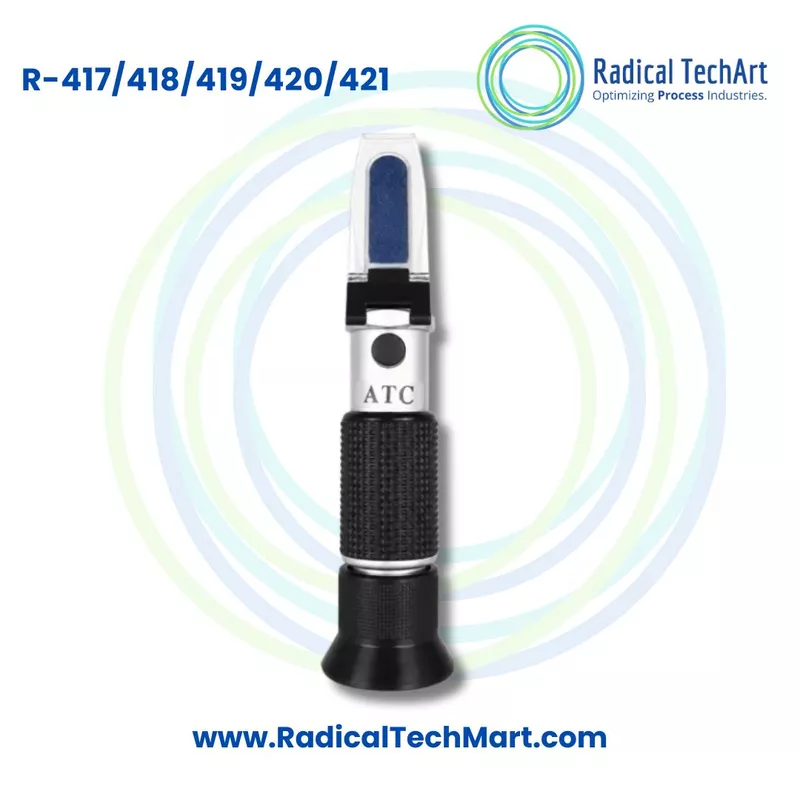


R-Tek Copper Refractometers
R-Tek Copper Refractometers are handheld optical instruments designed for quick measurement of liquid concentration, including Brix, sugar concentration, salinity and related solution parameters depending on the selected model. The range includes RK-412, RK-413, RK-415, RK-416, RK-417, RK-418, RK-419, RK-420 and RK-421, making it suitable for food processing, beverages, agriculture, aquaculture, laboratories and quality control applications.
Customize
Share :
A. Product Overview
R-Tek Copper Refractometers are portable optical measuring instruments used to determine the concentration of dissolved substances in liquid samples.
The available range includes:
- RK-412
- RK-413
- RK-415
- RK-416
- RK-417
- RK-418
- RK-419
- RK-420
- RK-421
Different models are intended for different measuring ranges and applications, including Brix measurement, sugar concentration and salinity testing.
These refractometers are suitable for field and laboratory use because only a small liquid sample is required for measurement.
Typical applications include:
- Fruit juice testing
- Beverage production
- Sugar concentration measurement
- Food processing
- Agriculture
- Aquaculture
- Laboratory testing
- Industrial quality control
- Liquid concentration inspection
B. Working Principle
R-Tek Copper Refractometers work on the principle of light refraction.
When light passes through a liquid sample, its direction changes depending on the concentration of dissolved substances present in the liquid.
A small amount of sample is placed on the refractometer prism. Light passes through the sample and prism, and the refractive index of the liquid creates a boundary on the internal scale.
The user looks through the eyepiece and reads the corresponding value from the scale.
For Brix refractometers, the reading represents the approximate concentration of dissolved sugar or soluble solids in the sample.
For salinity models, the scale is intended for measuring salt concentration.
The exact scale and measurement range depend on the selected R-Tek model.
C. Why R-Tek Copper Refractometers Are Used
R-Tek Copper Refractometers are used when users need a fast and convenient way to check liquid concentration without complex laboratory equipment.
They can help users:
- Measure Brix values
- Check sugar concentration
- Measure salinity depending on model
- Monitor product consistency
- Compare different liquid samples
- Perform incoming raw material inspection
- Monitor production processes
- Carry out quality control testing
- Check concentration during food and beverage processing
Regular concentration measurement can help manufacturers maintain consistent product quality and process conditions.
D. Suitable Buyers
R-Tek Copper Refractometers are suitable for:
- Food processing companies
- Beverage manufacturers
- Fruit juice manufacturers
- Sugar processing companies
- Dairy and food laboratories
- Agriculture professionals
- Fruit growers
- Aquaculture operators
- Research laboratories
- Educational laboratories
- Quality control departments
- Industrial production facilities
- Testing laboratories
- Food quality inspectors
- Process engineers
Frequently Asked Questions
1. What is an R-Tek Copper Refractometer?
An R-Tek Copper Refractometer is a handheld optical instrument used to measure the concentration of dissolved substances in liquids. Depending on the model, it can be used for Brix, sugar concentration, salinity and related solution measurements.
2. Which R-Tek Copper Refractometer models are available?
The range includes RK-412, RK-413, RK-415, RK-416, RK-417, RK-418, RK-419, RK-420 and RK-421.
3. What is Brix measurement?
Brix is commonly used to indicate the concentration of dissolved soluble solids, particularly sugar, in a liquid solution. It is widely used in fruit juice, food and beverage testing.
4. Can R-Tek refractometers measure sugar concentration?
Yes. Several R-Tek refractometer models are designed for Brix measurement, which is commonly used for estimating sugar concentration in liquid samples.
5. Can R-Tek Copper Refractometers measure salt concentration?
The R-Tek range includes models intended for salinity measurement. The correct model should be selected according to the required parameter and measurement range.
6. How do you use a handheld refractometer?
Place a small amount of the liquid sample on the prism, close the cover plate, point the instrument toward a suitable light source and look through the eyepiece. The measurement can then be read from the internal scale.
7. How much sample is required?
A handheld optical refractometer generally requires only a small amount of liquid to cover the measuring prism.
8. Can these refractometers be used for fruit juice?
Yes. Brix refractometers are commonly used for measuring soluble solids and sugar concentration in fruit juices and similar beverages.
9. Are R-Tek refractometers suitable for food processing?
Yes. They can be used for concentration checking and quality control in food and beverage processing, provided the selected model has the correct measuring range for the application.
10. Are these refractometers suitable for laboratory use?
Yes. R-Tek Copper Refractometers can be used for routine laboratory testing, educational applications, quality inspection and sample comparison.
11. How do I choose between RK-412, RK-413, RK-415, RK-416, RK-417, RK-418, RK-419, RK-420 and RK-421?
Select the model according to the parameter you need to measure and the expected concentration range of your sample. Different models cover different Brix or salinity ranges.
12. What industries commonly use optical refractometers?
Optical refractometers are commonly used in food processing, beverages, agriculture, aquaculture, laboratories, research, manufacturing and quality control.
13. What is the advantage of a handheld refractometer?
A handheld refractometer provides quick measurement, requires only a small sample and can be easily carried for field or production testing.
14. Can one R-Tek refractometer cover every concentration range?
No. Different models are designed for different measuring ranges. The appropriate model should be selected based on the expected concentration of the liquid being tested.
15. Why should the correct measuring range be selected?
Selecting the correct range helps ensure that the expected sample concentration falls within the instrument's readable scale and makes the instrument more suitable for the intended application.