

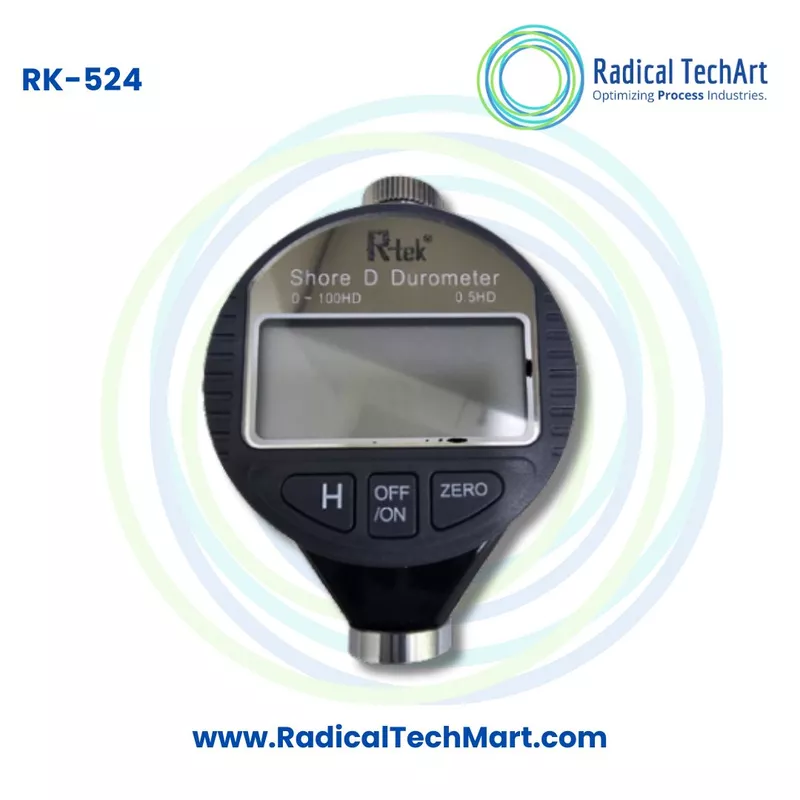


R-Tek Hardness Testers
R-Tek RK-523 Digital and RK-524 Manual Shore Hardness Testers are portable instruments designed for checking the hardness of rubber, synthetic rubber, plastics, resin, acrylic, leather, wax, foam and similar materials. The range includes Shore A, Shore C, Shore D and Shore O variants for industrial inspection, manufacturing, laboratory testing and quality control applications.
Customize
Share :
A. Product Overview
The R-Tek RK-523 and RK-524 Hardness Testers are Shore hardness measuring instruments intended for evaluating the hardness characteristics of different soft, medium and hard materials.
The product range includes both digital and analog models. The R-Tek sitemap identifies RK-523 as the Digital Hardness Tester and RK-524 as the Manual Hardness Tester.
The product page covers several Shore scales:
• Shore A for general rubber, synthetic rubber, soft rubber, leather, wax and similar softer materials
• Shore O for micro porous and foam type materials
• Shore D for hard rubber, resin, acrylic, thermoplastic rubber, printing plates, fibre and other harder materials
• Shore C as another available hardness testing variant within the R-Tek range
The page lists a measurement range of 0 to 100 Shore units for its digital Shore A tester and describes the instruments as portable, durable and suitable for accurate hardness measurement.
B. Working Principle
The source page does not provide a detailed internal working principle for RK-523 and RK-524.
Based on the Shore scale, indenter movement and indenter force specifications given on the page, the tester determines material hardness by pressing an indenter against the surface of the material and indicating the resulting hardness value on the selected Shore scale.
The manual versions display the measurement using an analog dial, while the digital versions provide the hardness reading through a digital display. The Shore O version listed on the page specifies an indenter travel of 0 to 2.5 mm and an indenter force range of 0.55 N to 8.06 N.
C. Why Is It Used?
R-Tek Shore Hardness Testers are used to determine whether materials have the required level of softness or hardness for their intended application.
Hardness testing is useful for:
• Rubber product inspection
• Plastic component testing
• Foam hardness checking
• Resin and acrylic inspection
• Leather hardness testing
• Synthetic rubber testing
• Production quality control
• Incoming material inspection
• Product development
• Laboratory material testing
• Manufacturing process verification
The tester provides a convenient method for comparing material hardness and checking whether manufactured products meet required hardness characteristics.
D. Suitable Buyers
R-Tek RK-523 and RK-524 Shore Hardness Testers are suitable for:
• Rubber manufacturers
• Plastic product manufacturers
• Polymer industries
• Foam manufacturers
• Automotive component manufacturers
• Rubber seal and gasket manufacturers
• Hose manufacturers
• Quality control departments
• Testing laboratories
• Research laboratories
• Production engineers
• Quality engineers
• Inspection departments
• Maintenance departments
• Educational institutes
• Material testing laboratories
The portable design also makes the instruments suitable for workshop and field inspection requirements.
Frequently Asked Questions
1. What are R-Tek RK-523 and RK-524 Hardness Testers?
The R-Tek RK-523 and RK-524 are Shore hardness testers designed for measuring the hardness of materials such as rubber, plastics, resin, acrylic, leather, wax and foam. The R-Tek sitemap identifies RK-523 as a digital hardness tester and RK-524 as a manual hardness tester.
2. What is the difference between RK-523 and RK-524?
RK-523 is listed as the digital hardness tester series, while RK-524 is listed as the manual hardness tester series.
3. Which Shore hardness scales are available?
The R-Tek product page includes hardness testers for Shore A, Shore C, Shore D and Shore O applications.
4. What is Shore A used for?
According to the product page, Shore A is suitable for materials such as general rubber, synthetic rubber, soft rubber, leather and wax.
5. What is Shore D used for?
Shore D is intended for harder materials such as hard rubber, resin, acrylic, glass, thermoplastic rubber, printing plates and fibre.
6. What is Shore O used for?
Shore O is suitable for micro porous and foam type plastic materials.
7. What is the measurement range of the R-Tek hardness tester?
The digital Shore hardness tester listing specifies a measurement range of 0 to 100 Shore units. The RK-524 manual listing elsewhere on the same R-Tek site also specifies 0 to 100 Shore hardness.
8. Is the R-Tek hardness tester portable?
Yes. The RK-524 is specifically listed as portable, and the product page describes the hardness tester range as easy to carry.
9. Can these hardness testers be used for rubber testing?
Yes. Rubber and synthetic rubber are specifically mentioned among the intended materials on the product page.
10. Can the tester be used for plastic hardness measurement?
Yes. The range includes Shore scales intended for soft plastics, foam materials, harder plastics, resin, acrylic and thermoplastic rubber.
11. Is RK-524 battery operated?
The RK-524 is described as a purely mechanical manual tester on another current R-Tek listing, so it can operate without a power source or battery.
12. Where can R-Tek Shore Hardness Testers be used?
They are suitable for manufacturing plants, rubber and plastic industries, workshops, testing laboratories, inspection departments and quality control applications where material hardness needs to be checked.