

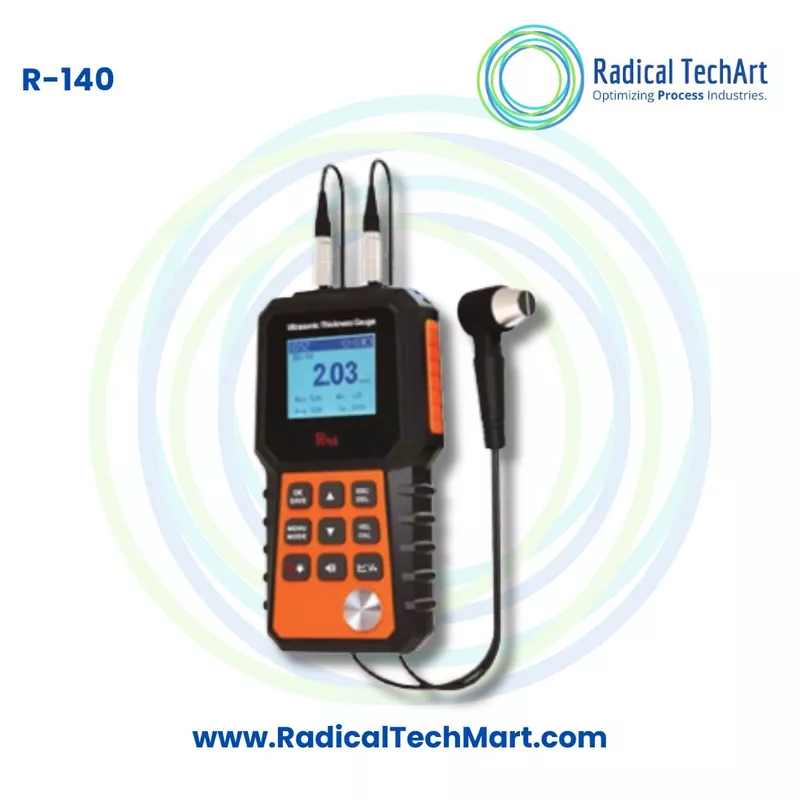
RK-140 Ultrasonic Thickness Gauge
The R-Tek RK-2000 Ultrasonic Thickness Gauge is a portable non destructive testing instrument designed to measure material thickness using ultrasonic technology. It provides a measuring range of 1.00 to 400.0 mm for steel, supports sound velocities from 1000 to 9999 m/s, and offers both single and continuous measurement modes. Its compact design, backlit LCD display, internal data storage and user calibration make it suitable for industrial inspection, maintenance and thickness monitoring applications.
Customize
Share :
A. Product Overview
The R-Tek RK-2000 Ultrasonic Thickness Gauge is designed for accurate thickness measurement where cutting or physically accessing both sides of a component is undesirable.
The instrument uses a 5 MHz ultrasonic frequency and provides a measurement range of 1.00 to 400.0 mm in steel. The sound velocity can be adjusted from 1000 to 9999 m/s, allowing the instrument to be configured according to the acoustic properties of the material being inspected.
The RK-2000 provides:
- Measurement range of 1.00 to 400.0 mm for steel
- 5 MHz operating frequency
- Sound velocity adjustment from 1000 to 9999 m/s
- Resolution of 0.01 mm below 100 mm
- Resolution of 0.1 mm from 100 mm onward
- Single measurement mode
- Continuous measurement mode
- Storage capacity for 100 groups of readings
- 4 mm user calibration mode
- 128 by 128 dot matrix LCD display with backlight
- Measurement in mm and inch
- Battery and USB Type-C power options
- Compact ABS housing
- IP40 protection class
The device measures approximately 135 by 72 by 27 mm and weighs about 127 g without batteries, making it convenient for portable field inspection.
B. Working Principle
The R-Tek RK-2000 works using the standard ultrasonic pulse echo thickness measurement principle.
An ultrasonic transducer sends a high frequency sound pulse into the material being tested. The ultrasonic wave travels through the material until it reaches the opposite surface or another material boundary. The wave is then reflected back toward the transducer.
The instrument measures the time required for the ultrasonic pulse to travel through the material and return. Since the velocity of sound in the material is known or entered into the instrument, the gauge can calculate the material thickness from the measured travel time.
In simplified form:
Thickness = Sound Velocity × Travel Time ÷ 2
Division by two is necessary because the ultrasonic pulse travels through the material once toward the opposite surface and once again while returning to the transducer.
Correct sound velocity selection and calibration are important because different materials transmit ultrasonic waves at different velocities.
C. Why is the R-Tek RK-2000 Ultrasonic Thickness Gauge Used?
The RK-2000 is useful when material thickness needs to be checked without cutting, drilling or damaging the component.
Ultrasonic thickness measurement is particularly valuable because measurements can normally be taken while having access to only one side of the object. This makes the technique useful for inspecting installed pipes, tanks and other industrial components.
Typical purposes include:
- Measuring remaining wall thickness
- Monitoring material thinning
- Checking corrosion or erosion
- Inspecting steel components
- Measuring pipe wall thickness
- Checking tanks and vessels
- Industrial maintenance inspection
- Preventive maintenance
- Quality control
- Fabrication inspection
- Comparing thickness at different locations
- Recording thickness values during periodic inspections
Ultrasonic thickness measurement is widely used for evaluating wall thinning in process equipment caused by corrosion and erosion.
D. Suitable Buyers
The R-Tek RK-2000 Ultrasonic Thickness Gauge can be suitable for buyers involved in industrial inspection, maintenance, manufacturing and quality assurance, including:
- NDT inspection companies
- Industrial maintenance departments
- Manufacturing plants
- Fabrication companies
- Pipeline maintenance companies
- Oil and gas facilities
- Chemical and process industries
- Tank inspection companies
- Engineering companies
- Quality control departments
- Testing laboratories
- Mechanical maintenance contractors
- Steel fabrication companies
- Boiler and pressure vessel maintenance teams
- Plant maintenance engineers
- Inspection engineers
- NDT technicians
- Service and maintenance contractors
Frequently Asked Questions
1. What is the R-Tek RK-2000 Ultrasonic Thickness Gauge?
The R-Tek RK-2000 is a portable ultrasonic instrument designed to measure material thickness using ultrasonic sound waves without physically cutting the material.
2. What is the measuring range of the RK-2000?
The manufacturer specifies a measurement range of 1.00 to 400.0 mm for steel.
3. What is the frequency of the R-Tek RK-2000?
The specified ultrasonic frequency is 5 MHz.
4. What is the resolution of the RK-2000?
For measurements up to 99.99 mm, the resolution is 0.01 mm. For measurements from 100 mm onward, the resolution is 0.1 mm.
5. Does the RK-2000 support different materials?
The instrument allows the sound velocity to be adjusted between 1000 and 9999 m/s. Since ultrasonic thickness calculations depend on the sound velocity of the material, this adjustment is relevant when configuring an ultrasonic gauge for different compatible materials. The R-Tek page specifically states the measurement range for steel.
6. Can the RK-2000 measure pipe thickness?
Ultrasonic thickness gauges are commonly used for wall thickness measurement of pipes and similar industrial components where access is available from only one side. Suitability for a particular pipe diameter, material and surface condition should be confirmed for the application.
7. Can it be used for corrosion inspection?
Ultrasonic thickness measurement is commonly used to identify and monitor material thinning caused by corrosion and erosion.
8. Does the RK-2000 have continuous measurement?
Yes. The RK-2000 provides both single measurement and continuous measurement modes. The specified reaction time is approximately 0.5 seconds for single measurement and 0.3 seconds for continuous measurement.
9. Can the RK-2000 store readings?
Yes. The manufacturer specifies storage capacity for 100 groups of values.
10. What units can the RK-2000 display?
The instrument supports measurements in millimetres and inches.
11. Does the RK-2000 have a backlit display?
Yes. It has a 128 by 128 dot matrix LCD screen with backlight.
12. How is the RK-2000 powered?
It can operate using three AAA 1.5 V alkaline batteries or a 5 V, 2 A USB Type-C power connection.
13. Is ultrasonic thickness measurement destructive?
No. Ultrasonic thickness gauging is a non destructive testing method, meaning thickness can generally be measured without cutting or sectioning the component.
14. Why is calibration important in ultrasonic thickness measurement?
Thickness calculation depends on the velocity of sound through the material. Different materials have different sound velocities, so correct calibration or velocity selection is important for obtaining accurate readings.