

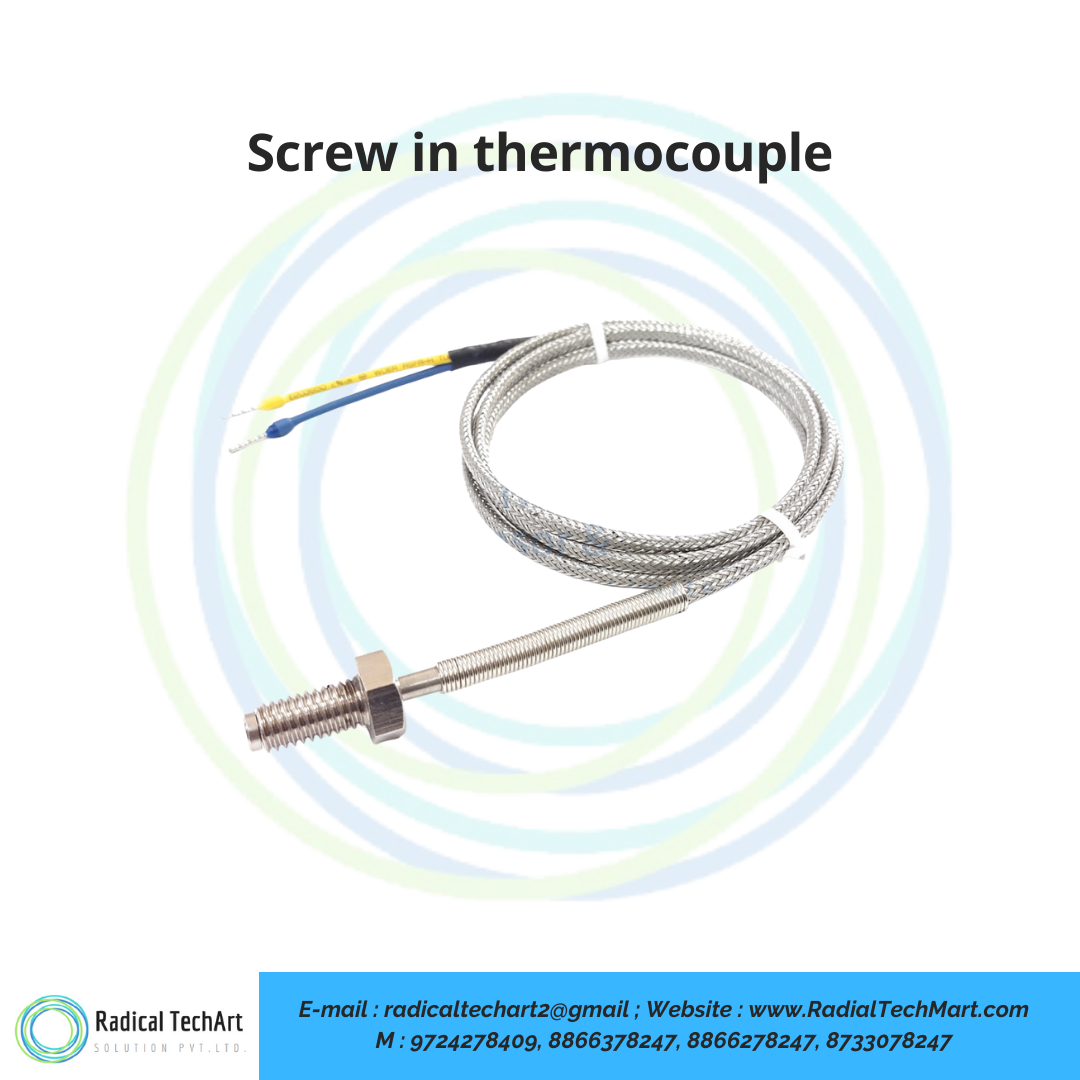
Screw In Thermocouple Sensor for Industrial Temperature Measurement
Screw In Thermocouple is a bolt-type temperature sensor designed for fixed temperature measurement on machinery, engines, turbines, heating equipment and industrial surfaces. It can be directly screwed, bolted or clamped at the required measuring point and is available in K type and J type options with different thread sizes, wire lengths and junction types.
Customize
Share :
A. Product Overview
Screw In Thermocouple is an industrial temperature sensor used where temperature needs to be measured at a fixed location. It is also known as a bolt type thermocouple because it can be mounted directly onto a machine surface, engine body, turbine casing, heating plate or process equipment.
The sensor is made with a thermocouple element inside a protective sheath or probe. The threaded portion helps in secure installation and better contact with the measurement surface. This design makes it suitable for continuous temperature monitoring in industrial machinery and high-temperature applications.
Typical specifications include:
Type: K and J
Temperature Range: 35 to 500 °C
Thread Options: M6, M8, M10, 1/4 BSW and custom options
Thread Material: Brass and Stainless Steel
Wire Length: 0.5 meter to 10 meter
Junction Type: Grounded and Ungrounded
B. Working Principle
A screw in thermocouple works on the thermoelectric principle. It contains two different metal wires joined at one sensing point. When this sensing point is exposed to heat, it generates a small voltage signal according to the temperature.
This voltage signal is sent to a temperature controller, indicator, PLC or data logger. The connected instrument converts this signal into a temperature reading.
In a screw in thermocouple, the threaded body keeps the sensor fixed at the required location. This helps maintain stable contact with the surface and provides consistent temperature measurement during machine operation.
C. Why It Is Used
Screw In Thermocouple is used when the temperature needs to be measured from a fixed point on equipment or machinery. It is preferred in applications where the sensor should not move during vibration, heating or continuous machine operation.
Key reasons for using this sensor:
It provides stable temperature measurement at a fixed location.
It is easy to install using threaded mounting.
It gives better contact with the machine surface.
It is suitable for engines, turbines, machinery and heating equipment.
It can be used for continuous temperature monitoring.
It is available in different thread sizes and wire lengths.
It can be supplied in grounded and ungrounded junction options.
It helps improve process safety, machine protection and temperature control.
It is suitable for harsh industrial environments depending on sheath and thread material.
D. Suitable Buyers
This product is suitable for:
Machinery manufacturers
Engine manufacturers
Turbine maintenance teams
Automotive industries
Aerospace industries
Industrial manufacturing plants
Heating equipment manufacturers
Plastic machinery users
OEM machine builders
Maintenance engineers
Automation panel builders
Temperature controller users
Process industries
Industrial sensor dealers
Thermocouple suppliers and traders
FAQ
1. What is a Screw In Thermocouple?
A Screw In Thermocouple is a temperature sensor with a threaded body that is mounted directly onto machinery, engines, turbines or industrial equipment for fixed temperature measurement.
2. Where is a screw in thermocouple used?
It is used in engines, turbines, heating equipment, industrial machinery, automotive systems, aerospace equipment, plastic machinery and manufacturing plants.
3. What is the temperature range of this thermocouple?
The typical temperature range is 35 to 500 °C, depending on the thermocouple type, material and application condition.
4. Which thermocouple types are available?
This product is commonly available in K type and J type options.
5. What thread sizes are available?
Common thread options include M6, M8, M10 and 1/4 BSW. Custom thread sizes can also be provided as per requirement.
6. What is the thread material?
The thread material is available in brass and stainless steel, depending on the application and temperature requirement.
7. What is the benefit of threaded mounting?
Threaded mounting gives secure fitting, better surface contact and stable temperature measurement, especially in machines where vibration or movement is present.
8. What is the difference between grounded and ungrounded junction?
A grounded junction gives faster response because the sensing element is connected to the sheath. An ungrounded junction provides better electrical isolation and is suitable where electrical noise may affect the reading.
9. Can wire length be customized?
Yes, wire length can be supplied from 0.5 meter to 10 meter or as per application requirement.
10. How do I select the right screw in thermocouple?
To select the right screw in thermocouple, check the required temperature range, thermocouple type, thread size, thread material, wire length, junction type and installation location.
11. Is this thermocouple suitable for machinery temperature monitoring?
Yes, it is suitable for fixed temperature monitoring in machinery, engines, turbines and industrial equipment where stable and reliable temperature measurement is required.
12. Can this sensor be connected to a temperature controller?
Yes, it can be connected to a temperature controller, digital indicator, PLC or data logger for temperature display, monitoring and control.