

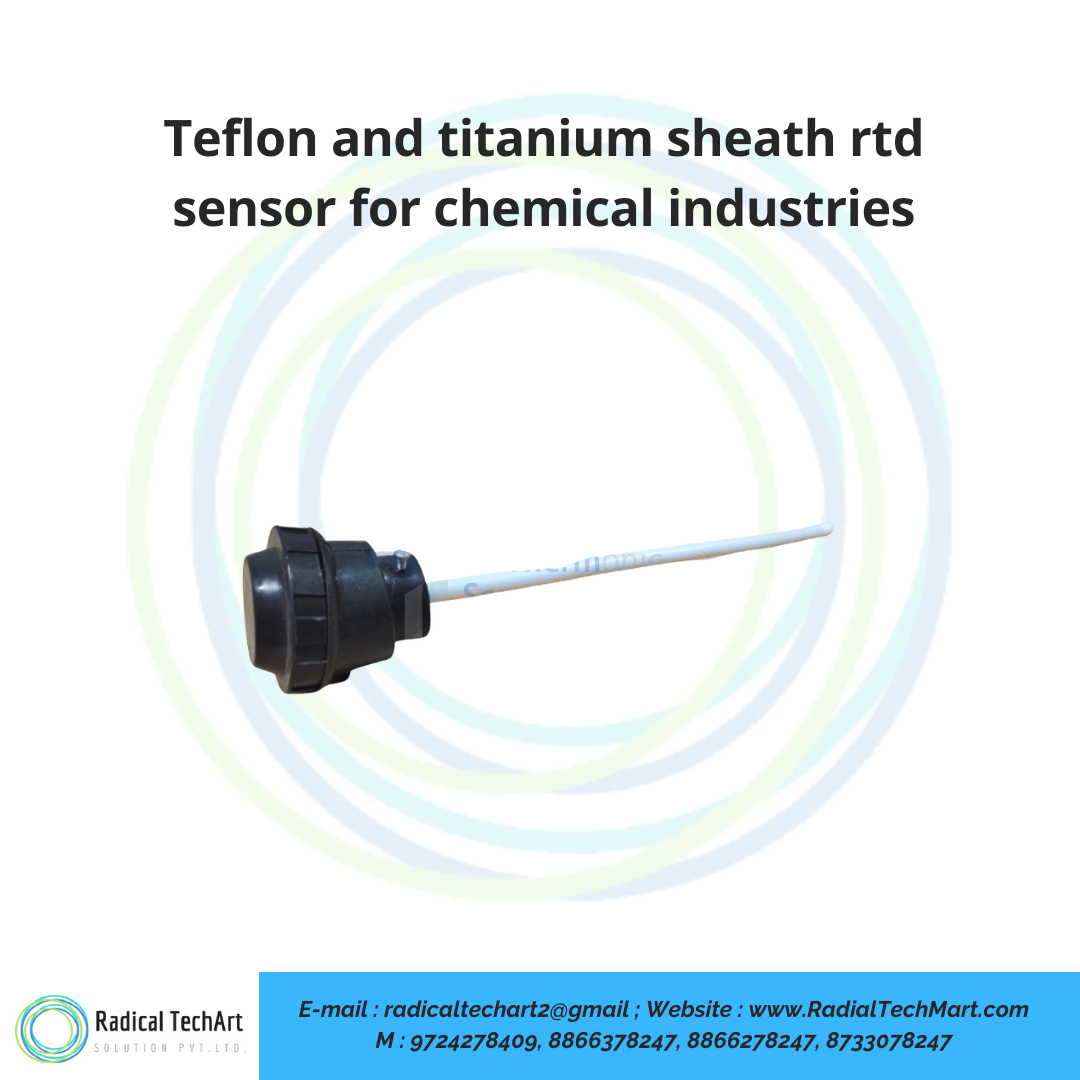
Teflon and Titanium Sheath Pt100 RTD Sensor for Chemical Industries
Teflon and Titanium Sheath RTD Sensor is designed for accurate temperature measurement in chemical, petrochemical, marine and offshore industries. It is suitable for corrosive chemicals, saltwater and harsh process environments where standard temperature sensors may fail due to corrosion or chemical attack.
Customize
Share :
A. Product Overview
Teflon and Titanium Sheath RTD Sensor is a Resistance Temperature Detector used for temperature measurement in corrosive and harsh industrial environments. It is mainly used in chemical industries where the sensor comes in contact with acids, alkalis, aggressive chemicals, saltwater or other corrosive media.
This sensor is available in Pt100 Simplex and Duplex options. It can be supplied with Teflon sheath or Titanium sheath depending on the application requirement. Teflon provides excellent chemical resistance, while Titanium provides strong corrosion resistance in saltwater, marine, offshore and chemical processing applications.
The sensor is suitable for temperature ranges from -50 to 400°C and is commonly available in probe lengths such as 100 mm, 150 mm, 200 mm, 250 mm and 300 mm. With Class A accuracy as per IEC-60751, it provides stable and reliable temperature readings in demanding process conditions.
B. Working Principle
The Teflon and Titanium Sheath RTD Sensor works on the RTD principle. RTD stands for Resistance Temperature Detector.
Inside the sensor, there is a platinum sensing element, commonly Pt100 or Pt1000. In a Pt100 sensor, the resistance is 100 ohms at 0°C. When the temperature changes, the resistance of the platinum element also changes in a predictable manner.
The measuring instrument, temperature controller or transmitter reads this change in resistance and converts it into a temperature value. The outer Teflon or Titanium sheath protects the sensing element from corrosive chemicals, harsh media and environmental damage while allowing accurate temperature measurement.
C. Why It Is Used
This sensor is used because chemical and corrosive environments can damage normal stainless steel temperature sensors. In such applications, the sensor needs special protection to maintain accuracy and long service life.
Teflon sheath RTD sensors are used where the process contains corrosive chemicals, acids, alkalis and aggressive liquids. Teflon coating helps protect the sensor from chemical attack and improves sensor life.
Titanium sheath RTD sensors are used where the process involves saltwater, seawater, marine environments, offshore equipment or highly corrosive chemical media. Titanium provides excellent corrosion resistance and is suitable for applications where stainless steel may not perform well.
It is used when the buyer needs accurate temperature measurement, corrosion resistance, chemical resistance and reliable performance in harsh process conditions.
D. Suitable Buyers
This product is suitable for:
Chemical industries
Petrochemical plants
Pharmaceutical process plants
Acid and alkali processing units
Marine industries
Offshore industries
Wastewater treatment plants
Saltwater treatment systems
Chemical storage tank manufacturers
Process equipment manufacturers
Industrial automation suppliers
Maintenance and utility departments
Temperature control system integrators
OEMs making chemical process machines
Industries handling corrosive liquids and gases
FAQ
1. What is a Teflon and Titanium Sheath RTD Sensor?
A Teflon and Titanium Sheath RTD Sensor is a temperature sensor designed for corrosive and harsh environments. It uses a platinum RTD element for temperature measurement and a Teflon or Titanium sheath for protection against chemicals and corrosion.
2. Where is this RTD sensor used?
This RTD sensor is used in chemical industries, petrochemical plants, marine applications, offshore equipment, wastewater treatment plants, acid tanks, alkali tanks and corrosive process systems.
3. Why is Teflon sheath used in RTD sensors?
Teflon sheath is used because it provides strong resistance against corrosive chemicals, acids, alkalis and aggressive process media. It helps protect the RTD sensor and improves sensor life in chemical applications.
4. Why is Titanium sheath used in RTD sensors?
Titanium sheath is used where strong corrosion resistance is required. It is suitable for saltwater, seawater, marine, offshore and chemical processing applications.
5. What is the temperature range of this sensor?
The temperature range is generally -50 to 400°C, depending on the design and application requirement.
6. What type of RTD element is used in this sensor?
This sensor commonly uses Pt100 or Pt1000 platinum sensing elements. Pt100 is the most commonly used RTD element for industrial temperature measurement.
7. Is this sensor suitable for acid and alkali applications?
Yes, the Teflon sheath version is suitable for acid and alkali applications because Teflon provides excellent chemical resistance.
8. Is this sensor suitable for marine and offshore applications?
Yes, the Titanium sheath version is suitable for marine and offshore applications because Titanium provides strong resistance against saltwater and corrosive environments.
9. What is the accuracy of this RTD sensor?
This sensor is available with Class A accuracy as per IEC-60751, which makes it suitable for reliable industrial temperature measurement.
10. Who should buy this sensor?
This sensor is suitable for buyers from chemical plants, petrochemical industries, marine industries, offshore plants, wastewater treatment facilities, OEMs, system integrators and maintenance teams who need a corrosion-resistant temperature sensor.