

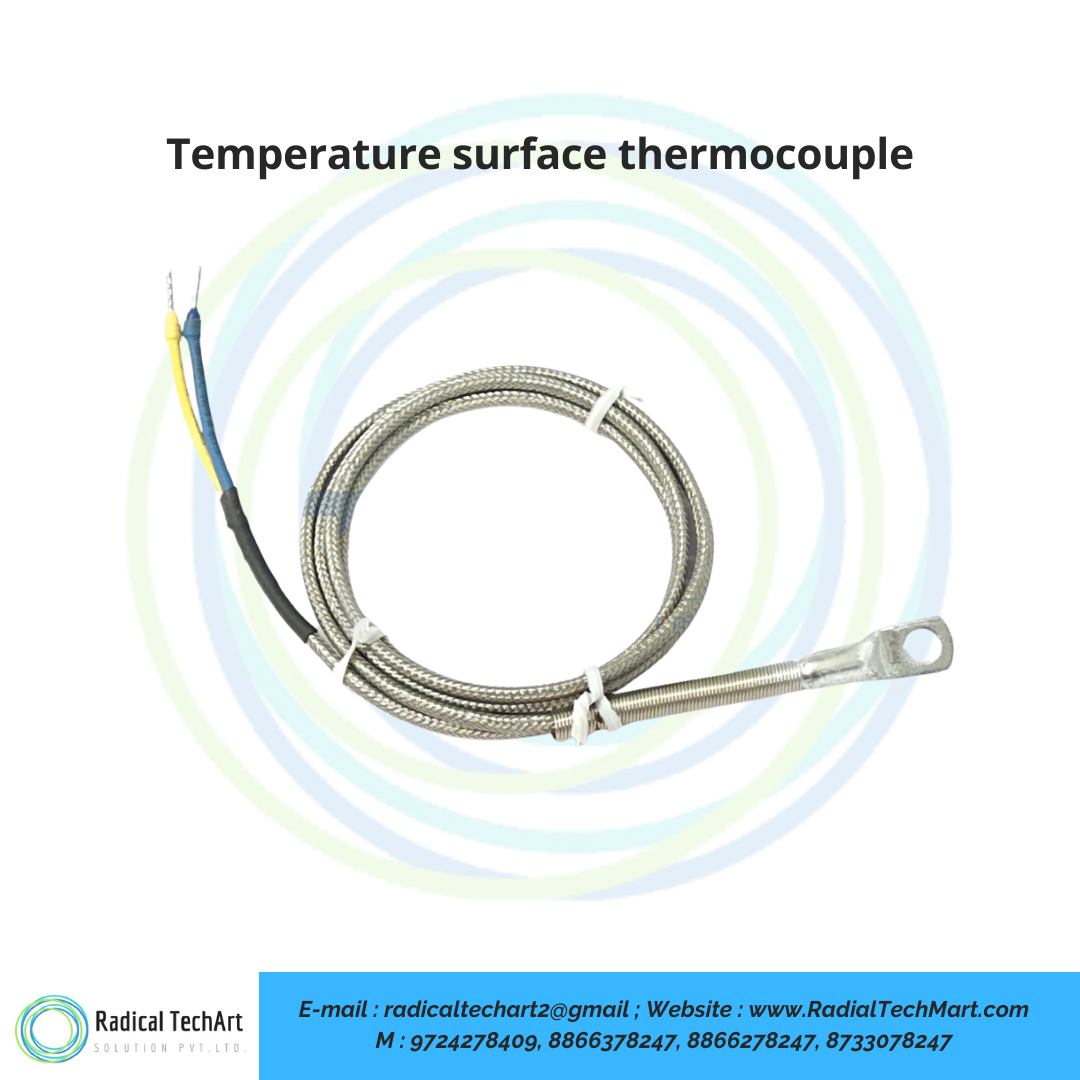


Temperature Surface Thermocouple Sensors
Temperature Surface Thermocouple is a contact-type temperature sensor used for measuring surface temperature of machinery, equipment, pipes, heaters, motors, panels and industrial components. It is available in Type E, Type J, Type K, Type T and RTD Pt100 options, with a temperature range of minus 50°C to 500°C, ring inner diameter from 3 mm to 10 mm and wire length from 0.5 meter to 10 meter.
Customize
Share :
A. Product Overview
Temperature Surface Thermocouple is a contact-type temperature sensor designed to measure the temperature of flat, curved or equipment surfaces. It is commonly used in industrial applications where the sensor needs to be placed directly on the surface instead of being inserted inside the process.
This sensor is available in different thermocouple and RTD types such as Type E, Type J, Type K, Type T and RTD Pt100. It supports a temperature range of -50 to 500°C, making it suitable for many machinery, heating, process and maintenance applications.
The probe material is nickel-plated copper, which helps provide good surface contact and better thermal conductivity. The ring ID is available from 3 mm to 10 mm, and the wire length can be supplied from 0.5 meter to 10 meter based on installation requirement. The junction can be selected as grounded or ungrounded depending on response time and electrical isolation needs.
B. Working Principle
Temperature Surface Thermocouple works on the thermocouple principle. When two different metal wires are joined at one end and that junction comes in contact with a heated surface, a small voltage is generated. This voltage changes according to the surface temperature.
The thermocouple signal is then connected to a temperature indicator, controller, transmitter, scanner or data logger. The instrument converts the millivolt signal into a readable temperature value.
In RTD Pt100 versions, the sensor works on resistance change. The resistance of the platinum element changes with temperature, and the connected instrument converts this resistance into a temperature reading.
For proper measurement, the sensing tip or ring surface must remain in good contact with the machine or equipment surface. Better contact gives faster and more accurate temperature response.
C. Why It Is Used
Temperature Surface Thermocouple is used when direct surface temperature measurement is required without drilling, immersion or process modification.
It is used to monitor overheating in machines, motors, heaters and industrial equipment. It helps detect abnormal temperature rise, which can indicate bearing failure, heater malfunction, poor heat transfer, loose electrical connections or process problems.
It is also useful for temporary inspection and troubleshooting because it can be installed and removed easily. Depending on the design, it can be mounted using ring type fixing, clamps, adhesive, magnets or other surface contact methods.
This sensor is preferred because it is simple, cost-effective, easy to install and suitable for many industrial temperature monitoring applications.
D. Suitable Buyers
Temperature Surface Thermocouple is suitable for:
Industrial machinery manufacturers who need surface temperature monitoring in their machines.
Maintenance teams who want to check overheating in motors, bearings, heaters, panels and rotating equipment.
Process industries that need surface temperature sensing on pipes, tanks, vessels, moulds and heating systems.
OEMs who require customized temperature sensors for machine integration.
Panel builders and automation system integrators who need thermocouple or RTD inputs for controllers, indicators and PLC systems.
HVAC, plastic, packaging, textile, furnace, food processing and general manufacturing industries where surface temperature monitoring is important.
Technical Specifications
Type: E, J, K, T and RTD Pt100
Temperature Range: -50 to 500°C
Ring ID: 3 mm to 10 mm
Probe Material: Nickel-plated copper
Wire Length: 0.5 meter to 10 meter
Junction: Grounded and ungrounded
FAQ
1. What is a Temperature Surface Thermocouple?
A Temperature Surface Thermocouple is a temperature sensor used to measure the temperature of machinery, equipment, pipes, heaters and other surfaces by direct contact.
2. Where is a surface thermocouple used?
It is used in industrial machinery, heaters, motors, pipes, moulds, ovens, packaging machines, HVAC equipment and process plants for surface temperature measurement.
3. What temperature range does this sensor support?
This sensor supports a temperature range of -50 to 500°C, depending on the sensor type, wire insulation and application condition.
4. Which sensor types are available?
It is available in Type E, Type J, Type K, Type T and RTD Pt100 options.
5. What is the probe material?
The probe material is nickel-plated copper, which provides good thermal conductivity and proper surface contact.
6. What ring ID options are available?
The ring ID is available from 3 mm to 10 mm, depending on the mounting and application requirement.
7. What wire length can be provided?
Wire length can be supplied from 0.5 meter to 10 meter as per installation requirement.
8. What is the difference between grounded and ungrounded junction?
A grounded junction gives faster response because the sensing junction is connected to the probe body. An ungrounded junction provides better electrical isolation and is useful where electrical noise may affect the reading.
9. Can this sensor be used for temporary temperature checking?
Yes, surface thermocouples are suitable for temporary, portable and maintenance-based temperature monitoring because they are easy to install and remove.
10. Can this sensor be connected to a temperature controller?
Yes, it can be connected to a compatible temperature controller, indicator, transmitter, scanner, PLC input module or data logger.
11. Is this sensor suitable for machinery overheating detection?
Yes, it is commonly used to detect overheating in machines, motors, bearings, heaters and industrial equipment.
12. Can the sensor be customized?
Yes, the sensor can be customized based on thermocouple type, RTD type, wire length, ring ID, junction type and mounting requirement.