

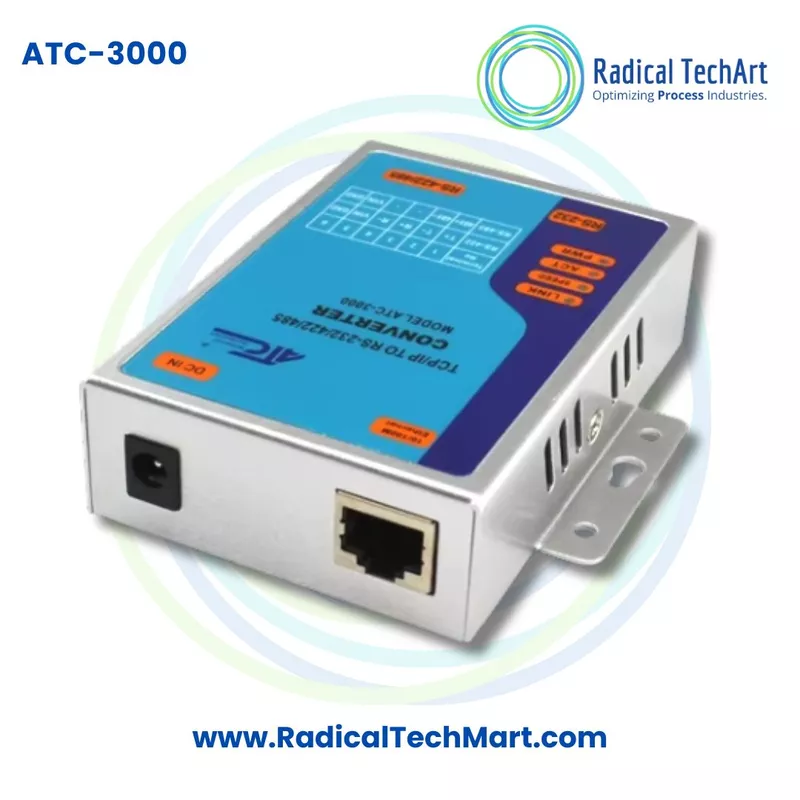


ATC-3000 Industrial Ethernet to RS232 RS485 RS422 Serial Device Server
Customize
Share :
A. Product Overview
The ATC-3000 Serial-to-Ethernet Device Server is designed to integrate conventional serial communication devices with modern Ethernet networks. It converts serial data from RS232, RS422 or RS485 equipment into Ethernet-based TCP or UDP communication, allowing serial devices to be accessed through a local network or remote network connection.
The converter provides one serial communication port with selectable RS232, RS422 and RS485 interfaces. It includes a 10 and 100 Mbps auto-sensing Ethernet port and supports serial transmission speeds from 300 bps up to 460.8 Kbps.
The ATC-3000 can be configured through a web page, Windows utility or Telnet connection. It supports Virtual COM, TCP Server, TCP Client and UDP operating modes, allowing it to work with different industrial communication architectures.
Its metal housing, DIN-rail mounting arrangement, wide 9 to 32 VDC power input, built-in watchdog and industrial operating temperature range make it suitable for continuous operation in control panels, machines and industrial installations.
Main Features
- RS232, RS422 and RS485 three-in-one serial interface
- 10 and 100 Mbps auto-sensing Ethernet communication
- Serial data rate from 300 bps to 460.8 Kbps
- Two-wire and four-wire RS485 communication
- Automatic RS485 data-direction control
- Virtual serial port operation
- TCP Server, TCP Client and UDP modes
- Configuration through web page, Windows utility and Telnet
- Wide 9 to 32 VDC power input
- Built-in watchdog
- 1.5 kV Ethernet isolation protection
- Serial-line protection for RS232, RS422 and RS485
- DIN-rail mounting
- Industrial metal enclosure
- Operating temperature from minus 25 to 70 degrees Celsius
- CE, RoHS and FCC certifications
B. Working Principle
The ATC-3000 acts as a communication bridge between a serial device and an Ethernet network.
A PLC, HMI, meter, barcode scanner, access controller or other field device is connected to the ATC-3000 through its RS232, RS422 or RS485 interface. The ATC-3000 receives serial data from the connected device and converts it into Ethernet-compatible TCP or UDP data packets.
These packets are transmitted through the RJ45 Ethernet port to a computer, server, SCADA system, monitoring platform or another network-connected device.
When information is sent back from the Ethernet network, the ATC-3000 converts the network data into the selected serial communication format and transfers it to the connected field device.
The operating mode can be selected according to the application:
Virtual COM Mode:
Creates a virtual serial port on a computer, allowing existing serial communication software to communicate with the remote device through Ethernet.
TCP Server Mode:
The ATC-3000 waits for a network client, such as a computer or monitoring system, to establish a connection.
TCP Client Mode:
The ATC-3000 automatically establishes a connection with a predefined network server.
UDP Mode:
Transfers data without maintaining a continuous connection, making it suitable for fast and lightweight communication applications.
For RS485 communication, the converter provides automatic data-direction control, eliminating the need for manual switching between transmit and receive modes.
C. Why It Is Used
The ATC-3000 is used when an existing serial communication device needs to be connected to an Ethernet network without replacing the original equipment.
Traditional RS232 communication is generally designed for short-distance, point-to-point connections. RS422 and RS485 support longer communication distances, but they still require dedicated serial wiring. The ATC-3000 allows these serial connections to be extended through an existing Ethernet network.
It is commonly used for the following purposes:
- Connecting legacy serial equipment to modern Ethernet networks
- Remotely accessing PLCs, HMIs, controllers and meters
- Extending serial communication beyond conventional cable limitations
- Centralising data collection from machines and field instruments
- Connecting industrial devices to SCADA or monitoring software
- Reducing dedicated serial cable requirements
- Integrating serial equipment into factory automation networks
- Enabling remote equipment configuration and diagnostics
- Creating network access for barcode scanners and access-control systems
- Connecting serial instruments installed in different plant locations
- Retaining existing serial equipment during network modernisation
- Supporting machine builders that require Ethernet-enabled equipment
The built-in watchdog helps improve operating reliability by monitoring internal operation and supporting recovery if communication becomes unresponsive.
D. Suitable Buyers
The ATC-3000 is suitable for organisations and professionals working with industrial communication, automation and remote monitoring systems.
Industrial Automation Companies
Automation companies can use the converter to connect serial PLCs, HMIs, controllers and field instruments to Ethernet-based factory networks.
System Integrators
System integrators can use the ATC-3000 for SCADA integration, remote data acquisition, machine networking and serial device connectivity.
Panel Builders
Electrical and automation panel builders can install the DIN-rail-mounted converter inside control panels to provide Ethernet connectivity for serial devices.
Machine Manufacturers and OEMs
Original equipment manufacturers can integrate the ATC-3000 into machines that contain serial controllers, displays, scanners or instruments.
Manufacturing Plants
Production facilities can use it to connect existing RS232, RS422 and RS485 equipment to a central monitoring or data-collection system.
Energy and Utility Companies
The converter can be used to network serial energy meters, monitoring instruments and control equipment.
Building Automation Companies
Building-management integrators can use it for connecting serial access controllers, monitoring devices and automation equipment to Ethernet infrastructure.
Water and Wastewater Plants
Treatment facilities can use the converter to integrate serial controllers, indicators, analysers and remote monitoring equipment.
Laboratories and Testing Facilities
Laboratories can use it to provide network access to serial instruments, test equipment and data-acquisition devices.
Maintenance and Engineering Teams
Maintenance teams can use the converter for remote troubleshooting, device monitoring and access to serial equipment from a network-connected computer.
FAQs
1. What is the ATC-3000?
The ATC-3000 is a serial-to-Ethernet device server that connects RS232, RS422 and RS485 devices to a TCP or IP Ethernet network.
2. Which serial interfaces are supported by the ATC-3000?
The ATC-3000 supports RS232, RS422 and RS485 serial communication interfaces.
3. Does the ATC-3000 support Ethernet communication?
Yes. It includes a 10 and 100 Mbps auto-sensing Ethernet interface with an RJ45 connector.
4. What is the serial communication speed of the ATC-3000?
The supported serial data rate ranges from 300 bps to 460.8 Kbps.
5. What operating modes are available?
The ATC-3000 supports Virtual COM, TCP Server, TCP Client and UDP operating modes.
6. Can the ATC-3000 be configured remotely?
Yes. It can be configured through a web page, Windows utility or Telnet connection over the Ethernet network.
7. Can it be used with an existing serial communication program?
Yes. Virtual COM mode allows compatible computer software to communicate with a remote serial device through a virtual serial port.
8. Does the ATC-3000 support two-wire RS485?
Yes. It supports both two-wire and four-wire RS485 operating modes.
9. Does it provide automatic RS485 direction control?
Yes. Automatic data-direction control manages transmission and reception on the RS485 interface.
10. What power supply is required?
The ATC-3000 operates on a 9 to 32 VDC power supply rated at up to 1 ampere.
11. Can it operate with a 24 VDC industrial power supply?
Yes. Its wide DC input range supports standard 24 VDC industrial control-panel power supplies.
12. Is the ATC-3000 suitable for DIN-rail mounting?
Yes. The device is designed for DIN-rail installation inside industrial control panels and equipment enclosures.
13. What type of enclosure does it have?
The ATC-3000 uses an iron metal housing designed for industrial installation.
14. What is its operating temperature range?
It is specified for operation from minus 25 to 70 degrees Celsius.
15. Does the converter provide electrical protection?
Yes. The Ethernet interface includes built-in 1.5 kV isolation protection. The serial interfaces also include line-protection provisions for RS232, RS422 and RS485 communication.
16. What devices can be connected to the ATC-3000?
It can be used with PLCs, HMIs, barcode scanners, access controllers, meters, displays, serial controllers, industrial instruments and other compatible serial devices.
17. Can it be used for remote PLC communication?
Yes. A compatible PLC with an RS232, RS422 or RS485 port can be connected to an Ethernet network through the ATC-3000.
18. Can multiple ATC-3000 units be installed on the same network?
Yes. Multiple units can be assigned separate network settings and used to connect serial devices located at different points on the network.
19. Does it require replacement of the connected serial device?
No. The main purpose of the ATC-3000 is to add Ethernet connectivity to compatible existing serial devices without replacing them.
20. Is the ATC-3000 suitable for industrial automation?
Yes. Its wide power input, DIN-rail installation, metal housing, watchdog, protection features and broad operating temperature range make it suitable for industrial automation environments.
21. What certifications does the ATC-3000 have?
The product documentation lists CE, RoHS and FCC certifications.