

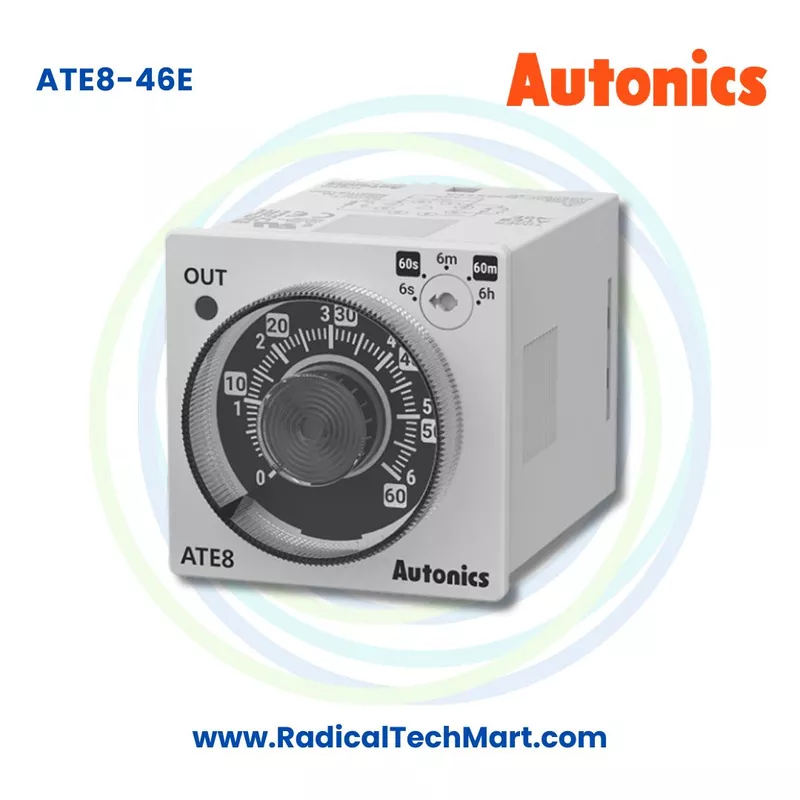
Autonics ATE8-46E 8 Pin Analog Timer
The Autonics PRD12-4 Series is a long sensing distance M12 inductive proximity sensor range designed for non contact detection of metallic objects in industrial automation applications. With a 4 mm sensing distance, 12 to 24 VDC operation, NPN or PNP output options, and normally open or normally closed switching configurations depending on the model, the PRD12-4 Series is suitable for machine positioning, metal detection, conveyor systems, production equipment, and factory automation.
Customize
Share :
A. Product Overview
The Autonics PRD12-4 Series is a range of cylindrical inductive proximity sensors developed for applications requiring a longer sensing distance from a compact M12 sensor body.
These sensors detect metallic objects without requiring physical contact between the sensor and target. The 4 mm sensing distance provides increased clearance compared with many conventional M12 inductive sensors.
The PRD12-4 Series includes different output configurations, allowing machine designers and automation engineers to select a sensor compatible with their control system.
Main Models
PRD12-4DN
M12 inductive proximity sensor
Sensing distance: 4 mm
Output: NPN
Operation: Normally open
PRD12-4DN2
M12 inductive proximity sensor
Sensing distance: 4 mm
Output: NPN
Operation: Normally closed
PRD12-4DP2
M12 inductive proximity sensor
Sensing distance: 4 mm
Output: PNP
Operation: Normally closed
Key Features
Series: PRD12-4
Sensor type: Inductive proximity sensor
Body size: M12 cylindrical
Sensing distance: 4 mm
Long sensing distance design
Power supply: 12 to 24 VDC
NPN and PNP model options
Normally open and normally closed model options
Non contact metallic object detection
Compact threaded cylindrical construction
Suitable for industrial automation
Suitable for PLC controlled machinery
IP67 protection
Designed for repetitive industrial sensing
B. Working Principle
The Autonics PRD12-4 Series works according to the inductive proximity sensing principle.
An electromagnetic field is generated at the sensing face of the sensor. When a metallic object approaches the sensing area, the metal interacts with this electromagnetic field.
The internal electronics detect this change and switch the sensor output.
The basic operating process is:
The sensor receives a 12 to 24 VDC power supply.
An electromagnetic field is generated from the sensing surface.
When no metallic object is present, the sensor remains in its normal output condition.
A metal target approaches the sensing face.
Eddy currents are generated in the metallic target.
These currents affect the electromagnetic field of the sensor.
The internal circuit detects the change.
The NPN or PNP transistor output switches according to the selected model.
The output signal is sent to a PLC, relay, counter, controller, or other automation equipment.
When the target moves away, the sensor returns to its original switching state.
Because the sensor does not physically touch the target, it can provide reliable repetitive detection with very little mechanical wear.
C. Why Is the Autonics PRD12-4 Series Used?
The PRD12-4 Series is used where industrial machines need reliable metal detection from an M12 proximity sensor while maintaining a relatively long 4 mm sensing distance.
Common Applications
The PRD12-4 Series can be used for:
Metal object detection
Machine position detection
Component presence sensing
Conveyor monitoring
Production line automation
Machine limit detection
Gear position sensing
Metal plate detection
Assembly line automation
Packaging machinery
Material handling systems
Machine tools
Automatic production equipment
Position confirmation
Counting metallic components
Industrial interlocking
Robotic machinery
Factory automation
Manufacturing equipment
Why Is Long Distance Detection Useful?
A longer sensing distance allows additional clearance between the sensor and metallic target.
This can help when:
The target cannot move extremely close to the sensor
Mechanical vibration is present
Additional installation clearance is required
Sensor contact with moving components must be avoided
Machine alignment cannot always remain extremely precise
A compact M12 body is required but greater sensing distance is preferred
Why Use an Inductive Sensor?
Inductive sensing is particularly suitable for industrial metal detection because it does not depend on mechanical contact with the target.
Benefits include:
Non contact operation
Reduced mechanical wear
Fast repetitive detection
Long service life
Reliable metal detection
Easy PLC integration
Reduced maintenance compared with mechanical switches
D. Suitable Buyers
The Autonics PRD12-4 Series is suitable for industrial users who require compact long distance proximity sensors for detecting metallic targets.
Typical buyers include:
Industrial automation companies
Machine manufacturers
Original equipment manufacturers
System integrators
PLC automation companies
Control panel manufacturers
Electrical panel builders
Conveyor manufacturers
Packaging machinery manufacturers
Material handling companies
Machine tool manufacturers
Automobile component manufacturers
Metal processing industries
Pharmaceutical machinery manufacturers
Food processing machinery manufacturers
Assembly line manufacturers
Manufacturing plants
Factory automation companies
Industrial maintenance departments
Automation engineers
Electrical engineers
Maintenance engineers
Machine designers
Production engineers
Industrial spare parts suppliers
Frequently Asked Questions
1. What is the Autonics PRD12-4 Series?
The Autonics PRD12-4 Series is a range of M12 cylindrical inductive proximity sensors designed for long distance non contact detection of metallic objects.
2. What is the sensing distance of the PRD12-4 Series?
The rated sensing distance is 4 mm.
3. Why is PRD12-4 called a long distance proximity sensor?
The series provides a 4 mm sensing distance from a compact M12 cylindrical sensor body, offering greater detection distance than many conventional M12 inductive proximity sensors.
4. What is the body size of the PRD12-4 Series?
The series uses an M12 threaded cylindrical body.
5. What does the PRD12-4 Series detect?
It is designed primarily for detecting metallic objects.
6. Can the PRD12-4 Series detect plastic?
Inductive proximity sensors are primarily designed for metallic targets. Plastic normally requires another sensing technology such as a photoelectric or capacitive sensor.
7. Can PRD12-4 sensors detect aluminium?
Yes. Aluminium is metallic and can be detected by an inductive sensor, although the actual sensing distance can differ from the sensing distance obtained with a standard iron target.
8. Can PRD12-4 sensors detect stainless steel?
Yes. Many stainless steel targets can be detected, although the effective sensing distance may differ depending on the material and target dimensions.
9. What power supply is required?
The PRD12-4 Series operates from a 12 to 24 VDC power supply.
10. What is the difference between PRD12-4DN and PRD12-4DN2?
The PRD12-4DN uses an NPN normally open output.
The PRD12-4DN2 uses an NPN normally closed output.
11. What is the difference between PRD12-4DN2 and PRD12-4DP2?
The PRD12-4DN2 provides an NPN normally closed output, while the PRD12-4DP2 provides a PNP normally closed output.
12. Which PRD12-4 model has NPN normally open output?
The PRD12-4DN provides NPN normally open switching.
13. Which PRD12-4 model has NPN normally closed output?
The PRD12-4DN2 provides NPN normally closed switching.
14. Which PRD12-4 model has PNP normally closed output?
The PRD12-4DP2 provides PNP normally closed switching.
15. What does NPN mean in a proximity sensor?
An NPN proximity sensor switches its output toward the negative side of the DC supply when activated. It should be used with a compatible control input.