

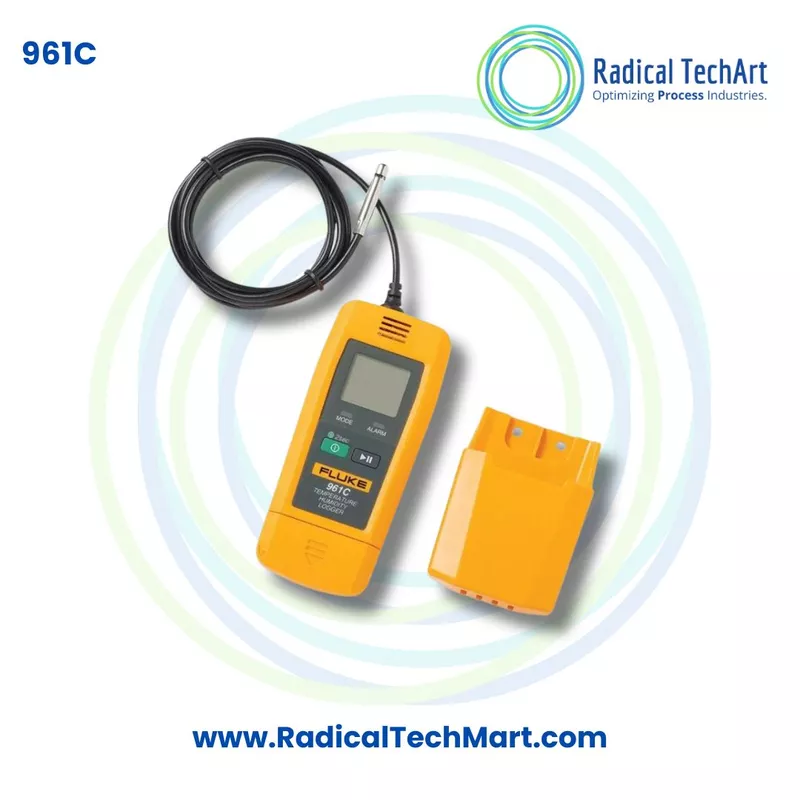


Fluke 961C Temperature and Humidity Data Logger with External Probe
Customize
Share :
A. Product Overview
The Fluke 961C is a battery-powered temperature and humidity data logger developed for continuous environmental monitoring. Unlike the Fluke 961A, which uses a built-in sensor, the 961C uses an external digital temperature and humidity sensor, allowing measurements to be taken inside storage chambers, packages, refrigerators or other enclosed areas while the logger remains accessible outside.
The logger has a large LCD screen that displays current temperature, relative humidity, minimum and maximum values, logging status, alarm status, battery level, date, time and the number of stored readings. Measurement data can be viewed directly on the display without connecting the logger to a computer.
The Fluke 961C can store up to 32,000 sets of temperature and humidity readings. Users can configure logging intervals from 10 seconds to 24 hours, making it suitable for both rapid monitoring and long-duration recording.
Its direct USB connection enables users to connect the logger to a computer and access an automatically generated PDF report without installing software. FlukeLog software can also be used for parameter configuration, data analysis, historical record management and exporting reports in PDF, Excel and TXT formats.
Main Features
- External digital temperature and humidity sensor
- Temperature measurement range from minus 40 degrees Celsius to 85 degrees Celsius
- Relative humidity measurement range from 0 percent RH to 100 percent RH
- Temperature accuracy of plus or minus 0.4 degrees Celsius
- Humidity accuracy of plus or minus 3 percent RH between 20 percent RH and 80 percent RH at 25 degrees Celsius
- Storage capacity of 32,000 readings
- Adjustable logging interval from 10 seconds to 24 hours
- Immediate, button-operated and timed start modes
- Configurable temperature and humidity alarms
- Single and cumulative alarm modes
- Stop-when-full and circular logging options
- Direct USB connection
- Automatic PDF report generation
- PDF, Excel and TXT report formats
- Password protection for settings and recorded data
- IP65 dust and water resistance
- One-metre drop-tested construction
- Approximately one-year battery life under specified operating conditions
- FlukeLog configuration software designed to support US FDA 21 CFR Part 11 requirements
B. Working Principle
The Fluke 961C uses an external digital sensor to measure the surrounding temperature and relative humidity. The sensor converts the measured environmental conditions into digital signals and sends them to the logger.
The logger records these values at a user-selected interval. Each reading is stored with its corresponding date and time, creating a traceable history of environmental conditions.
Before monitoring begins, the user can connect the logger to a computer and configure parameters through FlukeLog software. Configurable settings include:
- Logging interval
- Logging duration
- Start mode
- Stop mode
- Start delay
- Temperature alarm limits
- Humidity alarm limits
- Alarm delay
- Single or cumulative alarm operation
- Temperature and humidity correction values
- Circular logging
- Password protection
- PDF report settings
- Time zone and report language
During operation, the LCD displays live temperature and humidity measurements. The logger can also show minimum and maximum recorded values, the number of stored data points and alarm indications.
When a measured value exceeds a configured limit, the logger records an alarm event. Depending on the selected alarm mode, the alarm may be triggered by one continuous out-of-limit event or by the accumulated duration of several out-of-limit events.
After monitoring, the user can connect the Fluke 961C directly to a computer through its USB plug. A PDF report can be read or copied directly from the logger. For more detailed analysis, FlukeLog software can display the recorded data in tables and graphs and export it in several report formats.
C. Why the Fluke 961C Is Used
The Fluke 961C is used to create documented proof of temperature and humidity conditions during storage, transportation, testing and production.
Many products and processes can be affected by environmental variations. Excessive temperature may damage medicines, food, chemicals, electronics and biological samples. High humidity can cause condensation, corrosion, mould growth, packaging deterioration and changes in product quality. Very low humidity can also affect sensitive materials and manufacturing processes.
The logger helps users:
- Detect temperature and humidity excursions
- Verify cold-chain conditions
- Maintain storage records
- Identify environmental fluctuations
- Investigate product damage or quality complaints
- Monitor refrigerators and cooling cabinets
- Generate reports for audits and internal quality checks
- Review minimum and maximum environmental values
- Track conditions during transportation
- Improve compliance documentation
- Reduce the risk of product spoilage
- Analyse environmental trends over time
Its automatic PDF reporting is particularly useful when a quick record is required without installing specialist software. Circular logging is useful for continuous monitoring because the logger can overwrite the oldest readings after the memory becomes full. Stop-when-full mode is more appropriate when previously recorded data must not be overwritten.
D. Suitable Buyers
The Fluke 961C Temperature and Humidity Data Logger is suitable for:
Pharmaceutical Companies
For monitoring medicine storage rooms, vaccine refrigerators, cold rooms, warehouses and temperature-controlled transportation.
Cold-Chain Logistics Companies
For recording temperature and humidity inside refrigerated trucks, reefer containers, cooler bags and transport packages.
Food and Beverage Businesses
For monitoring refrigerated products, frozen foods, dairy products, packaged foods, ingredients and temperature-controlled storage.
Laboratories
For monitoring laboratory rooms, sample storage areas, refrigerators, test chambers and environmental conditions around sensitive equipment.
Hospitals and Healthcare Facilities
For recording storage conditions for medicines, vaccines, diagnostic materials and temperature-sensitive supplies.
Warehouses and Distribution Centres
For maintaining temperature and humidity records in storage areas containing sensitive products or raw materials.
Quality Assurance Teams
For environmental documentation, deviation investigation, audit preparation and verification of storage or transportation conditions.
Calibration and Validation Service Providers
For temperature and humidity mapping, transportation studies, storage verification and environmental monitoring projects.
Electronics and Component Manufacturers
For monitoring humidity-sensitive components, circuit boards, electronic assemblies and controlled production areas.
Museums, Archives and Libraries
For monitoring environmental conditions around documents, artwork, records and humidity-sensitive materials.
Research and Educational Institutions
For experiments, controlled studies, environmental observations and laboratory data collection.
Frequently Asked Questions
1. What does the Fluke 961C measure?
The Fluke 961C measures and records temperature and relative humidity using an external digital temperature and humidity sensor.
2. What is the temperature range of the Fluke 961C?
The temperature measurement range is minus 40 degrees Celsius to 85 degrees Celsius.
3. What is its humidity measurement range?
The logger measures relative humidity from 0 percent RH to 100 percent RH under non-condensing conditions.
4. How many readings can it store?
The Fluke 961C can store up to 32,000 sets of temperature and humidity data.
5. What logging intervals are available?
The logging interval can be configured from 10 seconds to 24 hours.
6. Does the Fluke 961C require software to download reports?
No. The logger can generate a PDF report that can be accessed directly after connecting it to a computer through USB. FlukeLog software is required for advanced configuration, graphing, analysis and Excel or TXT exports.
7. Can the logger display measurements without a computer?
Yes. Its LCD screen can display current temperature and humidity, minimum and maximum values, recording status, alarm status, date, time and stored data-point information.
8. Does the Fluke 961C support alarm limits?
Yes. It supports multiple upper and lower temperature alarm limits and upper and lower humidity limits. Alarm operation can be configured as single-event or cumulative.
9. What is circular logging?
Circular logging allows the logger to overwrite the oldest readings and continue recording after its memory becomes full.
10. Can the logger stop when its memory is full?
Yes. Circular logging can be disabled so that the logger stops recording when the storage capacity is reached.
11. What report formats are available?
The logger supports direct PDF reports. With FlukeLog software, data can also be exported in Excel and TXT formats.
12. Can the recorded data be password-protected?
Yes. A six-character password can be configured to protect logger settings and downloaded data through FlukeLog software. Directly opening the generated PDF does not require that password.
13. Is the Fluke 961C waterproof?
The logger has an IP65 rating, providing protection against dust and water jets. It should not be treated as a fully submersible instrument.
14. What battery does it use?
The Fluke 961C uses one CR2450 battery.
15. What is the approximate battery life?
The specified battery life is approximately one year when logging at a 15-minute interval at 25 degrees Celsius.
16. Can the Fluke 961C be used for cold-chain monitoring?
Yes. It is designed for applications including refrigerated trucks, reefer containers, cooler bags, cooling cabinets, refrigerators and other cold-chain environments.
17. Can it record data while connected to a computer?
Recorded data can be downloaded while logging is stopped or while logging is in progress. The logger should be switched on before it is connected to the computer.
18. What is the difference between the Fluke 961A and Fluke 961C?
The Fluke 961A uses a built-in temperature and humidity sensor, while the Fluke 961C uses an external digital temperature and humidity sensor. The external sensor is more suitable when measurements must be taken inside a chamber, package, cabinet or refrigerator.
19. What is the difference between the Fluke 961B and Fluke 961C?
The Fluke 961B measures temperature only through an external PT100 sensor and supports an extended temperature range. The Fluke 961C measures both temperature and relative humidity through an external digital sensor.
20. Is the Fluke 961C suitable for pharmaceutical monitoring?
Yes. Its alarm settings, time-stamped data, password protection, automatic reports and FlukeLog data-management functions make it suitable for pharmaceutical storage and cold-chain monitoring. Users should still follow their organisation’s validation procedures and applicable regulatory requirements.