

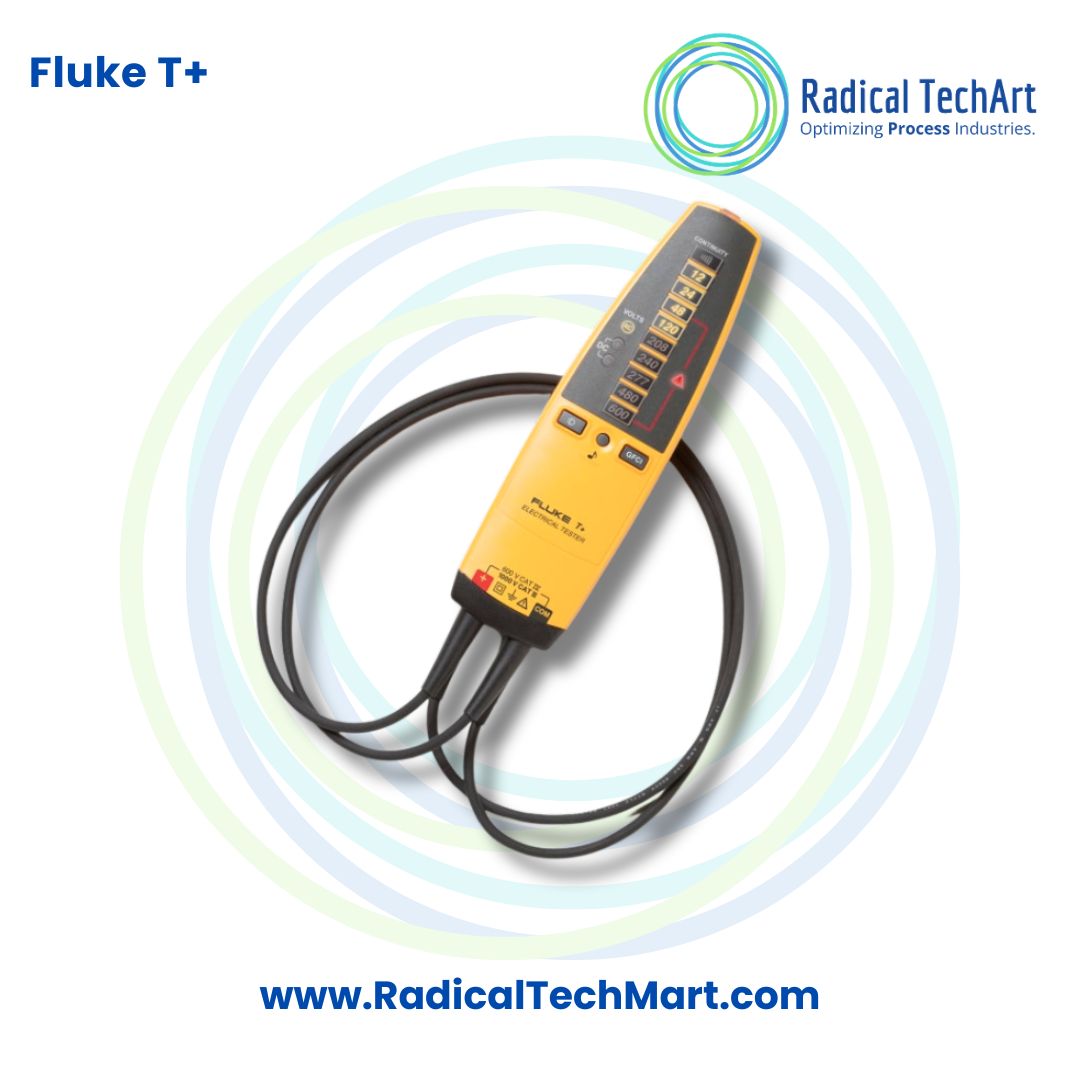


Fluke T+ Electrical Tester
The Fluke T Plus Electrical Tester is a professional contact voltage tester designed to measure AC and DC voltage from 12 V to 600 V. It provides LED, audible and vibration indications, along with continuity testing, GFCI testing and a built-in flashlight for electrical installation, maintenance and troubleshooting work.
Download the manual here!!
Customize
Share :
A. Product Overview
The Fluke T Plus Electrical Tester is designed for fast verification of AC and DC voltage in residential, commercial and industrial electrical systems. It measures voltage from 12 V to 600 V and displays the detected voltage level through a clear LED indicator bar.
When voltage is detected, the tester can provide three forms of indication:
- Visual LED indication
- Audible beeper indication
- Vibration feedback
The LED voltage indicators and hazardous-voltage warning can operate even without working batteries. Batteries are required for the beeper, vibration, continuity test, self-test and flashlight functions.
The Fluke T Plus also supports continuity testing and GFCI trip testing. Its built-in flashlight helps technicians work inside control panels, distribution boards, cabinets and poorly illuminated electrical areas.
Main Features
- AC voltage measurement from 12 V to 600 V
- DC voltage measurement from 12 V to 600 V
- LED voltage-level indication
- Hazardous-voltage warning
- Audible indication for AC voltage, DC voltage and continuity
- Vibration indication for voltage of 40 V and above
- Continuity testing with LED and beeper
- GFCI trip-test function
- Built-in flashlight
- Automatic voltage and continuity mode selection
- Operation with two AAA alkaline batteries
- CAT III 1000 V and CAT IV 600 V safety rating
- Two-year limited manufacturer warranty
B. Working Principle
Voltage Measurement
The Fluke T Plus uses two contact probes to measure the potential difference between two electrical points. When the probes are placed across a complete circuit, the tester automatically switches on and selects AC voltage, DC voltage or continuity mode according to the electrical condition detected.
The detected voltage level is shown through the LED bar. The tester also produces different audible signals for AC and DC voltage:
- A chirping tone indicates AC voltage
- A steady tone indicates DC voltage
For voltages of 40 V and above, the tester provides vibration feedback when the batteries are operational. The maximum measurable voltage is 600 V AC or DC.
Continuity Testing
For continuity testing, the circuit must be switched off and all stored electrical energy must be discharged. The tester applies a small internal test current through the circuit.
When resistance is below approximately 20 kiloohms, the continuity LED illuminates and the beeper sounds. This allows the user to check whether a wire, switch, fuse, connector or circuit path is electrically continuous.
GFCI Testing
The GFCI test function creates a controlled fault current between the live conductor and protective earth. A correctly operating GFCI should detect the fault and disconnect power to the circuit.
During the test, the tester’s indicators show that a GFCI test is in progress. If the device does not trip, the circuit wiring and GFCI should be inspected by a qualified electrician.
Automatic Operation
The tester switches on automatically when the probes are connected across a complete circuit. It automatically determines whether voltage or continuity is present and selects the appropriate operating mode.
When the probes are removed from the circuit, the tester switches off automatically.
C. Why the Fluke T Plus Electrical Tester Is Used
The Fluke T Plus is used for quick and dependable electrical verification during installation, repair and maintenance work.
It helps users:
- Check whether a circuit is energized
- Measure AC and DC voltage up to 600 V
- Identify approximate voltage levels through LED indicators
- Distinguish between AC and DC voltage using different beeper tones
- Receive vibration warnings in noisy working environments
- Check continuity in wires, switches, fuses and connectors
- Test compatible GFCI outlets and circuits
- Troubleshoot electrical sockets and distribution boards
- Verify electrical wiring during maintenance
- Work in dark panels using the built-in flashlight
- Obtain voltage indication even when the batteries are depleted
The combination of visual, audible and vibration alerts makes the tester particularly useful in industrial and field environments where one indication method may be difficult to observe.
D. Suitable Buyers
The Fluke T Plus Electrical Tester is suitable for:
- Professional electricians
- Electrical contractors
- Industrial maintenance technicians
- Facility maintenance teams
- HVAC service technicians
- Control panel technicians
- Electrical installation professionals
- Residential electrical service providers
- Commercial building maintenance teams
- Machine maintenance technicians
- Plant engineering departments
- Electrical inspection professionals
- Technical training institutes
- Electrical troubleshooting teams
The tester is intended for use by qualified personnel familiar with electrical hazards, test procedures and appropriate personal protective equipment.
Frequently Asked Questions
1. What is the voltage range of the Fluke T Plus Electrical Tester?
The tester measures AC and DC voltage from 12 V to 600 V. Its maximum measurable voltage is 600 V AC or DC.
2. Does the Fluke T Plus have an LCD display?
No. The Fluke T Plus indicates voltage through an LED voltage bar, beeper and vibration. The backlit LCD display is available only on the Fluke T Plus Pro model.
3. Can the Fluke T Plus operate without batteries?
The LED voltage indicators and hazardous-voltage indication can operate without batteries. However, working batteries are required for the beeper, vibration, continuity testing, self-test and flashlight.
4. Can it measure both AC and DC voltage?
Yes. The tester measures both AC and DC voltage. Different audible tones help the user distinguish between AC and DC voltage.
5. Does the tester vibrate when voltage is detected?
Yes. It provides vibration indication when voltage of 40 V or higher is measured. Batteries are required for the vibration function.
6. Can the Fluke T Plus test continuity?
Yes. It provides LED and audible continuity indication when the measured resistance is below approximately 20 kiloohms.
The circuit must be switched off and capacitors must be discharged before performing a continuity test.
7. Can the Fluke T Plus measure resistance?
No. Numerical resistance measurement is a feature of the Fluke T Plus Pro. The standard Fluke T Plus provides continuity testing but does not display resistance values.
8. Can it test a GFCI outlet?
Yes. The tester includes a GFCI trip-test function for checking compatible GFCI receptacles and circuits.
9. Does the Fluke T Plus test three-phase rotation?
No. Rotary field direction testing is available only on the Fluke T Plus Pro model.
10. What are the safety ratings of the Fluke T Plus?
The tester is rated for CAT III 1000 V and CAT IV 600 V environments, subject to the operating limits and safety instructions specified by the manufacturer.
11. Is the tester suitable for industrial use?
Yes. It can be used for electrical troubleshooting in control panels, distribution systems, machinery and industrial installations when operated by qualified personnel.
12. Does it have a built-in flashlight?
Yes. The tester includes a battery-powered flashlight for working inside poorly illuminated panels, cabinets and equipment areas.
13. Which batteries does the tester use?
The Fluke T Plus uses two AAA alkaline batteries. The specified battery life is approximately 40 hours under normal operating conditions.
14. Can it be used for PLC circuit testing?
It may be used for certain PLC control-voltage checks, but caution is required. Testing relay-control voltages can cause a relay or switch to open or close unexpectedly.
15. What should be checked before using the tester?
Before use, inspect the tester and test leads for damage, perform the self-test and verify operation using a known voltage source. A damaged tester or one that fails the self-test must not be used.