

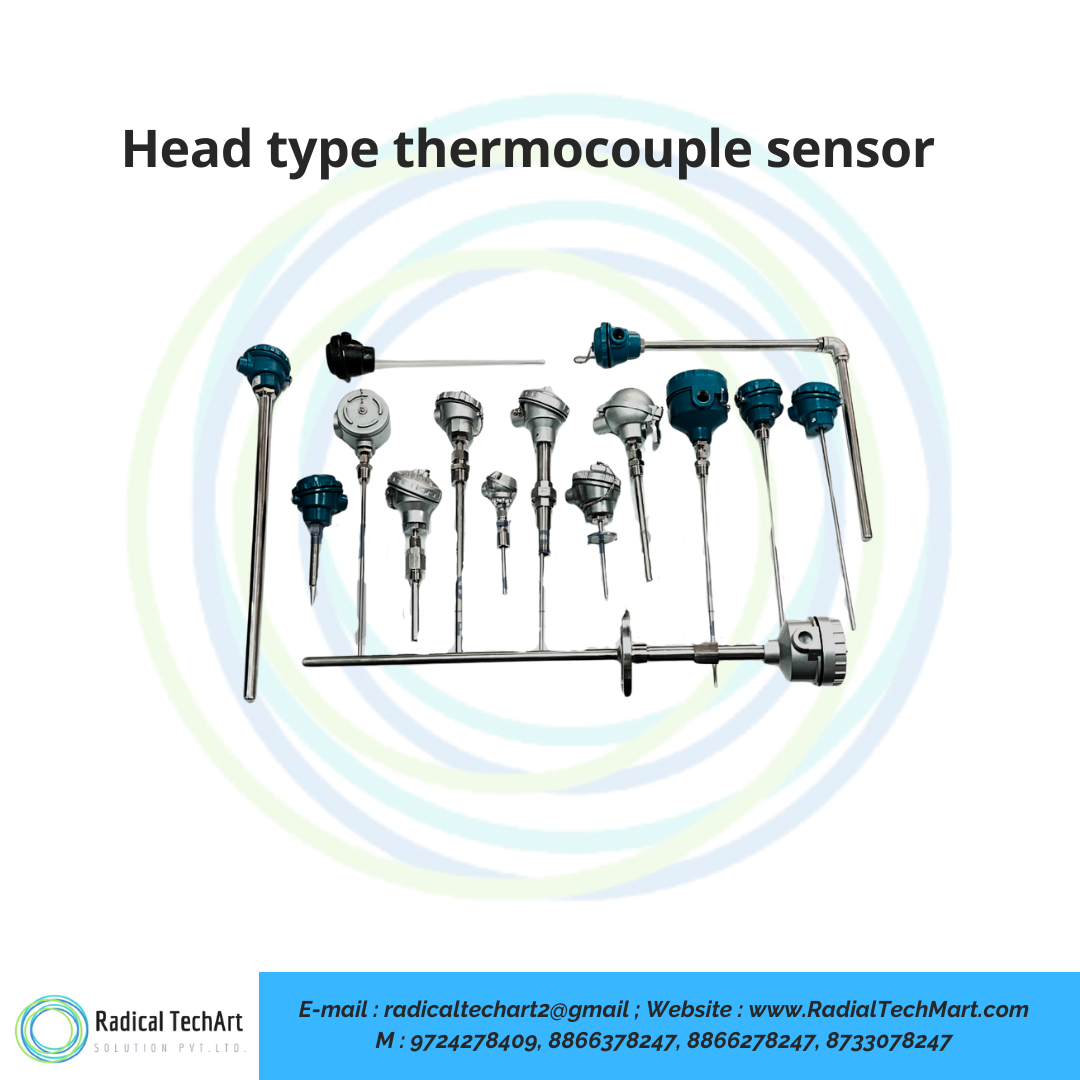
Head Type Thermocouple Sensor
Head Type Thermocouple Sensor is an industrial temperature sensor used for reliable temperature measurement in process plants, machines, furnaces, HVAC systems, chemical industries, food processing units and other industrial applications. It is available in Pt100, J type and K type options with simplex and duplex construction, different probe diameters, probe lengths and sheath materials such as SS304, SS316, SS310 and Inconel.
Customize
Share :
A. Product Overview
Head Type Thermocouple Sensor is a robust temperature sensing device designed for industrial temperature measurement applications. It consists of a thermocouple element or Pt100 element enclosed inside a metallic probe and protected by a terminal head. The head provides safe cable termination, mechanical protection and easy maintenance during installation.
This sensor is commonly used where stable, accurate and long-term temperature measurement is required. It is suitable for applications such as chemical processing, food and beverage production, HVAC systems, furnaces, boilers, ovens, tanks, pipelines, machinery and process heating equipment.
The sensor can be supplied in different types such as Pt100, J type and K type, with simplex and duplex options. Probe diameter, probe length, sheath material and connection type can be customized as per process requirement.
Key Specifications:
Type: Pt100, J type, K type, Simplex and Duplex
Temperature Range: minus 50 to 500 degree Celsius, 0 to 600 degree Celsius, 0 to 1200 degree Celsius
Probe Diameter: 6 mm to 16 mm, optional
Probe Length: 50 mm to 5000 mm
Accuracy: Class A and Class B as per IEC 60751 for Pt100 models
Sheath Material: SS304, SS316, SS310, Inconel and other suitable materials
B. Working Principle
A head type thermocouple sensor works on the thermocouple principle. Two different metal wires are joined together at one end to form a measuring junction. When this junction is exposed to temperature, a small voltage is generated. This voltage changes according to the temperature and is converted into a temperature reading by a temperature indicator, controller, transmitter, PLC or data logger.
In Pt100 versions, the sensor works on the resistance temperature detector principle. The resistance of the Pt100 element changes with temperature. This change in resistance is measured by the instrument and converted into an accurate temperature value.
The protective sheath helps transfer heat from the process medium to the sensing element while protecting it from pressure, corrosion, vibration and mechanical damage. The head provides a secure enclosure for terminal wiring and allows easy connection with field cables.
C. Why It Is Used
Head Type Thermocouple Sensors are used because they provide reliable temperature measurement in demanding industrial environments. The protective head makes wiring simple and safe, while the metallic sheath protects the sensing element from harsh process conditions.
These sensors are preferred because they are easy to install, easy to replace and suitable for a wide temperature range. They can be customized based on temperature range, probe length, probe diameter, sheath material, mounting connection and head type.
They are useful in applications where surface-mounted or open-wire sensors are not suitable. The rigid probe design gives better durability and stable temperature measurement in tanks, pipelines, ovens, furnaces, process vessels and industrial machines.
Main Benefits:
Reliable temperature measurement in industrial processes
Suitable for high-temperature and medium-temperature applications
Available in Pt100, J type and K type options
Simplex and duplex construction available
Strong protection through SS304, SS316, SS310 and Inconel sheath
Easy wiring through terminal head
Easy replacement and maintenance
Custom probe length and diameter available
Suitable for process plants, OEM machines and maintenance applications
D. Suitable Buyers
Head Type Thermocouple Sensors are suitable for industries and buyers who need accurate and durable temperature measurement solutions.
Suitable Industries:
Chemical plants
Food and beverage industries
Pharmaceutical industries
HVAC systems
Furnace and oven manufacturers
Boiler manufacturers
Packaging machinery manufacturers
Plastic processing industries
Power plants
Petrochemical industries
Oil and gas industries
Textile industries
Water treatment plants
Industrial automation projects
Suitable Buyer Profiles:
Purchase managers looking for industrial temperature sensors
Maintenance engineers replacing existing temperature sensors
Instrumentation engineers selecting sensors for process control
OEM machine manufacturers requiring customized temperature sensors
Panel builders integrating sensors with controllers and PLC systems
System integrators working on automation projects
Plant engineers handling temperature monitoring and control
Dealers and traders of industrial sensors
FAQ
1. What is a Head Type Thermocouple Sensor?
A Head Type Thermocouple Sensor is an industrial temperature sensor with a protective terminal head and metal probe. It is used to measure temperature in machines, tanks, pipelines, furnaces, ovens and process equipment.
2. Which sensor types are available in head type construction?
Head type sensors are commonly available in Pt100, J type and K type options. They can also be supplied in simplex and duplex construction based on the application.
3. What is the temperature range of a Head Type Thermocouple Sensor?
The temperature range depends on the sensor type and sheath material. Common ranges include minus 50 to 500 degree Celsius, 0 to 600 degree Celsius and 0 to 1200 degree Celsius.
4. What probe diameter is available?
The standard probe diameter is usually available from 6 mm to 16 mm. Other probe diameters can also be supplied depending on the process requirement.
5. What probe length can be supplied?
Probe length can be customized from 50 mm to 5000 mm based on the tank depth, pipeline size, furnace depth or machine design.
6. Which sheath materials are available?
Common sheath materials include SS304, SS316, SS310 and Inconel. The selection depends on temperature, corrosion level, process medium and application environment.
7. What is the difference between simplex and duplex sensor construction?
Simplex construction has one sensing element, while duplex construction has two sensing elements inside the same probe. Duplex sensors are used when two instruments need the same temperature signal or when backup sensing is required.
8. Where is a Head Type Thermocouple Sensor used?
It is used in chemical plants, food processing units, HVAC systems, furnaces, boilers, ovens, tanks, pipelines, packaging machines, plastic machinery and process automation systems.
9. Why is a protective head used in this sensor?
The protective head provides safe cable termination, mechanical protection and easy access for wiring. It also helps protect the terminal connection from dust, moisture, vibration and industrial conditions.
10. Can Head Type Thermocouple Sensors be customized?
Yes, they can be customized based on sensor type, probe diameter, probe length, sheath material, mounting connection, head type, simplex construction and duplex construction.