



Kyoritsu Digital Clamp Meter
Customize
Share :
A. Product Overview
The Kyoritsu digital clamp meter range includes several models designed for different current measurement requirements.
Kyoritsu KEW 200
Compact AC clamp meter for measuring AC current up to 400A along with AC voltage, DC voltage, resistance and continuity.
Kyoritsu KEW 203
AC and DC digital clamp meter capable of measuring current up to 400A. It is suitable where both alternating and direct current systems need to be tested.
Kyoritsu KEW 2003A
High current AC and DC clamp meter capable of measuring current up to 2000A. Its large clamp jaw makes it suitable for heavy electrical conductors and industrial power systems.
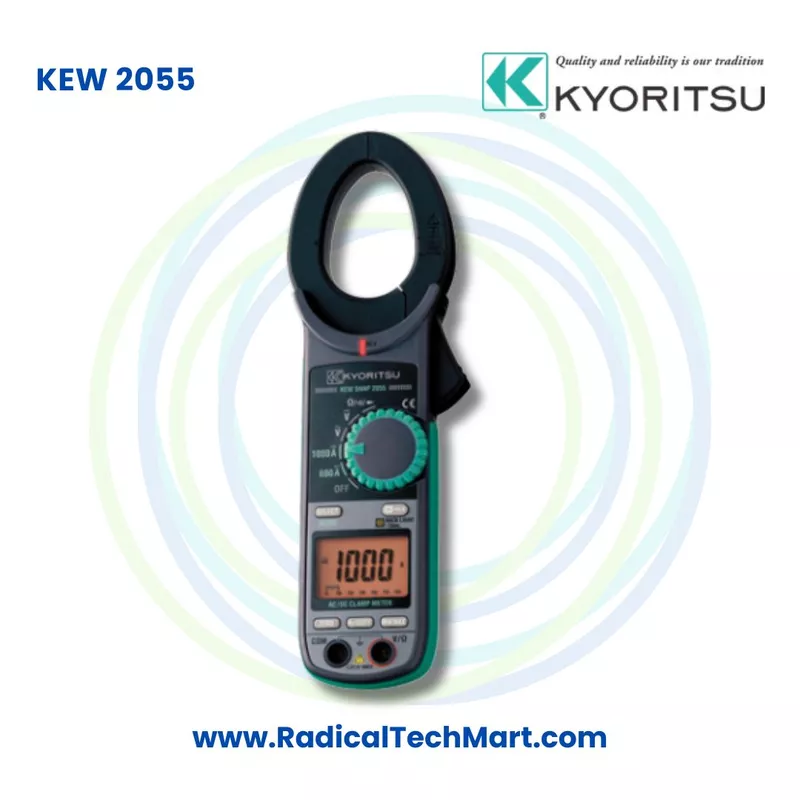
Kyoritsu KEW 2055
True RMS AC and DC clamp meter capable of measuring current up to 1000A. It also supports voltage, resistance, continuity, frequency and duty cycle measurement along with non contact voltage detection.
Kyoritsu KEW 2117R
True RMS AC digital clamp meter with current measurement up to 1000A. It provides AC and DC voltage, resistance and continuity functions and is suitable for professional electrical maintenance work.
These models allow electricians and maintenance engineers to select a clamp meter according to current range, AC or DC measurement requirement and application.
B. Working Principle
A clamp meter measures electrical current by detecting the magnetic field generated around a current carrying conductor.
The jaws of the clamp meter are opened and placed around a single conductor. Current flowing through the conductor produces a magnetic field. The meter senses this magnetic field and converts it into an electrical measurement that appears on the digital display.
Because the conductor does not need to be disconnected, current can be measured while the electrical circuit remains operational.
For AC current measurement, the clamp meter detects the alternating magnetic field around the conductor.
For DC current measurement on models such as KEW 203, KEW 2003A and KEW 2055, the meter uses sensing technology capable of detecting the magnetic field produced by direct current.
Many Kyoritsu clamp meters also include test leads for measuring voltage, resistance and continuity.
C. Why Kyoritsu Clamp Meters Are Used
Kyoritsu clamp meters are used because they allow electrical current to be measured quickly without opening or disconnecting the circuit.
They are useful for:
- Measuring electrical load current
- Checking motors and electrical equipment
- Troubleshooting control panels
- Testing distribution boards
- Measuring AC current in industrial installations
- Measuring DC current in compatible models
- Checking AC and DC voltage
- Testing resistance and continuity
- Identifying overloaded circuits
- Performing preventive electrical maintenance
- Testing electrical power distribution systems
- Diagnosing faults in machines and equipment
Clamp meters are particularly useful when current measurement must be performed while equipment is operating.
D. Suitable Buyers
Kyoritsu KEW 200, KEW 203, KEW 2003A, KEW 2055 and KEW 2117R are suitable for:
Electrical contractors
Industrial electricians
Electrical maintenance engineers
Panel builders
Automation engineers
Power distribution companies
Facility maintenance teams
Machine manufacturers
Electrical service technicians
HVAC technicians
Solar installation and maintenance companies
Industrial plants
Manufacturing facilities
Electrical testing laboratories
Engineering colleges and training institutes
OEM machine builders
Power system maintenance teams
Frequently Asked Questions
What is a Kyoritsu clamp meter?
A Kyoritsu clamp meter is an electrical testing instrument used to measure current by clamping its jaws around an electrical conductor. The circuit normally does not need to be disconnected for current measurement.
What is the difference between KEW 200 and KEW 203?
KEW 200 is primarily designed for AC current measurement up to 400A, while KEW 203 can measure both AC and DC current up to 400A.
Which Kyoritsu clamp meter can measure up to 2000A?
Kyoritsu KEW 2003A can measure AC and DC current up to 2000A, making it suitable for high current industrial and power applications.
Which Kyoritsu clamp meter is suitable for 1000A measurement?
KEW 2055 and KEW 2117R can measure current up to 1000A. KEW 2055 supports AC and DC current, while KEW 2117R is designed for AC current measurement.
Which Kyoritsu clamp meters support DC current measurement?
KEW 203, KEW 2003A and KEW 2055 support both AC and DC current measurement.
Which models offer True RMS measurement?
KEW 2055 and KEW 2117R provide True RMS measurement, which is useful when measuring electrical loads with distorted or non sinusoidal waveforms.
Can these clamp meters measure voltage?
Yes. Depending on the model, these meters can measure AC voltage and DC voltage using test leads.
Can Kyoritsu clamp meters measure resistance?
Yes. These models include resistance measurement capability, making them useful for general electrical troubleshooting.
Do Kyoritsu clamp meters have continuity testing?
Yes. The listed models provide continuity testing functionality for checking electrical wiring and circuits.
What is non contact voltage detection?
Non contact voltage detection allows the meter to identify the possible presence of AC voltage without making direct electrical contact. KEW 2055 includes this function.
Which model is suitable for heavy industrial current measurement?
KEW 2003A is particularly suitable for heavy industrial applications because it can measure current up to 2000A and accommodates larger conductors.
Which Kyoritsu clamp meter is suitable for regular electrical maintenance?
KEW 200 and KEW 2117R are suitable options for regular electrical maintenance where AC current measurement is the primary requirement.
Which model should be selected for both AC and DC systems?
KEW 203, KEW 2003A and KEW 2055 are suitable when both AC and DC current measurements are required.
Can a clamp meter measure current without cutting the wire?
Yes. The clamp jaws are placed around a single conductor, allowing current measurement without disconnecting or cutting the electrical wire.