

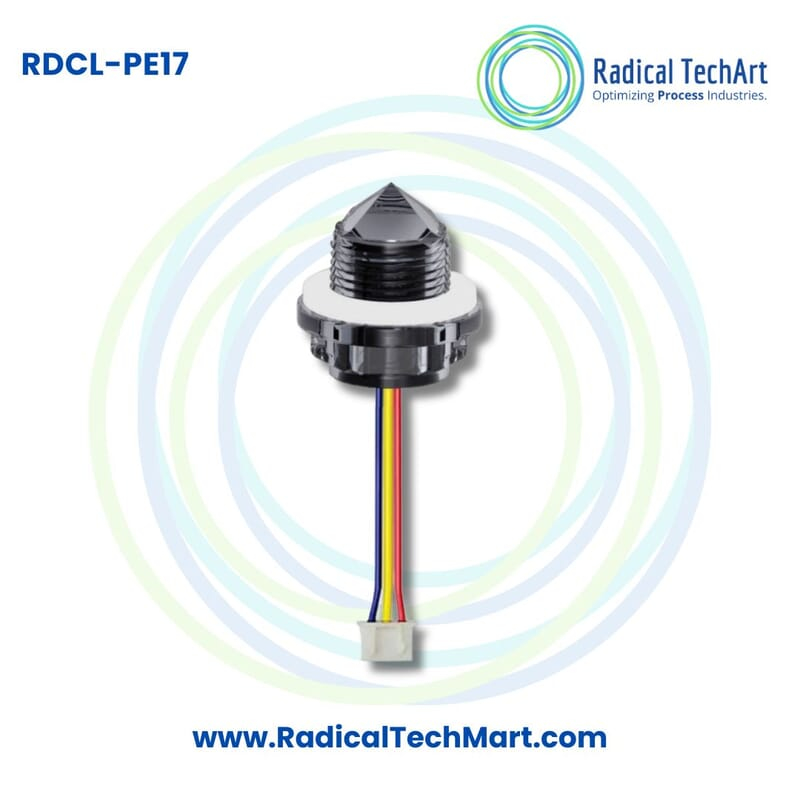
RDCL Compact Optical Liquid Level Switch RDCLPE17
The RDCL Compact Optical Liquid Level Switch RDCLPE17 is a compact, fast-response photoelectric liquid level sensor designed for accurate water, oil, and liquid level detection in industrial tanks and equipment.
It operates using infrared optical sensing technology to detect the presence or absence of liquid without mechanical moving parts.
Featuring a 5V DC operating supply, standard M14 threaded installation, and an operating temperature range of -25°C to 85°C, the RDCLPE17 is suitable for water level monitoring, overflow prevention, low-level alarms, water shortage protection, and automated liquid control applications.
Customize
Share :
A. Product Overview
The RDCL RDCLPE17 Compact Optical Liquid Level Switch uses infrared reflection and refraction to detect liquid at a fixed point in a tank or machine.
Unlike a float switch, it has no moving parts. An infrared emitter and receiver detect reflected-light changes when liquid touches the tip and generate a switching signal.
Compact M14 mounting suits water purifiers, air dryers, oil tanks, medical and beverage equipment, refrigeration units, chemical tanks and refill systems.
Important Technical Specifications
| Specification | Details |
|---|---|
| Product Name | Compact Optical Liquid Level Switch |
| Brand | RDCL |
| Model Number | RDCLPE17 |
| Sensor Type | Photoelectric Liquid Level Switch |
| Detection Principle | Infrared Light Reflection and Refraction |
| Operating Voltage | 5V DC |
| Output With Liquid Present | 0V Typical |
| Output Without Liquid | 5V Typical |
| Current Consumption, Liquid Present | 15 mA Typical |
| Current Consumption, Liquid Absent | 20 mA Typical |
| Operating Temperature | -25°C to 85°C |
| Installation Thread | M14 |
| Output Options | Voltage, NPN, PNP and Relay |
| Detection Method | Point Level Detection |
| Moving Sensing Parts | None |
| Suitable Media | Water, Oil and Compatible Chemical Liquids |
| Main Uses | High and Low Level Detection, Water Shortage Protection |
Note: Electrical values are typical at 5V DC and 25°C. Confirm the output and connection configuration of the selected RDCLPE17 variant.
B. Working Principle
The RDCLPE17 uses infrared reflection and refraction to identify whether its sensing tip is in air or liquid.
When dry, light reflects internally toward the receiver. Liquid contact changes the refractive index and reflected intensity, allowing electronics to identify a wet or dry tip.
Step-by-Step Working Process
- Infrared Generation: The emitter directs infrared light toward the optical sensing tip.
- Dry Detection: In air, internal reflection produces a characteristic signal at the receiver.
- Liquid Contact: Liquid changes the refractive index and reflected light intensity.
- Signal Processing: The receiver and electronics detect the optical variation.
- Switching Output: The electrical output changes state when liquid is detected or removed.
- Control Response: A compatible controller or alarm circuit uses the signal for level monitoring and automation.
Typical Output Behavior
Under the stated 5V DC conditions:
- Liquid present: Approximately 0V output.
- Liquid absent: Approximately 5V output.
Behavior depends on the output configuration.
Important: The RDCLPE17 detects liquid presence at its installed position. It is a point level switch, not a continuous transmitter for measuring tank height or volume.
C. Why Is the RDCLPE17 Optical Liquid Level Switch Used?
The RDCLPE17 supports liquid detection, equipment protection and fluid automation.
1. Accurate Liquid Level Detection
Infrared sensing identifies liquid at the probe for full and empty indications.
2. Water Shortage Protection
At a low-level point, it can signal a controller to stop equipment, raise an alarm or refill a tank, protecting purification, circulation and refrigeration equipment.
3. Overflow Prevention
Mounted near the tank maximum, it signals a controller to stop filling or activate an alarm.
4. Fast Response for Automation
Optical sensing switches quickly as liquid reaches or leaves the tip.
5. Compact Installation
M14 threaded mounting suits small tanks and restricted spaces.
6. Reduced Mechanical Wear
No float or rotating mechanism means less mechanical wear.
7. Multiple Liquid Detection Applications
It can detect water, oil and compatible chemicals, including certain acids and alkalis. Verify wetted-material compatibility before use.
8. Integration With Electronic Control Systems
Depending on the variant, it connects to compatible controllers, PLC inputs and alarms.
D. Suitable Buyers and Industrial Applications
Suitable for OEMs, system integrators, equipment makers and maintenance teams.
| Suitable Buyers | Typical Applications |
|---|---|
| Water Purifier Manufacturers | Low-water and tank-full detection |
| Water Treatment Equipment Manufacturers | Tank monitoring and automatic refilling |
| Air Compressor Manufacturers | Liquid monitoring in refrigerated air dryers |
| Oil Pump Manufacturers | Oil presence in pump tanks |
| Medical Equipment Manufacturers | Liquid monitoring in compatible medical instruments |
| Laboratory Equipment Manufacturers | Liquid detection in biochemical instruments |
| Beverage Equipment Manufacturers | Tank level detection in beverage machinery |
| Refrigeration Equipment Manufacturers | Water level detection in refrigeration units |
| Lithium Battery Equipment Manufacturers | Compatible process-liquid monitoring |
| Chemical Processing Industries | Compatible acid and alkaline liquid tanks |
| Industrial Automation Companies | Level signals for control systems |
| OEM Machine Builders | Compact sensors in automated machinery |
| Plant Maintenance Departments | Replacement of compatible level switches |
Common Industrial Applications
- High and low water tank level detection
- Water purifier tank monitoring
- Automatic water replenishment and dry-run protection
- Oil tank liquid presence detection
- Refrigerated air dryer equipment
- Medical and biochemical instruments
- Beverage processing machinery
- Refrigeration units and chillers
- Small industrial storage tanks
- Compatible chemical liquid monitoring
- Machine automation, overflow alarms and filling control
E. Frequently Asked Questions (FAQ)
1. What is the RDCL RDCLPE17 Compact Optical Liquid Level Switch?
The RDCLPE17 is a compact photoelectric level switch that uses infrared technology to detect whether liquid is present at a fixed sensing point inside a tank or machine.
It sends an electrical switching signal for level indication, alarms or compatible equipment control rather than measuring the entire liquid level continuously.
2. How does the RDCLPE17 Optical Liquid Level Switch work?
An infrared emitter directs light into the optical sensing tip. When liquid contacts the tip, the refractive index changes, altering the light reflected to the photoelectric receiver.
The electronic circuit detects this variation and changes the output state to indicate liquid presence or absence.
3. What is the operating voltage of the RDCLPE17?
The RDCLPE17 has a typical operating voltage of 5V DC. Its electrical requirements and wiring should be checked against the selected output version before connection.
4. Can the RDCLPE17 be used for water tank level detection?
Yes. The RDCLPE17 can detect high and low water levels at its installed sensing position. It is suitable for compatible water tanks, purification equipment and automatic replenishment systems.
5. Can the RDCLPE17 detect oil?
Yes. The sensor may be used for compatible oils where their optical properties allow reliable detection.
Confirm the oil's optical characteristics, compatibility with wetted sensor materials and operating conditions before installation.
6. Does the RDCLPE17 contain any mechanical moving parts?
No. It uses an electronic infrared emitter and receiver, eliminating the moving float or mechanical sensing mechanism used in conventional float switches.
7. What is the operating temperature range of the RDCLPE17?
The specified operating temperature range is -25°C to 85°C. Ensure the liquid and surrounding installation conditions remain within the selected device's rating.
8. What is the mounting thread size of the RDCLPE17?
The RDCLPE17 uses an M14 threaded mounting arrangement, allowing installation in appropriately designed small tanks and compact equipment.
9. What output types are available for the RDCLPE17?
The product information identifies voltage, NPN, PNP and relay output options. The supplied version must be confirmed because wiring and compatibility differ between configurations.
10. What is the output voltage when liquid touches the sensor?
Under the stated 5V DC test conditions, the typical output is approximately 0V when liquid is present. Other output variants may behave differently.
11. What is the output voltage when liquid is absent?
Under the same stated conditions, the typical output is approximately 5V when the tip is dry. Verify the logic for the selected sensor variant.
12. Can the RDCLPE17 be used for water shortage protection?
Yes. When installed at a minimum-water position, it detects when the level falls below the tip. A connected controller can sound an alarm, stop equipment to prevent dry running or initiate refilling.
13. Can the RDCLPE17 be connected to a PLC?
Yes, if the selected output is compatible with the PLC digital input. A suitable interface may be needed when connecting a 5V sensor output to an industrial PLC that expects a higher input voltage.
14. Can the RDCLPE17 be used in chemical tanks?
It can be considered for compatible chemical liquids, including some acidic or alkaline solutions. Confirm the sensor's wetted-material resistance to the specific chemical, concentration and operating temperature.
15. What is the difference between an optical liquid level switch and a float switch?
An optical switch uses changes in infrared light reflection and refraction to detect liquid, while a float switch uses the movement of a buoyant float to actuate a contact.
The RDCLPE17 provides compact electronic point level detection without mechanical moving sensing parts.