

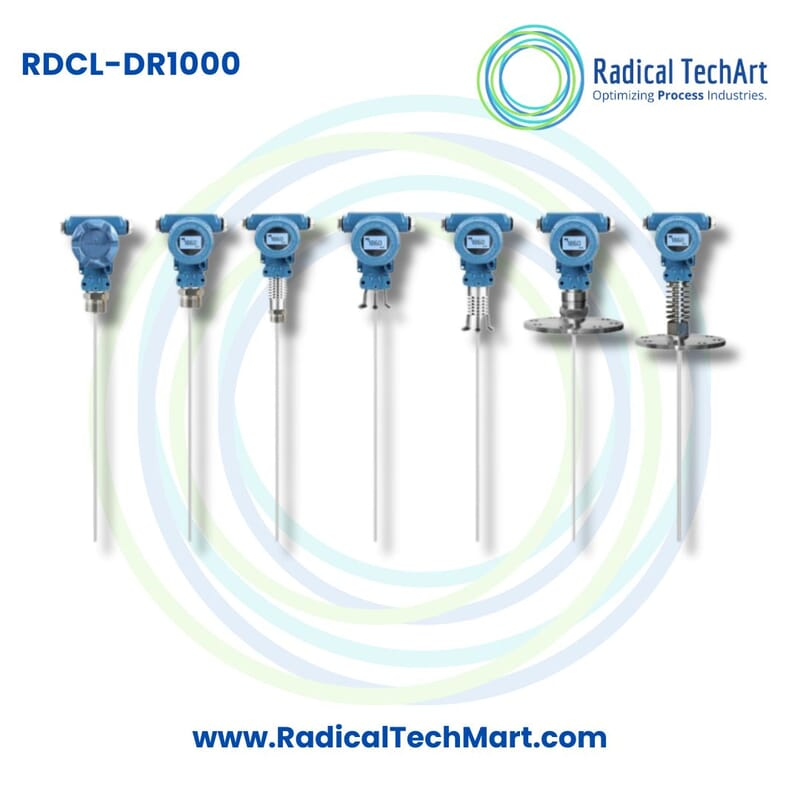
RDCL Continuous Capacitive Level Transmitter RDCLDR1000
The RDCL Continuous Capacitive Level Transmitter RDCLDR1000 is an industrial level measurement instrument designed for continuous monitoring of liquids and suitable solid materials in storage tanks, vessels and process equipment. It uses capacitive sensing technology to measure changes in material level and convert them into electrical output signals. With options for 4 to 20 mA, HART and RS485 communication, the transmitter is suitable for water treatment plants, chemical processing, oil storage, food processing and industrial automation applications.
Customize
Share :
A. Product Overview
The RDCL RDCLDR1000 Continuous Capacitive Level Transmitter is an industrial level measurement device designed to provide continuous level monitoring of liquids and compatible bulk materials.
The instrument operates using capacitance measurement technology, which detects changes in electrical capacitance caused by variations in the level of material surrounding its sensing probe.
The internal electronic circuit processes these capacitance variations and converts them into a corresponding output signal for continuous level indication.
The referenced design supports industrial signal options such as 4 to 20 mA, HART communication and RS485 communication, allowing integration with compatible PLCs, process indicators, SCADA systems and industrial control panels.
Parameter | Reference Specification |
Product Name | Continuous Capacitive Level Transmitter |
Brand | RDCL |
Model Number | RDCLDR1000 |
Measurement Principle | Capacitive Sensing |
Measurement Type | Continuous Level Measurement |
Detection Range | Up to 30 meters |
Capacitance Measurement Range | 0.1 pF to 2500 pF |
Accuracy Options | 0.2% or 0.5% |
Output Signal | 4 to 20 mA |
Communication Options | HART and RS485 |
Power Supply | 15 to 36 VDC |
Probe Material Options | Stainless Steel 316 and PTFE |
Ambient Temperature | Minus 40°C to 85°C |
Protection Rating | IP67 |
B. Working Principle
The RDCL RDCLDR1000 Continuous Capacitive Level Transmitter operates on the principle of electrical capacitance variation.
Capacitance is the ability of two conductive surfaces to store an electrical charge when separated by an insulating medium, also known as a dielectric.
When the material level changes, the effective dielectric properties surrounding the sensing probe also change.The transmitter then converts the measured capacitance into a proportional electrical output signal representing the material level.
Step-by-Step Working Process
1. Probe Installation
The capacitive sensing probe is installed inside the tank, vessel or storage container. A suitable electrical reference is established using the tank wall or a separate reference electrode.
2. Capacitance Formation
The probe and reference electrode form a capacitive sensing arrangement. The material surrounding the probe influences the capacitance between the electrodes.
3. Material Level Changes
As the liquid or solid material rises, a greater portion of the sensing probe becomes surrounded by the material.
Because the dielectric properties of the material differ from those of air, the capacitance changes.
4. Capacitance Detection
The internal electronics continuously monitor the capacitance variation and identify changes corresponding to the material level.
5. Signal Processing
The transmitter processes the measured capacitance using its calibration settings and electronic circuitry to determine the corresponding level.
6. Electrical Output Generation
The measured level is converted into a standard electrical signal, such as 4 to 20 mA, depending on the selected transmitter configuration.
7. Continuous Level Monitoring
The output can be transmitted to a compatible PLC, SCADA system, digital indicator or industrial monitoring device for real-time level indication and automated control.
The RDCL RDCLDR1000 is used for continuous level monitoring in industrial tanks and process equipment where accurate material level information is required for operation, inventory management and process automation.
1. Continuous Level Measurement
Unlike point level switches, a capacitive level transmitter provides a continuous measurement signal throughout its configured operating range.
This allows operators to monitor changes in tank or vessel levels rather than receiving only high-level or low-level switching indications.
2. Suitable for Different Industrial Liquids
The transmitter can be configured for measurement of various conductive and non-conductive liquids.
Typical applications include water, wastewater, chemical solutions, oils and compatible industrial process fluids.
Proper probe selection and calibration are necessary for materials with different dielectric properties.
3. No Mechanical Moving Parts
The sensing principle does not require mechanical floats or continuously moving measuring components.
This reduces dependence on mechanical movement and can help lower maintenance requirements in suitable applications.
4. Industrial Automation Compatibility
The referenced transmitter family offers standard industrial output and communication options.
These signals allow compatible integration with PLCs, SCADA systems, digital process indicators and automated tank management equipment.
5. Chemical Storage Tank Monitoring
Capacitive level transmitters can be used for chemical storage applications when suitable corrosion-resistant sensing materials are selected.
PTFE-insulated probes may be used for compatible acidic, alkaline and other chemically aggressive liquids.
6. Water Treatment Applications
The transmitter can monitor water levels in storage tanks, treatment vessels and industrial water handling equipment.
Continuous level information supports pump operation, tank inventory monitoring and process control.
7. Compact and Flexible Probe Construction
The sensing system can use different electrode arrangements depending on the tank structure and measurement application.
Rod-type configurations are commonly suitable for smaller tanks, while cable-type probes can be considered for deeper vessels.
The RDCL Continuous Capacitive Level Transmitter RDCLDR1000 is suitable for industrial users requiring continuous measurement of liquid levels and compatible bulk materials.
Suitable Buyers | Typical Applications |
Chemical Manufacturing Companies | Acid, alkali and chemical storage tank level monitoring |
Water Treatment Plants | Water storage and treatment tank measurement |
Wastewater Treatment Facilities | Sewage and wastewater tank level monitoring |
Oil Processing Industries | Oil and lubricant storage tank measurement |
Petrochemical Industries | Compatible process liquid level monitoring |
Food Processing Industries | Milk, juice and ingredient storage tanks |
Pharmaceutical Manufacturing Companies | Suitable process liquid and storage vessel monitoring |
Industrial Automation Companies | PLC-based continuous tank level monitoring |
OEM Equipment Manufacturers | Integration into industrial tanks and equipment |
System Integrators | Automated level measurement and control systems |
Pump System Manufacturers | Liquid level monitoring for pump control |
Plant Maintenance Teams | Replacement and maintenance of level instrumentation |
Instrumentation Engineers | Industrial capacitive level measurement applications |
E. Frequently Asked Questions (FAQ)
1. What is the RDCL RDCLDR1000 Continuous Capacitive Level Transmitter?
The RDCL RDCLDR1000 is an industrial level transmitter designed to measure liquid levels continuously using capacitive sensing technology.
It detects changes in electrical capacitance as the material level rises or falls and converts these changes into a corresponding electrical signal.
2. How does a capacitive level transmitter work?
A capacitive level transmitter measures changes in the electrical capacitance between a sensing probe and a reference electrode.As the liquid or material level changes, the dielectric properties surrounding the probe change, causing a variation in capacitance.The transmitter processes this variation to calculate and communicate the material level.
3. What is the measurement range of the RDCLDR1000 capacitive level transmitter?
The referenced transmitter family lists a detection range of up to 30 meters.
The actual available measuring range for RDCLDR1000 depends on the selected sensing probe and product configuration.
4. Can the RDCL capacitive level transmitter measure both liquids and solids?
Capacitive level measurement technology can be used for liquids and certain solid materials.
However, the measurement capability depends on the dielectric properties, material characteristics, probe construction and calibration.Suitability for a specific solid material should be confirmed before selecting the transmitter.
5. What is the output signal of the RDCLDR1000 level transmitter?
The referenced product family provides 4 to 20 mA analog output, with HART and RS485 communication options.The actual RDCLDR1000 output configuration should be confirmed according to the selected model.
6. Can the RDCLDR1000 be connected to a PLC?
Yes. A capacitive level transmitter with a compatible 4 to 20 mA output can be connected to a PLC analog input module.Models supporting compatible digital communication can also be integrated with suitable industrial control equipment.
7. Is the RDCL capacitive level transmitter suitable for water tanks?
Yes. Capacitive level transmitters can be used for continuous water level monitoring in industrial storage tanks and water treatment applications.
The sensing probe and transmitter must be selected according to the tank dimensions and operating requirements.
8. Can the RDCLDR1000 measure oil levels?
Capacitive level measurement can be used for suitable oils and other non-conductive liquids.However, oils often have relatively low dielectric constants, so the transmitter may require a suitable probe arrangement and application-specific calibration.
9. Is a capacitive level transmitter suitable for chemical tanks?
Yes. Capacitive level transmitters can be used for compatible chemical storage applications.For corrosive liquids, suitable probe insulation and chemically resistant materials are important for safe and reliable operation.