

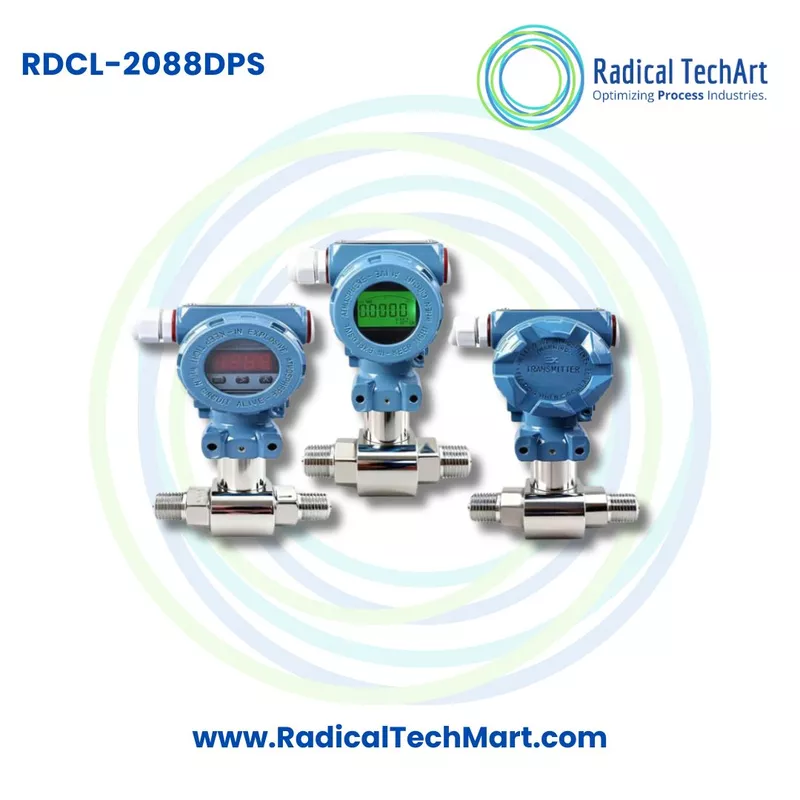
RDCL Digital Display Differential Pressure Transmitter RDCL2088DPS
The RDCL Digital Display Differential Pressure Transmitter is an industrial pressure measurement instrument designed to accurately measure and monitor pressure differences between two points in a system.
It features a clear LCD digital display for convenient real-time differential pressure monitoring, allowing operators to observe pressure variations in industrial processes.
The transmitter operates on a 12 to 30 V DC power supply and is designed for reliable pressure measurement in industrial and environmental monitoring applications.
It supports integration with compatible PLC, SCADA and industrial monitoring systems using the appropriate signal output configuration.
The RDCL Digital Display Differential Pressure Transmitter is suitable for industrial automation, HVAC systems, filtration equipment, water treatment plants and process control applications.
Customize
Share :
A. Product Overview
The RDCL Digital Display Differential Pressure Transmitter measures the pressure difference between two points in an industrial system. Its integrated LCD shows readings locally, helping operators monitor filter condition, pressure drops and equipment performance.
The transmitter operates on 12 to 30 V DC, including common 24 V DC instrumentation supplies. Depending on the selected output configuration, readings may also be transmitted to compatible monitoring and control equipment. Applications include HVAC, water treatment, pipelines, filtration and industrial automation.
Key Features
Integrated LCD for local differential pressure readings.
Measures pressure difference between high and low pressure points.
12 to 30 V DC power supply, compatible with 24 V DC systems.
Continuous monitoring of pressure drops and filter conditions.
Suitable for process monitoring and maintenance.
Optional system integration, subject to available output configuration.
Can support external alarms and control when connected to suitable equipment.
Technical Specifications
Parameter | Specification |
|---|---|
Brand | RDCL |
Product Name | Digital Display Differential Pressure Transmitter |
Measurement Type | Differential Pressure |
Display | LCD Digital Display |
Power Supply | 12 to 30 V DC |
Common Industrial Supply | 24 V DC |
Measurement Principle | Differential Pressure Sensing |
Measurement Parameter | High-side pressure minus low-side pressure |
Applications | HVAC, Filtration, Water Treatment, Process Monitoring |
System Integration | Depends on selected output configuration |
Pressure Range | Confirm for selected variant |
Output Signal | Confirm for selected variant |
Accuracy | Confirm for selected variant |
Process Connection | Confirm for selected variant |
Protection Rating | Confirm for selected variant |
Important: The LCD and 12 to 30 V DC supply are identified for this product. Pressure range, output, accuracy, connection and protection rating must be confirmed for the exact model before publication as guaranteed specifications.
B. Working Principle
The transmitter senses pressure at two points, calculates the difference and presents it as a digital measurement.
Step 1: Pressure Detection
The high-pressure and low-pressure ports connect to separate points in the system. Across a filter, these are typically the inlet and outlet.
Step 2: Differential Pressure Measurement
The sensing element responds to the difference between the two applied pressures. Changes in flow or equipment condition can change this differential pressure.
Step 3: Electrical Signal Processing
Internal electronics process the sensing element's electrical response into a usable pressure measurement.
Step 4: LCD Digital Display
The LCD displays the measured differential pressure, allowing local inspection without a separate indicator.
Step 5: Signal Transmission
If the selected variant includes an appropriate output, readings can be sent to PLCs, SCADA, process indicators, data acquisition systems, control panels or building management systems. Confirm the output type before integration.
Step 6: Continuous Differential Pressure Monitoring
The instrument continuously tracks changes between the two pressure points, supporting monitoring of flow conditions, equipment operation and filtration.
Example of Differential Pressure Measurement
Measurement | Pressure |
|---|---|
Filter Inlet Pressure | 5 bar |
Filter Outlet Pressure | 4.2 bar |
Differential Pressure | 0.8 bar |
The difference is 0.8 bar. Under comparable operating conditions, an increasing pressure drop can indicate filter blockage and a need for cleaning or replacement.
C. Why Is the RDCL Digital Display Differential Pressure Transmitter Used?
Differential pressure monitoring helps detect changes in filtration, flow, equipment operation and process performance.
1. HVAC Differential Pressure Monitoring
Measures pressure differences across suitable filters, fans and duct components to support maintenance and identify abnormal operating conditions.
2. Industrial Filter Monitoring
Tracks the pressure drop across a filter. A rising differential pressure under similar operating conditions may indicate clogging.
3. Water Treatment Plants
Monitors pressure losses across filtration systems and other compatible treatment and water-distribution equipment.
4. Industrial Pipeline Monitoring
Tracks pressure differences across pipelines, restrictions and process equipment. With a suitable primary element and calculation, differential pressure can also support flow measurement.
5. Pump Performance Monitoring
Measures the pressure difference across suitable pumping equipment to help evaluate operating conditions and hydraulic performance.
6. Chemical Processing Applications
Monitors differential pressure across compatible filters, vessels and pipelines. Verify wetted-material, pressure-range and connection compatibility.
7. Industrial Automation Systems
With a supported output interface, readings can feed external monitoring, alarms, data logging and programmed control systems.
8. Liquid Level Measurement in Pressurized Tanks
In suitable closed tanks, differential pressure can be used to estimate liquid level from hydrostatic pressure. Correct range, installation and liquid-density assumptions are essential.
D. Suitable Buyers
Suitable for industrial buyers, plant engineers, maintenance teams and system integrators who need differential pressure measurement.
Buyer Category | Typical Application |
|---|---|
HVAC Contractors | Ventilation pressure monitoring |
Pharmaceutical Companies | Filter and process pressure monitoring |
Water Treatment Plant Operators | Filter pressure drop measurement |
Chemical Processing Companies | Process differential pressure monitoring |
Industrial Automation Companies | Pressure measurement integration |
PLC Panel Manufacturers | Differential pressure monitoring panels |
Pump Manufacturers | Pump differential pressure measurement |
Filter Equipment Manufacturers | Filter condition monitoring |
Food Processing Equipment Manufacturers | Compatible process filtration systems |
Power Plant Maintenance Teams | Pressure across process equipment |
Engineering Procurement Companies | Differential pressure instrumentation |
OEM Machine Manufacturers | Machine and equipment integration |
Facility Management Companies | HVAC and filtration maintenance |
Industrial Maintenance Engineers | Pressure variation troubleshooting |
System Integrators | Compatible process control integration |
E. Frequently Asked Questions (FAQ)
Q1. What is the RDCL Digital Display Differential Pressure Transmitter?
An industrial instrument that measures and displays the pressure difference between two points. It has an LCD and operates on 12 to 30 V DC.
Q2. What is the working principle of a differential pressure transmitter?
It senses pressure at high and low pressure connections, processes the difference electronically and displays it or transmits it when a compatible output is provided.
Q3. What power supply is required?
12 to 30 V DC. A standard 24 V DC industrial supply is within this range.
Q4. Does the RDCL transmitter have a digital display?
Yes. Its integrated LCD shows the differential pressure directly.
Q5. Can it be connected to a PLC?
Yes, if the selected configuration includes an output compatible with the PLC input. Confirm the output signal and wiring first.
Q6. Does it support 4 to 20 mA output?
A 4 to 20 mA signal is common for this instrument type, but availability on the exact RDCL model must be confirmed before ordering.
Q7. Can it be used in HVAC systems?
Yes, for suitable filters and ducts, provided the selected measuring range matches the application.
Q8. How is it used for filter monitoring?
It measures inlet and outlet pressure. A higher difference under comparable flow conditions may indicate a blocked filter and a maintenance requirement.
Q9. How is it different from a conventional pressure transmitter?
A conventional pressure transmitter measures pressure relative to a reference, such as atmosphere or vacuum. A differential pressure transmitter measures the difference between two separate points.
Q10. Can it measure liquid pressure?
It can measure pressure differences in compatible liquid systems. Confirm its sensing construction, wetted materials, pressure range and process connections.