

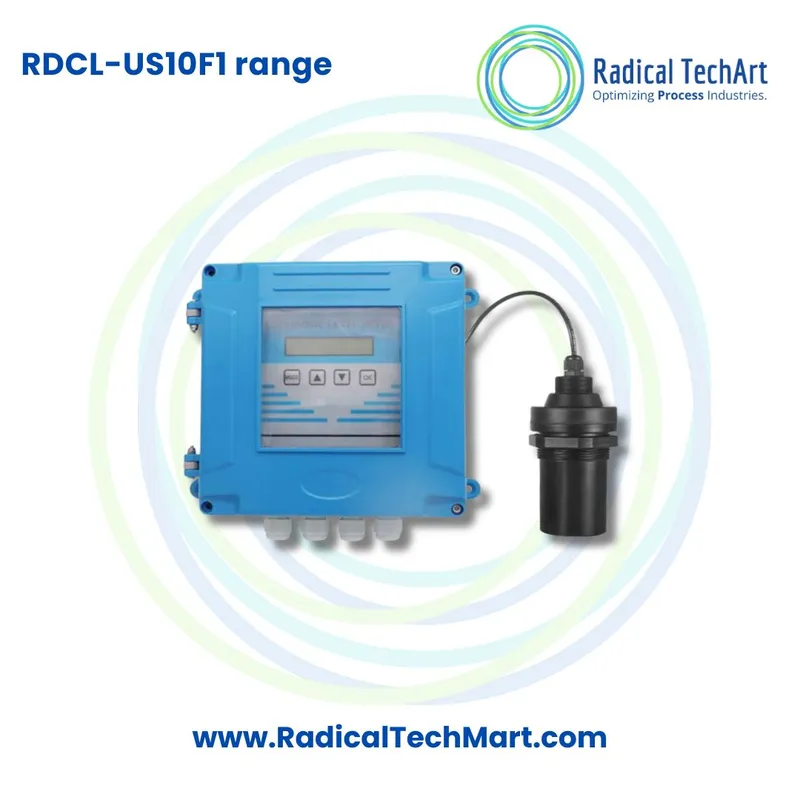
RDCL Explosion Proof Split Type Ultrasonic Level Transmitter RDCLUS10F1
The RDCL Explosion Proof Split Type Ultrasonic Level Transmitter RDCLUS10F1 is an industrial non-contact liquid level measurement instrument designed for continuous level monitoring in storage tanks, chemical processing plants, petrochemical facilities, wastewater treatment systems, and industrial automation applications.
It operates using ultrasonic echo reflection technology to measure liquid levels without requiring direct contact with the process medium.
The RDCLUS10F1 features a split-type construction with a separate sensing probe and electronic controller, allowing flexible installation and convenient access to the control unit.
It supports 4 to 20 mA analog output and RS485 communication for integration with compatible PLC, DCS, and SCADA systems, making it suitable for continuous industrial liquid level monitoring and process automation applications.
Customize
Share :
A. Product Overview
The RDCL RDCLUS10F1 Explosion Proof Split Type Ultrasonic Level Transmitter measures continuous liquid level without contact, using ultrasonic echoes and a separate electronic controller.
Its probe installs at the tank while the controller remains accessible. Applications include chemical, petrochemical and wastewater tanks. 4 to 20 mA and RS485 interfaces support compatible PLC, DCS and SCADA systems.
The instrument is described for hazardous areas, but explosion protection certification must be verified for the exact unit and installation.
Important Features
- Explosion Protection: Subject to certification.
- Non-Contact Sensing: Probe stays above liquid.
- Split-Type Design: Separate probe and controller.
- Continuous Measurement: Tracks level across its range.
- 4 to 20 mA: Analog level signal for compatible systems.
- RS485: Digital interface, with protocol subject to confirmation.
- Automation Integration: PLC, DCS and SCADA.
- Remote Controller: Installed separately from tank.
- Reduced Process Contact: No probe immersion.
- Industrial Use: Suitable tanks and process vessels.
Important Technical Specifications
| Specification | Details |
|---|---|
| Product Name | Explosion Proof Split Type Ultrasonic Level Transmitter |
| Brand / Model | RDCL / RDCLUS10F1 |
| Sensor / Principle | Ultrasonic level transmitter / Echo reflection |
| Measurement | Continuous, non-contact |
| Construction | Split type |
| Range Options | 5 m, 10 m and 15 m reported for corresponding series |
| Analog Output | 4 to 20 mA |
| Digital Interface | RS485 |
| Protocol | Confirm Modbus compatibility |
| Display | Confirm controller configuration |
| Power Supply | Confirm selected version |
| Accuracy / Resolution | Confirm RDCLUS10F1 values |
| Blind Zone | Depends on probe and range |
| Operating Pressure | Confirm process compatibility |
| Explosion Protection | Verify exact approval and marking |
| Applications | Chemical, petrochemical, water treatment and process tanks |
Technical Note: Reference data covers another transmitter construction. Do not assume its ratings apply. Confirm RDCLUS10F1 range, power, protocol, process limits and explosion approval.
B. Working Principle
The RDCLUS10F1 uses ultrasonic time-of-flight measurement. Its probe emits sound pulses above the liquid surface and receives returning echoes. The controller calculates distance from echo travel time and sound speed, then converts distance into level using the configured tank reference height.
Step-by-Step Working Process
- Signal Generation: The controller drives the ultrasonic probe.
- Transmission: The transducer produces high-frequency sound waves.
- Propagation: Waves travel through gas toward the liquid.
- Reflection: The liquid surface returns part of the sound.
- Reception: The probe converts the echo to an electrical signal.
- Distance Calculation: Echo travel time determines surface distance.
- Level Calculation: The tank reference height converts distance to level.
- Output: The level is sent via 4 to 20 mA or RS485.
How the Split-Type Design Works
A cable joins the tank probe and separate controller for remote monitoring. Verify cable length and installation limits.
Measurement Considerations: Foam, vapor, turbulence, obstructions and the blind zone affect readings. Check pressure and temperature limits.
C. Why Is the RDCLUS10F1 Ultrasonic Level Transmitter Used?
1. Liquid Level Measurement in Hazardous Industrial Areas
Intended for sites with potentially flammable vapors. Certification, gas group, temperature class and protection marking must match the area.
2. Continuous Liquid Level Monitoring
Unlike point switches, it tracks level changes throughout the measuring span for filling, storage and discharge monitoring.
3. Non-Contact Measurement
The probe remains outside the liquid, reducing direct exposure and some maintenance problems associated with wetted instruments.
4. Remote Monitoring With Split-Type Construction
A separate controller can be installed in an accessible location. Verify the maximum cable length and environment requirements.
5. Integration With PLC and DCS Systems
The 4 to 20 mA output supports compatible analog inputs; RS485 supports digital monitoring when the protocol matches.
6. Automatic Pump and Valve Control
A PLC or controller can use the level signal to operate pumps, valves and alarms at configured thresholds.
7. Reduced Maintenance Requirements
Non-contact sensing helps limit corrosion and adhesion from immersion, though the probe still needs protection from condensation and buildup.
8. Chemical Storage Tank Monitoring
Suitable chemical tanks can be monitored after verifying vapor conditions, pressure, temperature and required explosion protection.
9. Wastewater Treatment Applications
Suitable atmospheric-pressure wastewater tanks and pump stations can use its continuous level signal.
10. Industrial Process Automation
Level signals support tank alarms, filling, discharge and automated handling.
D. Suitable Buyers and Industrial Applications
For industrial buyers needing remote, non-contact level monitoring and automation.
| Suitable Buyers | Typical Applications |
|---|---|
| Petrochemical Industries | Suitable petroleum storage and process tanks |
| Chemical Manufacturers | Chemical liquid storage monitoring |
| Oil and Gas Industries | Tanks with suitable hazardous-area approval |
| Pharmaceutical Manufacturers | Utility and compatible process liquid tanks |
| Food and Beverage Industries | Suitable liquid storage and processing |
| Wastewater Treatment Plants | Collection tanks and treatment vessels |
| Water Treatment Companies | Raw and treated water tanks |
| Power Plants | Utility water storage |
| Automation Companies | PLC and DCS integration |
| OEM Manufacturers | Liquid handling equipment |
| System Integrators | Remote tank monitoring and control |
| Instrumentation Contractors | Installation and transmitter replacement |
| Maintenance Teams | Instrument upkeep and modernization |
| EPC Contractors | Industrial level measurement projects |
Common Industrial Applications
- Chemical and petrochemical storage tank level monitoring
- Water treatment, wastewater tanks and reservoirs
- Continuous non-contact and remote liquid level measurement
- Pump stations, automatic filling and discharge control
- PLC, DCS and RS485-based tank monitoring
- High-level and low-level alarms via external control equipment
E. Frequently Asked Questions (FAQ)
1. What is the RDCL RDCLUS10F1 Explosion Proof Ultrasonic Level Transmitter?
The RDCLUS10F1 is a split-type ultrasonic transmitter used for continuous, non-contact liquid level measurement. It measures distance through ultrasonic echoes and sends level signals to compatible monitoring and control systems.
2. How does the RDCLUS10F1 Ultrasonic Level Transmitter work?
The probe sends ultrasonic waves toward the liquid surface and receives reflected echoes. The controller uses echo travel time to calculate surface distance, then converts that distance into a liquid level reading.
3. What is the measuring range of the RDCLUS10F1?
The corresponding series reports 5 m, 10 m and 15 m range options. Confirm the exact range, probe and blind zone of the selected RDCLUS10F1 unit before ordering.
4. What is the difference between a split-type and an integrated ultrasonic level transmitter?
A split-type transmitter has a separate probe and electronic controller connected by a cable. An integrated transmitter combines them in one assembly. The split design allows the controller to be installed away from the tank measurement point.
5. Is the RDCLUS10F1 suitable for hazardous industrial areas?
It is described as an explosion-proof transmitter, but suitability depends on the selected unit's certification, protection marking, gas group, temperature classification and installation conditions. These must be verified before hazardous-area use.
6. Does the RDCLUS10F1 support 4 to 20 mA output?
Yes. The corresponding product series specifies a 4 to 20 mA analog output for transmitting continuous level measurements to compatible industrial controllers and indicators.
7. Does the RDCLUS10F1 support RS485 communication?
Yes. The series is described with RS485 communication. Confirm the selected unit's protocol, registers and communication settings before integration.
8. Can the RDCLUS10F1 be connected to a PLC?
Yes. Its analog output or supported digital communication interface can connect to a compatible PLC. The input module, wiring and signal settings must match the selected transmitter configuration.
9. Can the RDCLUS10F1 be used for chemical tank level measurement?
It can be considered for suitable chemical tanks where ultrasonic measurement is appropriate. Evaluate vapors, pressure, temperature, chemical compatibility and any hazardous-area requirements before installation.
10. Can the RDCLUS10F1 measure liquid without direct contact?
Yes. The probe remains above the liquid and measures surface distance through reflected ultrasonic sound waves rather than immersion in the process medium.
11. Can the RDCLUS10F1 measure continuous liquid level?
Yes. It provides continuous level measurement across its usable span instead of detecting only whether liquid has reached one fixed point.
12. What is the purpose of explosion protection in a level transmitter?
Explosion protection reduces the risk of instrument equipment igniting a surrounding potentially explosive atmosphere. The actual protection depends on the instrument's certified design and approved installation conditions.