

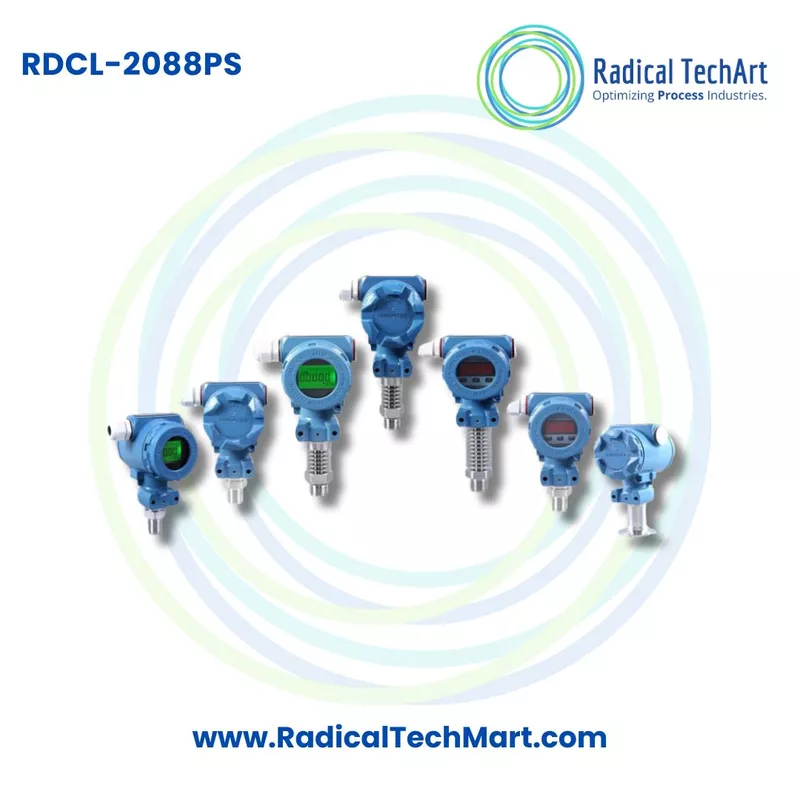
RDCL Industrial Pressure Transmitter with LCD or LED Display RDCL2088PS
The RDCL Industrial Pressure Transmitter with LCD or LED Display is a high-precision digital pressure sensor designed for accurate measurement and continuous monitoring of liquid, gas, steam and hydraulic pressure in industrial applications.
It features a 316L stainless steel isolation diaphragm and diffused silicon sensing technology to provide reliable and precise pressure measurements in demanding industrial environments.
The transmitter supports multiple pressure ranges and offers optional 4 to 20 mA, RS485 and voltage outputs for integration with compatible industrial monitoring and automation systems.
With LCD or LED digital display options and IP65 protection, the transmitter allows convenient local pressure indication while maintaining reliable performance in industrial conditions.
The RDCL Industrial Pressure Transmitter is suitable for water treatment plants, hydraulic systems, industrial pipelines, pump stations and process automation applications, with compatibility for PLC, SCADA and industrial control systems.
Customize
Share :
A. Product Overview
A dual-chamber cast aluminium housing, IP65 protection and 316L stainless steel isolation diaphragm support use in demanding industrial environments. Optional LCD or LED displays provide local readings, while 4 to 20 mA, RS485 and voltage output options enable connection to compatible automation systems.
Key Features and Technical Specifications
Parameter | Specification |
|---|---|
Product Name | RDCL Industrial Pressure Transmitter |
Display Options | LCD, LED or without display |
Measurement Type | Gauge and absolute pressure |
Measurement Range | -100 kPa to 100 MPa, selectable |
Sensor Technology | Diffused silicon piezoresistive sensor |
Accuracy | ±0.25% FS or ±0.5% FS |
Output Signals | 4 to 20 mA, RS485, 0 to 5 V, 0 to 10 V |
Power Supply | 12 to 30 V DC |
Diaphragm Material | 316L stainless steel |
Housing Material | Cast aluminium, dual chamber |
Protection Rating | IP65 |
Long-Term Stability | ≤0.1% FS per year |
Overload Capacity | 150% |
Ambient Temperature | -30°C to 85°C |
Medium Temperature | -40°C to 85°C, standard version |
High Temperature Version | Up to 200°C |
Connection Options | Threaded, flanged and clamp |
Applications | Water treatment, hydraulics, HVAC, pumps, pipelines and automation |
Note: Display, pressure range, accuracy, output, temperature limits and process connection vary by configuration. Confirm the selected model before ordering.
B. Working Principle
The transmitter uses the piezoresistive effect to convert applied pressure into an electrical measurement.
Pressure Detection: Liquid or gas pressure acts on the 316L stainless steel isolation diaphragm.
Sensing and Conversion: Pressure-induced deformation changes the resistance of the diffused silicon sensing element.
Signal Processing: Internal electronics amplify and compensate the signal for stable measurement.
Signal Transmission: The processed value becomes a configured 4 to 20 mA, RS485 or voltage output.
Digital Display: LCD or LED variants show pressure directly at the instrument.
Automation Integration: Compatible PLC, SCADA and controllers use the signal for monitoring, alarms and automated control.
Example: For a 0 to 10 bar transmitter with linear 4 to 20 mA output, 0 bar gives 4 mA, 5 bar gives 12 mA and 10 bar gives 20 mA.
C. Why Is the RDCL Industrial Pressure Transmitter Used?
Continuous pressure measurement helps improve process monitoring, operating efficiency and equipment protection.
1. Water Treatment and Water Supply Systems
Monitors pressure in treatment plants, filtration equipment, pipelines and pumping stations. It helps identify abnormal pressure and maintain operating conditions.
2. Hydraulic Pressure Monitoring
Measures pressure in hydraulic power packs, pumps, actuators and machinery. The signal provides feedback to detect unexpected changes in operating pressure.
3. Industrial Process Automation
Supplies pressure signals to PLCs, SCADA and controllers for centralized monitoring, alarms and automatic process control.
4. Pump and Compressor Monitoring
Measures inlet or outlet pressure in pumps and compressors, supporting operating checks and automated control through external equipment.
5. HVAC and Building Management Systems
Monitors pressure in chilled-water lines, hot-water circulation and compatible air-pressure applications. Readings can support BMS monitoring and control.
6. Chemical and Petrochemical Processing
Measures pressure in compatible tanks, pipelines and process equipment. Verify fluid compatibility with the 316L stainless steel diaphragm and other wetted parts.
7. Liquid Level Monitoring
In suitable open tanks, hydrostatic pressure can be used to estimate liquid level when liquid density and installation conditions are known.
8. Industrial Safety and Equipment Protection
Helps detect high pressure, sudden drops and other abnormal conditions. Properly configured external control systems can generate alarms or protective actions.
D. Suitable Buyers
The transmitter suits industrial manufacturers, integrators, plant operators and maintenance teams requiring pressure measurement.
Water Treatment Plant Operators: Pressure monitoring in filtration, pumping and distribution systems.
Hydraulic Equipment Manufacturers: Pressure sensing for pumps, presses, cylinders and power packs.
Industrial Automation Companies: PLC, SCADA and process controller integration.
OEM Machine Manufacturers: Pressure measurement in industrial machinery and automated equipment.
Chemical and Petrochemical Industries: Monitoring compatible process lines, tanks and equipment.
Pump and Compressor Manufacturers: Pressure feedback for machine monitoring and control panels.
HVAC Contractors and Building Automation Integrators: Chilled-water, circulation and compatible HVAC pressure measurement.
Maintenance and Instrumentation Engineers: Replacements, troubleshooting and monitoring upgrades.
Engineering, Procurement and Construction Contractors: Pressure instrumentation for industrial projects.
Industrial Instrumentation Dealers and Distributors: Supplying transmitters to plants, OEMs and integrators.
Frequently Asked Questions (FAQ)
1. What is an RDCL Industrial Pressure Transmitter?
An electronic instrument that converts pressure from compatible liquids, gases or steam into electrical signals for continuous industrial monitoring and automation. Medium compatibility and temperature limits must be confirmed.
2. What is the difference between LCD and LED display pressure transmitters?
LCD uses a liquid crystal screen; LED uses light-emitting diodes. Both display local pressure readings. Selection depends on visibility and installation needs.
3. What is the pressure measurement range of the RDCL transmitter?
Selectable ranges cover approximately -100 kPa to 100 MPa. Choose a range suited to normal and maximum system pressure.
4. Does the RDCL pressure transmitter support 4 to 20 mA output?
Yes. A 4 to 20 mA option transmits pressure readings to compatible PLCs, indicators, controllers and monitoring systems.
5. Can the RDCL pressure transmitter connect to a PLC or SCADA system?
Yes, with a compatible 4 to 20 mA or RS485 configuration. Verify signal type, protocol and electrical compatibility.
6. Is the RDCL pressure transmitter suitable for water treatment plants?
Yes. It can monitor water pipelines, filtration equipment and pump stations when the medium is compatible with its wetted materials.
7. What is the accuracy of the RDCL Industrial Pressure Transmitter?
Depending on the version, ±0.25% FS or ±0.5% FS. FS means full scale, the reference used to specify measurement accuracy.
8. Can the RDCL pressure transmitter measure hydraulic pressure?
Yes, in compatible hydraulic power packs, pumps and machinery. Select the appropriate pressure range and process connection.
9. What power supply is required for the RDCL pressure transmitter?
12 to 30 V DC. Wiring and supply must match the selected output configuration.
10. Does the RDCL pressure transmitter support RS485 communication?
Yes, as an output option. Confirm the communication protocol, register details and receiving-device compatibility before integration.