

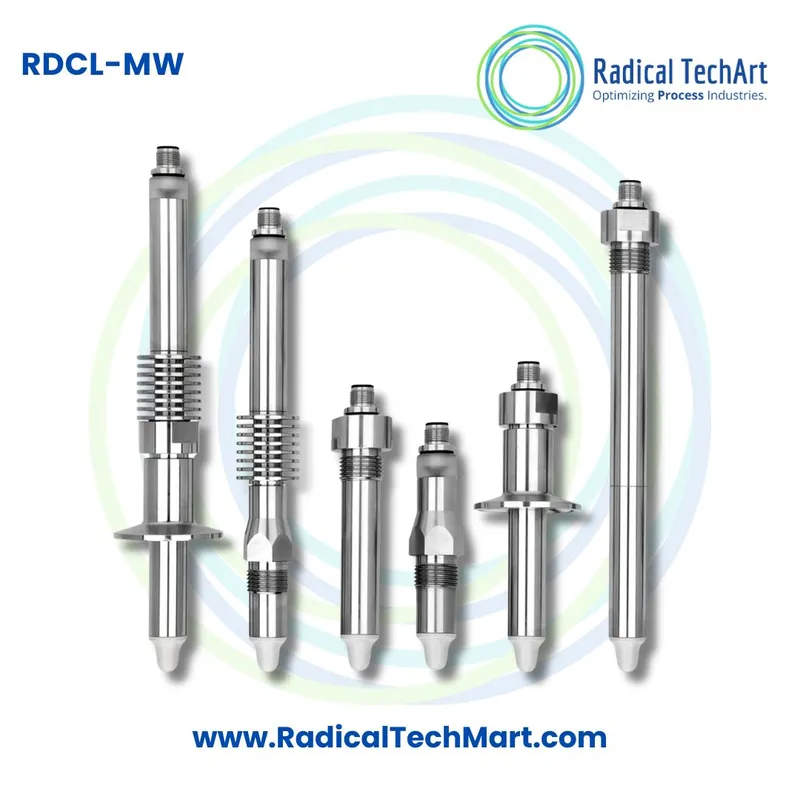
RDCL Microwave Frequency Sweep Level Switch RDCLMW
The RDCL Microwave Frequency Sweep Level Switch RDCLMW is an industrial level detection sensor designed for monitoring solids, liquids, and slurries in tanks, silos, hoppers, and process vessels.
It uses advanced frequency sweep technology to detect material presence through changes in resonant frequency.
Featuring NPN and PNP switching outputs, IP67 protection, a fast 0.2-second response time, and reliable performance in demanding industrial environments, the RDCLMW is suitable for process automation, level monitoring, and material detection applications.
Customize
Share :
A. Product Overview
The RDCL RDCLMW Microwave Frequency Sweep Level Switch is a compact industrial sensor for point level detection of liquids, solids and slurries. It detects dielectric changes near the probe using high-frequency resonance.
Unlike mechanical level switches, it detects material without moving sensing components.
It supports reliable material detection and fast switching.
Applications include chemical and food processing, mining, storage tanks, bulk material handling and waste treatment.
Important Technical Specifications
| Specification | Details |
|---|---|
| Product Name | Microwave Frequency Sweep Level Switch |
| Brand | RDCL |
| Model Number | RDCLMW |
| Measurement Principle | Microwave Frequency Sweep |
| Suitable Media | Solids, Liquids, and Slurries |
| Output Type | NPN and PNP |
| Measurement Hysteresis | Plus or minus 1 mm |
| Repeatability | Plus or minus 1 mm |
| Response Time | 0.2 Seconds |
| Adjustable Damping Time | 0 to 5 Seconds |
| Medium Dielectric Constant | 1.5 or Higher |
| Operating Temperature | Minus 40°C to 115°C, Standard Type |
| Process Pressure | Minus 0.1 to 10 MPa |
| Wetted Materials | PEEK, Stainless Steel 304 or 316L |
| Wetted Surface Roughness | Ra less than 0.8 Micrometers |
| Protection Rating | IP67 |
B. Working Principle
The RDCLMW uses high-frequency electrical resonance to detect dielectric variation.
Its probe, housing and electronics form a resonant circuit.
An electrical field surrounds the probe. Contact with liquid, solid or slurry changes the local dielectric properties.
This shifts the circuit’s resonant frequency.
Electronics compare the frequency with a preset switching threshold.
Crossing the threshold changes the switching output.
Step-by-Step Working Process
- High-Frequency Field Generation: The sensor generates a high-frequency electrical field around its sensing probe.
- Material Detection: When solid, liquid, or slurry material reaches the sensing area, it changes the surrounding dielectric properties.
- Frequency Variation: The presence of the material causes a measurable change in the resonant frequency.
- Signal Processing: Internal electronic circuitry compares the detected frequency with the configured threshold.
- Switching Output: The RDCLMW generates an NPN or PNP switching signal for the connected control system.
- Industrial Control: The switching signal can be used for alarms, level indication, and automated equipment control.
Important: The RDCLMW is primarily designed for point level detection and material presence monitoring. It is not a continuous level transmitter that measures the entire liquid or solid level throughout a vessel.
C. Why Is the RDCLMW Microwave Level Switch Used?
The RDCLMW provides electronic point level detection for safe handling of liquids, bulk solids and slurries.
1. High-Level and Low-Level Detection
The switch can detect whether material has reached a specified position inside a storage tank, hopper, or silo.
This makes it useful for high-level alarms, low-level indications, and automatic filling or emptying control.
2. Prevention of Material Overflow
Overfilling storage vessels can cause spills, waste and interruptions.
At a preset level, its output can trigger an alarm or control action.
3. Reliable Detection of Different Materials
The sensor detects compatible solids, liquids and slurries.
Detection relies on changes in dielectric characteristics.
4. Fast Response for Industrial Automation
With a specified response time of 0.2 seconds, the RDCLMW supports applications requiring quick material detection and switching.
5. Industrial Equipment Integration
The NPN and PNP switching outputs enable integration with compatible PLCs, control panels, alarm systems, and other industrial automation equipment.
6. Performance in Demanding Environments
The IP67 protection rating provides resistance against dust ingress and temporary water immersion under the rating's specified test conditions.
The standard model's listed operating temperature range of minus 40°C to 115°C makes it suitable for a variety of industrial process environments.
7. Reduced Mechanical Wear
Because the sensing principle is electronic, the device does not rely on rotating paddles or mechanical floats for material detection.
This helps avoid wear associated with moving sensing mechanisms.
D. Suitable Buyers and Industrial Applications
The RDCLMW serves buyers requiring point level detection of solids, liquids or slurries.
| Suitable Buyers | Typical Applications |
|---|---|
| Chemical Manufacturing Plants | Liquid and slurry level monitoring in process tanks |
| Food Processing Industries | Material level detection in storage and processing equipment |
| Mining Industries | Chute blockage and bulk material detection |
| Cement and Bulk Material Plants | Powder and granular material level monitoring |
| Waste Treatment Facilities | Slurry and waste material detection |
| Power and Energy Industries | Material monitoring in industrial process systems |
| Industrial Automation Companies | Integration with PLCs and automated control systems |
| OEM Machine Manufacturers | Level detection in custom machines and process equipment |
| System Integrators | Automated tank, hopper, and silo monitoring |
| Plant Maintenance Teams | Replacement and maintenance of industrial level detection equipment |
Common Industrial Applications
- Solid material level detection in storage silos
- Liquid level monitoring in process tanks
- Slurry detection in industrial vessels
- Chute blockage detection in mining operations
- Feed chute monitoring in waste incineration plants
- Material presence detection in hoppers
- High-level and low-level alarm systems
- Industrial filling and discharge automation
- Closed silo level control in carbide furnace operations
E. Frequently Asked Questions (FAQ)
1. What is the RDCLMW Microwave Frequency Sweep Level Switch?
The RDCLMW is an industrial point level detection sensor designed to identify the presence of solids, liquids, and slurries. It uses frequency sweep technology to detect material near its sensing probe and generates an NPN or PNP switching output.
2. How does the RDCLMW Microwave Level Switch work?
The sensor creates a high-frequency electrical field around its probe. When material reaches the sensing area, its dielectric properties influence the resonant frequency. The internal electronics detect this change and activate or deactivate the switching output.
3. Can the RDCLMW detect both solids and liquids?
Yes. The RDCLMW is designed for solid, liquid, and slurry detection. However, the material should meet the sensor's dielectric requirements, and suitability should be confirmed for the actual process conditions.
4. What is the output type of the RDCLMW Level Switch?
The RDCLMW supports NPN and PNP switching outputs, which can be connected to compatible industrial automation and control systems.
5. What is the response time of the RDCLMW Microwave Level Switch?
The specified response time is 0.2 seconds. The sensor also provides an adjustable damping time of 0 to 5 seconds.
6. What is the operating temperature range of the RDCLMW?
The standard version has a specified operating temperature range of minus 40°C to 115°C.
7. Can the RDCLMW be used in a high-pressure industrial application?
The listed process pressure range is minus 0.1 to 10 MPa. The appropriate process connection, material compatibility, and installation requirements should be verified before using the sensor in a pressurized vessel.
8. Is the RDCLMW Microwave Level Switch waterproof?
The device has an IP67 protection rating, which indicates dust-tight protection and resistance to temporary water immersion under specified conditions. It should not be assumed suitable for continuous underwater operation.
9. Can the RDCLMW be connected to a PLC?
Yes. Its NPN and PNP switching outputs can be integrated with compatible PLC digital inputs for level monitoring, alarm generation, and process control.
10. What materials are used in the RDCLMW sensing components?
The listed wetted materials include PEEK and stainless steel grades 304 or 316L. The exact construction should be confirmed for the selected product configuration.
11. Can the RDCLMW be used for slurry level detection?
Yes. The RDCLMW is specified for slurry detection. Its suitability depends on the slurry's dielectric properties, material buildup, temperature, pressure, and other operating conditions.
12. Can the RDCLMW measure continuous liquid level?
No. The RDCLMW is intended for point level detection. It detects whether material is present at the sensor's installed position rather than continuously measuring the entire material level.