

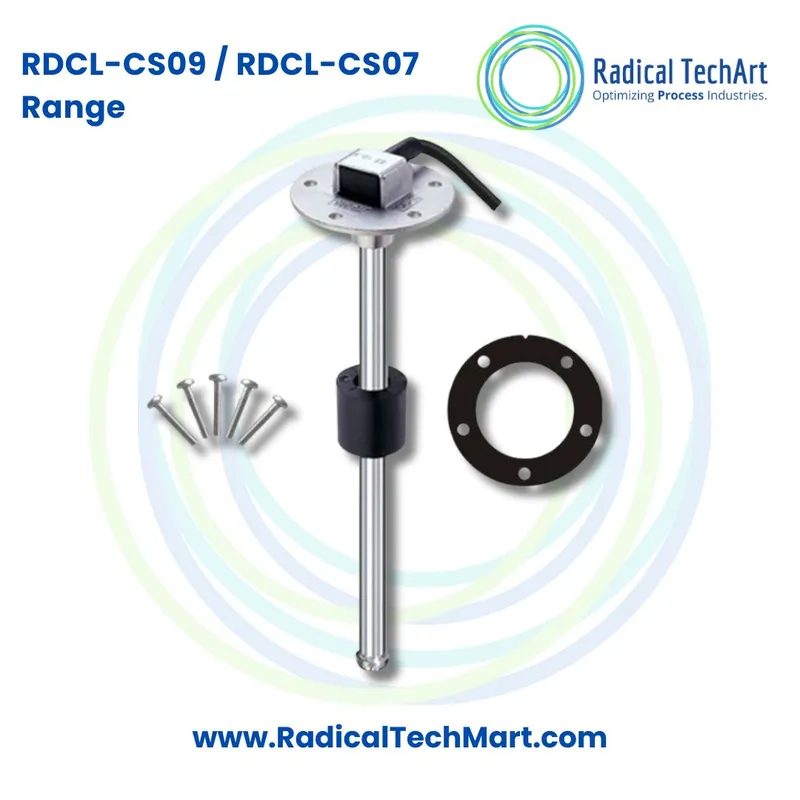
RDCL Resistive Fuel Tank Level Sender RDCLCS Series
The RDCL Resistive Fuel Tank Level Sender RDCLCS Series CS07/CS09 is a magnetic float-based liquid level sensor designed for continuous fuel and oil level indication in vehicles, diesel tanks, industrial storage tanks, and other compatible liquid reservoirs.
It operates using a magnetic float mechanism to provide reliable liquid level monitoring through a standard 0 to 190 Ohm resistance output.
The RDCLCS Series features SUS304 or SUS316 stainless steel construction, IP67 protection, and an operating temperature range of minus 40°C to 85°C, making it suitable for demanding industrial and automotive environments.
The CS07 model offers sensor lengths ranging from 100 to 2000 mm, while the CS09 supports lengths from 150 to 400 mm.
Customize
Share :
A. Product Overview
The RDCLCS Series Resistive Fuel Tank Level Sender uses a magnetic float to change electrical resistance with fuel or liquid level. A compatible gauge interprets the signal to show the remaining level.
The RDCLCS07 and RDCLCS09 differ mainly in sensing length and mounting.
RDCLCS07 supports lengths from 100 to 2000 mm and uses a BSP 1/4 threaded connection. It provides a standard 0 to 190 Ohm output, with other resistance, current or voltage configurations available on request.
RDCLCS09 supports lengths from 150 to 400 mm and uses SAE standard five-hole mounting. It is intended for compact automotive fuel tanks, including cars, trucks and recreational vehicles.
Both use magnetic float sensing, SUS304 or SUS316 stainless steel, IP67 protection and vibration-resistant construction.
Important Technical Specifications
| Parameter | RDCLCS07 | RDCLCS09 |
|---|---|---|
| Product Name | Resistive Fuel Tank Level Sender | Resistive Fuel Tank Level Sender |
| Brand | RDCL | RDCL |
| Model Number | RDCLCS07 | RDCLCS09 |
| Series | RDCLCS Series | RDCLCS Series |
| Measurement Principle | Magnetic Float and Resistive Sensing | Magnetic Float and Reed Switch Sensing |
| Standard Output | 0 to 190 Ohm | 0 to 190 Ohm |
| Sensor Length | 100 to 2000 mm | 150 to 400 mm |
| Custom Length | Available on request | Available on request |
| Body Material | SUS304 or SUS316 Stainless Steel | SUS304 or SUS316 Stainless Steel |
| Mounting | BSP 1/4 Threaded Connection | SAE Standard Five-Hole Mounting |
| Protection Rating | IP67 | IP67 |
| Rated Power | 125 mW | 125 mW |
| Accuracy Specification | 10 to 40 mm | 10 to 40 mm |
| Operating Temperature | −40°C to 85°C | −40°C to 85°C |
| Cable / Protection | PVC / Optional PA Corrugated Sleeve | PVC / Optional PA Corrugated Sleeve |
| Additional Outputs | 240 to 33 Ohm, current or voltage options | Not specified |
| Typical Applications | Fuel Tanks, Industrial Liquid Storage | Cars, Trucks, RVs, Fuel Tanks |
Note: Confirm length, mounting, resistance direction and output before ordering. A 4 to 20 mA output is optional only for RDCLCS07.
B. Working Principle
The series uses buoyancy, magnetic float movement and resistance variation. As the liquid rises or falls, the magnetic float moves along the tube, changing the resistance detected by internal sensing elements.
How It Works
Float Movement: As liquid rises or falls, the magnetic float moves vertically along the sensing tube due to buoyancy.
Magnetic Field Detection: The permanent magnet inside the float changes its position relative to the internal sensing arrangement.
Reed Switch Operation: The magnetic field activates reed switch contacts inside the sensor assembly, producing a resistance value related to float position.
Resistance Output: The standard resistance range is 0 to 190 Ohm. Its value changes as the float moves between the lower and upper sensing positions.
Gauge Processing: A compatible fuel gauge, dashboard indicator or electronic circuit receives the resistance and converts it into a fuel level indication.
Level Indication: The displayed level changes with the float position. Measurement resolution depends on the internal sensing arrangement and gauge compatibility.
This method does not require ultrasonic or capacitive sensing.
C. Why Is the RDCLCS Series Resistive Fuel Tank Level Sender Used?
The series monitors fuel and compatible liquids in vehicle tanks, industrial vessels and equipment reservoirs.
Key Benefits
Reliable Fuel Level Measurement: A magnetic float tracks liquid level changes and provides a corresponding resistance signal.
Standard Gauge Compatibility: Both models have a 0 to 190 Ohm output for gauges with matching resistance range and empty-to-full direction.
Stainless Steel Construction: SUS304 and SUS316 options offer corrosion resistance for compatible fuels, oils and other liquids.
IP67 Protection: The enclosure is protected against dust and temporary immersion under specified test conditions.
Vibration-Resistant Design: Suitable for applications involving vehicle movement and industrial equipment vibration.
Sensor Length Selection: RDCLCS07 offers 100 to 2000 mm, while RDCLCS09 offers 150 to 400 mm, with custom lengths available on request.
Wide Temperature Range: Both models are specified for operation from −40°C to 85°C.
Mounting Options: RDCLCS07 uses a BSP 1/4 threaded connection; RDCLCS09 uses an SAE five-hole mounting arrangement.
Fuel Gauge Integration: Resistance output works with compatible dashboard gauges, indicators and monitoring equipment.
Versatile Applications: Suitable for compatible cars, trucks, diesel tanks, RVs, machinery and industrial liquid reservoirs.
Common Applications
- Cars, trucks and commercial vehicle fuel tanks
- Diesel generators and industrial diesel storage tanks
- Agricultural and construction machinery fuel tanks
- Recreational vehicle fuel and water tanks
- Industrial oil storage and machinery reservoirs
- Automotive dashboard fuel gauges and sender replacements
- Custom fuel tank monitoring and liquid level indication systems
Safety note: For flammable liquids, confirm material compatibility, electrical safety and any applicable hazardous-area requirements before installation.
D. Suitable Buyers
Suitable buyers include automotive manufacturers, tank builders, OEMs, maintenance teams and industrial users.
| Buyer Category | Typical Requirement |
|---|---|
| Automotive Manufacturers | Vehicle fuel tank level indication |
| Truck and Commercial Vehicle Manufacturers | Fuel level monitoring in commercial tanks |
| Diesel Generator Manufacturers | Generator fuel storage monitoring |
| Industrial Plant Operators | Fuel and oil inventory indication |
| Fuel Tank Manufacturers | Integration into storage tanks |
| OEM Equipment Manufacturers | Fuel sensing in machinery |
| Agricultural Equipment Manufacturers | Tractor and agricultural machinery fuel levels |
| Construction Equipment Manufacturers | Equipment fuel tank level monitoring |
| Automotive Maintenance Workshops | Replacement fuel level sending units |
| Fleet Maintenance Companies | Vehicle fuel indication maintenance |
| RV and Specialty Vehicle Manufacturers | Fuel and water tank monitoring |
| Industrial Instrument Distributors | Supply of resistive fuel level senders |
| Automation System Integrators | Resistance signals in monitoring systems |
| Maintenance Engineers | Fuel tank sensor replacement and service |
Relevant terms include 0 to 190 Ohm fuel sender, resistive fuel tank sensor, magnetic float fuel sensor, stainless steel fuel sender and diesel level sending unit.
E. Frequently Asked Questions (FAQ)
1. What is the RDCL RDCLCS Series Resistive Fuel Tank Level Sender?
The RDCLCS Series uses a magnetic float to detect levels in fuel tanks and compatible vessels. It converts float movement into a resistance signal for a compatible gauge, dashboard indicator or monitoring instrument.
2. What is the difference between RDCLCS07 and RDCLCS09?
The main differences are length and mounting. RDCLCS07 supports 100 to 2000 mm with a BSP 1/4 threaded connection, while RDCLCS09 supports 150 to 400 mm with SAE five-hole mounting. Both have a standard 0 to 190 Ohm output.
3. How does the RDCLCS Series Fuel Tank Level Sender work?
A magnetic float rises or falls with the fuel. Its magnetic field interacts with the sensor's internal reed switch arrangement, changing electrical resistance. The connected gauge interprets that resistance and indicates the corresponding liquid level.
4. What is the output signal of RDCLCS07 and RDCLCS09?
Both provide 0 to 190 Ohm resistance. RDCLCS07 offers optional 240 to 33 Ohm and selected current or voltage outputs. Match the output to the gauge.
5. What is the measuring length of the RDCLCS07 Fuel Level Sender?
RDCLCS07 is offered in lengths from 100 to 2000 mm. Customized lengths may be available for particular tank dimensions and installation requirements.
6. What is the measuring length of the RDCLCS09 Fuel Level Sender?
RDCLCS09 supports lengths from 150 to 400 mm. Custom lengths may be considered for compatible vehicle tanks and other compact installations.
7. Can the RDCLCS Series measure diesel fuel levels?
Yes, in compatible diesel tanks and machinery reservoirs. Check float, seals, materials and electrical configuration before installation.
8. Is the RDCLCS Series suitable for cars and trucks?
Yes. RDCLCS09 suits cars and trucks when mounting, length, resistance and empty-to-full direction match the tank and gauge.
9. Does the RDCLCS Series support a 0 to 190 Ohm fuel gauge?
Yes. Both models provide a standard 0 to 190 Ohm output and can be paired with gauges designed for the same resistance range and signal direction. Matching the range alone does not guarantee correct empty and full readings.
10. Can the RDCLCS Series be connected to a PLC?
Yes, with a compatible resistance measurement module or signal converter. The standard sender does not directly provide a 4 to 20 mA signal. An optional 4 to 20 mA configuration may be available for RDCLCS07.
11. Does the RDCLCS Series support a 4 to 20 mA output?
RDCLCS07 lists 4 to 20 mA as an optional configuration, subject to availability. The standard output for both RDCLCS07 and RDCLCS09 remains 0 to 190 Ohm resistance.
12. What materials are used in the RDCLCS Series Fuel Level Sender?
The body comes in SUS304 or SUS316 stainless steel, offering corrosion resistance. Confirm body, float and seal compatibility with the liquid.