

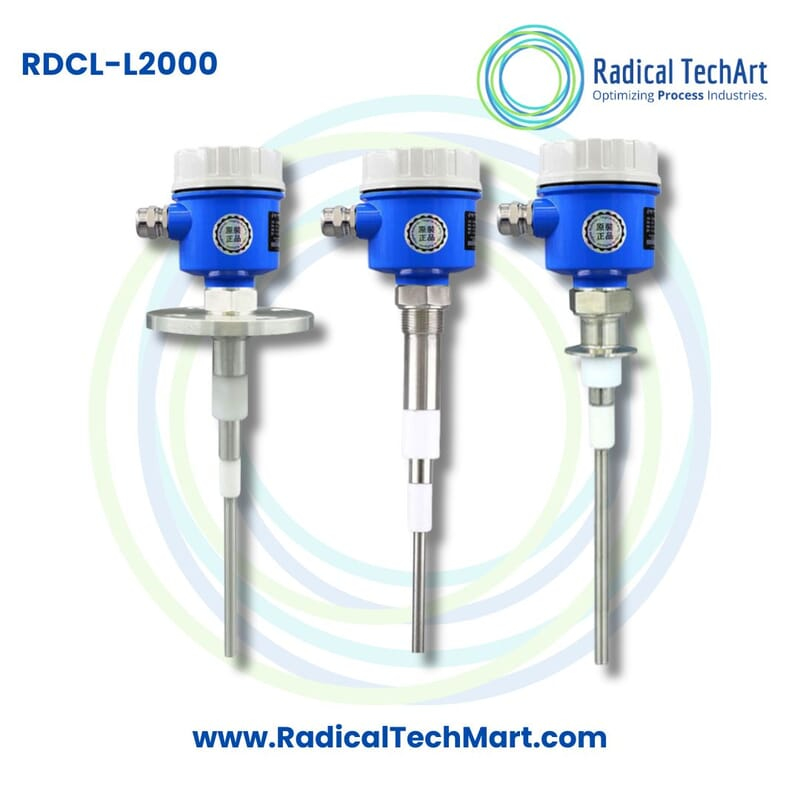
RDCL RF Admittance Level Switch RDCLL2000
The RDCL RF Admittance Level Switch RDCLL2000 is an industrial point level detection instrument designed for reliable monitoring of liquids, powders, granules, slurries and bulk solid materials. Using advanced radio frequency admittance sensing technology with an anti-buildup shielding circuit, it helps prevent false switching caused by material adhesion, dust and moisture. Featuring SPDT relay output, adjustable sensitivity, configurable switching delay and IP65 protection, the RDCLL2000 is suitable for cement silos, coal bunkers, crude oil tanks, chemical processing plants, fly ash storage and industrial automation applications.
Customize
Share :
A. Product Overview
The RDCL RDCLL2000 RF Admittance Level Switch detects liquids and solids at a selected point in tanks, silos, hoppers and process vessels.
It uses Radio Frequency (RF) Admittance technology to detect changes in electrical admittance around a sensing probe. Its anti-buildup shielding helps reduce false detection from coating, condensation and deposits.
It suits compatible sticky powders, fly ash, coal dust, chemical powders, wastewater and oils. Its insulated stainless steel probe has no moving sensing parts.
Important Technical Specifications
| Parameter | Specification |
|---|---|
| Product Name | RF Admittance Level Switch |
| Brand | RDCL |
| Model Number | RDCLL2000 |
| Measurement Principle | Radio Frequency Admittance |
| Measurement Type | Point Level Detection |
| Power Supply | 220V AC, 50/60 Hz or 24V DC |
| Output Type | SPDT Relay |
| Contact Rating | 5A at 240V AC |
| Power Consumption | Maximum 2.5 W |
| Sensitivity | 0.3 pF or lower |
| Sensitivity Adjustment | 9 Levels |
| Switching Delay | Adjustable from 0 to 59 seconds |
| Calibration | Push Button Zero Calibration |
| Alarm Configuration | Upper or Lower Level |
| Ambient Temperature | −40°C to 80°C |
| Process Temperature | Special configurations listed up to 800°C |
| Process Pressure | Special configurations listed up to 5 MPa |
| Probe Material | Stainless Steel |
| Probe Insulation | PTFE, depending on configuration |
| Protection Rating | IP65 |
Note: Specifications reflect a reference design. Confirm electrical ratings, temperature and pressure limits, and probe options in the final RDCLL2000 datasheet. Extreme conditions require specifically rated versions.
B. Working Principle
The RDCLL2000 works through radio frequency admittance measurement. Admittance describes how readily alternating current passes through a circuit and is the reciprocal of impedance.
An RF signal passes to the probe and conductive reference. The circuit measures a baseline admittance in air or gas; contact with material changes that value.
Step-by-Step Working Process
- RF Signal Generation: An internal electronic circuit applies a high-frequency signal to the probe.
- Reference Measurement: With no material contact, the circuit establishes the air or gas reference admittance.
- Material Contact: Rising material reaches the probe and alters the electrical characteristics of the sensing arrangement.
- Admittance Variation: Differences in dielectric and conductive properties change the measured admittance.
- Signal Processing: Electronics compare this value with the configured sensitivity threshold.
- Anti-Buildup Compensation: Shielding reduces the influence of sticky coating, powder deposits and condensation that could trigger false switching.
- Relay Activation: Once the selected detection condition is met, the SPDT relay changes state to signal an alarm, PLC input or control circuit.
- Automatic Reset: When material moves away and the measurement crosses the reset threshold, the relay returns to its normal state.
How Does Anti-Buildup Technology Work?
Sticky residue on a conventional capacitive switch can alter capacitance even after the actual material level falls below the probe. RF admittance shielding and electronic compensation help distinguish genuine material contact from residual coating, reducing false alarms.
Performance depends on probe design, material and configuration.
C. Why Is the RDCL RF Admittance Level Switch Used?
The RDCLL2000 provides reliable high-level and low-level point detection for compatible liquids, powders, slurries and bulk solids, particularly where dust or buildup makes conventional switching difficult.
1. High-Level Detection and Overflow Prevention
Mounted near the top of a tank or silo, it detects material reaching the probe and can trigger an alarm or stop feeding equipment to help avoid overflow and spillage.
2. Low-Level Detection and Material Shortage Prevention
Installed lower in the vessel, it detects when the level falls below a selected point and can activate a shortage alarm or compatible feeding system.
3. Reliable Detection of Sticky Materials
The anti-buildup circuit helps reduce false switching from sticky powders, sludge, chemical deposits and other materials that coat sensing probes.
4. Suitable for Both Liquids and Solids
It detects points in compatible liquids, powders, granules and slurries, making it useful in chemical plants, cement production, wastewater treatment and bulk handling.
5. No Mechanical Moving Sensing Parts
Unlike rotary paddle switches, it does not need a rotating sensing mechanism, avoiding paddle motor wear and reducing mechanical jamming.
6. Adjustable Sensitivity
The reference design has nine sensitivity levels to match switching thresholds to different materials' electrical properties.
7. Adjustable Switching Delay
A 0 to 59-second adjustable delay helps avoid unwanted switching from splashing, temporary material movement or fluctuations at the detection point.
D. Suitable Buyers
The RDCLL2000 is intended for industrial users requiring point-level alarms or control in tanks, silos, hoppers and process equipment.
| Suitable Buyers | Typical Applications |
|---|---|
| Cement Manufacturing Companies | Cement silos and raw-material hoppers |
| Thermal Power Plants | Coal bunkers, fly ash silos and ash hoppers |
| Coal Handling Plants | Coal storage and bunker level detection |
| Oil and Gas Companies | Compatible crude oil and process-liquid tanks |
| Petrochemical Industries | Process vessels and chemical storage |
| Chemical Manufacturing Companies | Powders, liquids and slurries |
| Fertilizer Manufacturing Plants | Fertilizer powders and granules |
| Steel Manufacturing Plants | Raw-material hoppers and bulk solids |
| Mining Industries | Mineral powders and suitable stored materials |
| Plastic Manufacturing Companies | Resin, PVC powder and plastic granules |
| Food Processing Industries | Flour, sugar, starch and powder storage |
| Pharmaceutical Manufacturers | Powders and process materials with suitable hygienic probes |
| Wastewater Treatment Plants | Sludge and process tanks |
| Industrial Automation Companies | PLC-based high-level and low-level alarms |
| OEM Equipment Manufacturers | Material-handling and processing machines |
| System Integrators | Automated industrial level-monitoring projects |
| Plant Maintenance Departments | Level-switch maintenance and replacement |
E. Frequently Asked Questions (FAQ)
1. What is the RDCL RDCLL2000 RF Admittance Level Switch?
The RDCL RDCLL2000 is an industrial point-level detection device that uses radio frequency admittance sensing to identify whether material has reached a selected level in a tank, silo or hopper.
It is designed for suitable liquids, powders, granules, slurries and bulk solids, providing a switching signal rather than a continuous level reading.
2. How does an RF admittance level switch work?
The switch applies a high-frequency electrical signal to a sensing probe. When material contacts the probe, changes in dielectric and conductive properties alter the electrical admittance.
The electronics detect this change and operate a relay when the configured switching threshold is reached.
3. What is the difference between an RF admittance level switch and a capacitive level switch?
A conventional capacitive switch mainly responds to capacitance changes. An RF admittance switch measures electrical admittance and typically uses shielding to reduce interference from deposits on the probe.
This makes RF admittance sensing especially useful for sticky powders, sludge and materials that leave coating, subject to proper probe selection.
4. Can the RDCLL2000 detect both liquids and solids?
Yes. The referenced technology supports point-level detection of compatible liquids, powders, granules, slurries and bulk solids.
Reliable operation depends on selecting a suitable probe and adjusting sensitivity for the material's electrical characteristics.
5. Is the RDCL RF Admittance Level Switch suitable for cement silos?
Yes. RF admittance switches are commonly used for high-level and low-level detection in cement silos and hoppers.
The anti-buildup sensing arrangement helps reduce false alarms caused by cement powder deposits on the probe.
6. Can the RDCLL2000 detect coal levels?
Yes. RF admittance sensing can be used in suitable coal bunkers, storage vessels and coal-handling equipment.
Probe selection must account for the coal characteristics and installation conditions.
7. Can the RDCL RF Admittance Level Switch measure crude oil levels?
It can detect whether compatible crude oil or another process liquid has reached the installed probe position.
However, RDCLL2000 is a point-level switch, not a continuous level transmitter, so it does not report the full tank level.
8. What is the output of the RDCLL2000?
The reference design provides an SPDT relay output rated at 5A at 240V AC.
It can be used with compatible high-level alarms, low-level alarms and industrial control circuits.
9. Can the RDCLL2000 be connected to a PLC?
Yes. Its SPDT relay contacts can connect to a compatible PLC digital input circuit.
The PLC can use the switching status to control alarms, pumps, conveyors or feeding equipment according to its programmed logic.
10. What power supply is required for the RDCLL2000?
The reference design lists 220V AC at 50/60 Hz or 24V DC supply options.
Confirm the specific model's voltage configuration before installation to ensure compatibility with the available power supply.