

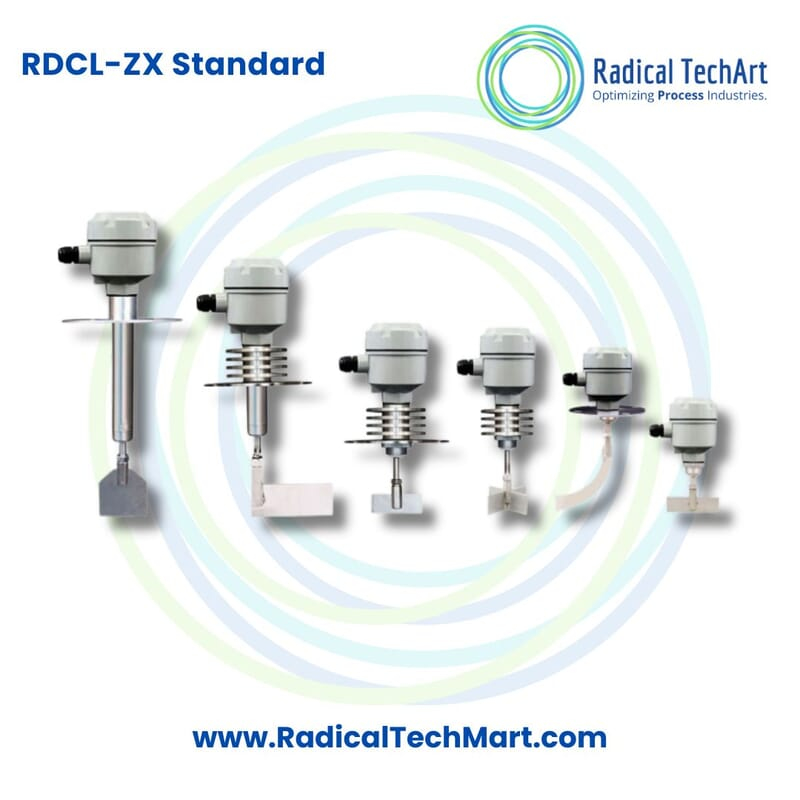
RDCL Standard Rotary Paddle Level Switch RDCLZX-STD
The RDCL Standard Rotary Paddle Level Switch RDCLZX-STD is an industrial level detection device designed for monitoring powdered, granular and bulk solid materials in silos, hoppers, storage bins and processing equipment. It operates using a motor-driven rotating paddle mechanism and provides an SPDT relay output for high-level and low-level alarms. With IP65 protection, a stainless steel paddle and 220V AC or 24V DC power supply options, it is suitable for cement plants, grain storage, plastic processing, chemical industries and material handling applications.
Customize
Share :
A. Product Overview
The RDCL RDCLZX-STD Standard Rotary Paddle Level Switch is an electromechanical point level detection instrument designed to detect the presence or absence of solid materials at a predetermined level inside industrial storage containers.
The device uses a rotating paddle mechanism driven by a small electric motor. When the material reaches the paddle, its rotation is restricted, activating an internal switching mechanism that generates an electrical output signal.
This signal can be used for high-level alarms, low-level detection, material overflow prevention and automatic operation of feeding or discharge equipment.
The rotary paddle level switch is suitable for detecting various solid materials, including cement, fly ash, grains, plastic granules, chemical powders, animal feed, sand and other bulk solids.
The device features an SPDT relay contact, providing normally open and normally closed switching options for integration with industrial automation systems.
Its compact design, straightforward operating principle and durable construction make it suitable for industrial material storage and handling applications.
Important Technical Specifications
Parameter | Specification |
Product Name | Standard Rotary Paddle Level Switch |
Brand | RDCL |
Model Number | RDCLZX-STD |
Measurement Type | Point Level Detection |
Operating Principle | Motor-Driven Rotary Paddle |
Power Supply Options | 220V AC or 24V DC |
Power Consumption | 4 W |
Output Type | SPDT Relay |
AC Contact Rating | 5A at 250V AC |
DC Contact Rating | 10A at 24V DC |
Paddle Rotation Speed | 1 RPM |
Paddle Material | SUS304 Stainless Steel |
Operating Temperature | −20°C to 80°C |
Protection Rating | IP65 |
Process Connection | Threaded or Flanged Options |
Suitable Materials | Powders, Granules and Bulk Solids |
Applications | Silos, Hoppers, Storage Bins and Material Handling Systems |
B. Working Principle
The RDCL RDCLZX-STD Rotary Paddle Level Switch operates using a mechanical resistance detection principle.
An internal electric motor rotates a paddle blade through a reduction mechanism at approximately 1 revolution per minute.
When the paddle is not in contact with the material, it rotates freely, indicating that the material level is below the detection point.
As the material level rises and reaches the paddle, the surrounding material restricts its rotation.
The internal detection mechanism senses this resistance and activates a microswitch, changing the state of the SPDT relay contacts.
The resulting electrical signal can be connected to an alarm, PLC, control panel or material feeding system.
When the material level falls below the paddle, the obstruction is removed, allowing the paddle to rotate again and resetting the output signal.
Step-by-Step Working Process
1. Paddle Rotation: An internal electric motor continuously rotates the paddle at approximately 1 RPM when no material is obstructing it.
2. Material Contact: As solid material accumulates inside the silo or hopper, it eventually reaches the rotating paddle.
3. Rotation Restriction: The material restricts the paddle movement and creates mechanical resistance.
4. Switch Activation: The internal detection mechanism senses the restricted movement and activates the electrical switching circuit.
5. Relay Output: The SPDT relay changes state, providing a signal for an alarm or control system.
6. Automatic Reset: When the material falls below the paddle, normal rotation resumes and the switch returns to its original state.
This operation allows the rotary paddle level switch to provide reliable point level detection without requiring continuous level measurement.
C. Why Is the RDCL Rotary Paddle Level Switch Used?
The RDCL RDCLZX-STD is used to detect high and low material levels in industrial storage and processing systems.
1. High-Level Detection and Overflow Prevention
The rotary paddle level switch can be installed near the upper section of a silo or storage bin.
When material reaches the paddle, the switch generates a signal that can activate an alarm or stop the material feeding equipment.
This helps prevent overfilling, material spillage and unnecessary product wastage.
2. Low-Level Detection
When installed near the lower section of a hopper or silo, the device can detect whether material is available at the required level.
This helps operators identify low material conditions and take necessary action before the storage container becomes empty.
3. Automatic Material Feeding Control
The SPDT relay output can be integrated with PLCs, motor control panels and compatible automation equipment.
This allows the switch to participate in automatic filling and material transfer operations.
4. Suitable for Powder and Granular Materials
The device is suitable for detecting solid materials such as cement, grain, plastic granules, fertilizers, fly ash, animal feed and other bulk materials.
Its paddle-based mechanism allows level detection without depending on the electrical conductivity of the material.
5. Industrial Protection
The referenced standard design features IP65 protection, helping protect the electrical enclosure against dust and water jets.
This is useful in industrial environments where airborne dust and material particles are common.
6. Simple Installation and Operation
The rotary paddle level switch uses a straightforward mechanical detection system.
Threaded and flanged process connection options make it adaptable to different silo, hopper and storage vessel arrangements.
7. Reduced Operational Downtime
By providing high-level and low-level detection signals, the device helps prevent overflow and material shortage conditions that could interrupt production.
It can support efficient operation of conveyors, feeders and other material handling equipment.
D. Suitable Buyers
The RDCL Standard Rotary Paddle Level Switch RDCLZX-STD is suitable for industries that store, transport or process powdered and granular materials.
Suitable Buyers | Applications |
Cement Manufacturing Plants | Cement silo level monitoring and overflow prevention |
Ready Mix Concrete Plants | Cement, fly ash and aggregate hopper level detection |
Grain Storage Companies | Wheat, rice, maize and grain silo monitoring |
Food Processing Industries | Flour, sugar, starch and bulk ingredient storage |
Animal Feed Manufacturers | Feed pellets and raw material hopper level detection |
Plastic Manufacturing Industries | Plastic granule and masterbatch storage monitoring |
Chemical Manufacturing Plants | Fertilizer, chemical powder and granular material detection |
Pharmaceutical Manufacturers | Suitable powder and granule storage applications |
Power Generation Plants | Coal powder and fly ash silo level monitoring |
Mining and Mineral Processing Plants | Mineral powder and bulk material storage |
OEM Machine Manufacturers | Integration into material handling and filling equipment |
Industrial Automation Companies | PLC-based material level detection and control |
System Integrators | High-level and low-level alarm systems |
Plant Maintenance Teams | Replacement of industrial rotary paddle level switches |
E. Frequently Asked Questions (FAQ)
1. What is the RDCL RDCLZX-STD Rotary Paddle Level Switch?
The RDCL RDCLZX-STD is an industrial point level switch designed to detect the presence or absence of powdered, granular and bulk solid materials in silos, hoppers and storage bins using a motor-driven rotating paddle mechanism.
2. How does a rotary paddle level switch work?
A rotary paddle level switch uses an electric motor to rotate a paddle blade. When solid material reaches the paddle, the rotation is restricted, activating an internal microswitch that changes the SPDT relay output.
When the material moves away, the paddle resumes rotation and the switch resets.
3. What is the purpose of a rotary paddle level switch?
A rotary paddle level switch is used for high-level detection, low-level alarms, overflow prevention and automatic material feeding control in industrial storage and material handling systems.
4. Can the RDCLZX-STD rotary paddle level switch detect cement?
Yes. Rotary paddle level switches are commonly used for detecting cement levels inside storage silos and hoppers.
The switch can provide high-level alarms to help prevent cement silo overfilling.
5. Is the RDCL rotary paddle level switch suitable for fly ash silos?
Yes. Rotary paddle level switches can be used for fly ash level detection in cement plants, power generation facilities and other bulk material storage applications, provided the paddle and mechanical configuration suit the material.
6. Can a rotary paddle level switch measure liquid levels?
No. A standard rotary paddle level switch is designed primarily for solid materials such as powders, granules and bulk solids.
Liquid level measurement generally requires a suitable liquid level switch or transmitter.
7. What is the output of the RDCLZX-STD rotary paddle level switch?
The referenced design provides an SPDT relay output with normally open, normally closed and common contacts.
The relay can be connected to compatible alarm systems, PLC inputs and industrial control equipment.
8. What power supply is required for the RDCL rotary paddle level switch?
The referenced product offers 220V AC and 24V DC power supply options. The required voltage should be selected when ordering the device.
9. Can the RDCLZX-STD rotary paddle level switch be connected to a PLC?
Yes. Its SPDT relay contacts can be connected to compatible PLC digital input circuits to provide material level status signals.
The PLC can then operate alarms, feeders, conveyors or other control equipment according to the programmed logic.
10. Is a rotary paddle level switch suitable for grain storage?
Yes. Rotary paddle level switches are commonly used for detecting wheat, rice, maize, soybean and other grains in storage bins and silos.
They help monitor material levels and support automated grain handling operations.