

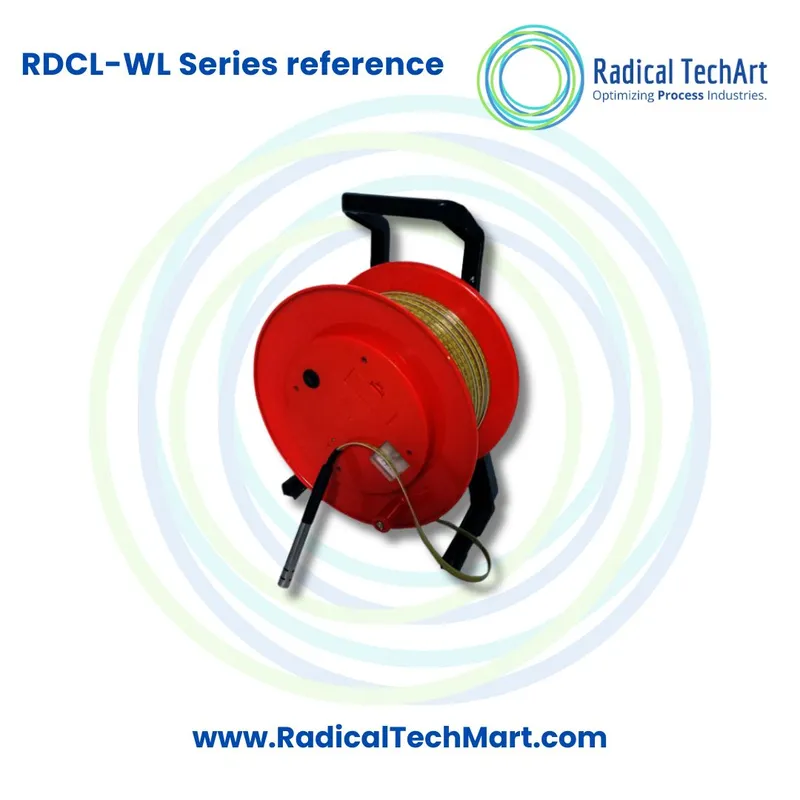
RDCL Steel Tape Borewell Water Level Meter RDCLWL
The RDCL Steel Tape Borewell Water Level Meter RDCLWL is a portable groundwater depth measuring instrument designed for manual water level measurement in borewells, piezometers, observation wells, and geological boreholes.
It operates using a millimeter-marked steel measuring tape and a water-contact sensing probe to accurately detect the groundwater surface. The instrument features audible and visual indicators that activate when the probe comes into contact with water, allowing users to identify the water level easily.
With a measurement resolution of up to 1 mm, the RDCLWL provides precise groundwater depth measurements for various field applications.
The RDCLWL is suitable for groundwater surveys, geotechnical investigations, dam seepage monitoring, foundation pit dewatering, and hydrogeological studies.
Customize
Share :
A. Product Overview
The RDCL RDCLWL Steel Tape Borewell Water Level Meter manually measures groundwater depth in borewells, piezometers, observation wells and geological boreholes.
It uses electrical conductivity detection. When the probe contacts water, an electrical circuit closes and activates audible and visual indicators. The operator reads depth from a graduated steel tape with millimeter markings.
With a probe, steel tape, winding reel and indicator, the portable RDCLWL supports surveys, geotechnical studies, construction dewatering and periodic monitoring. Resolution is up to 1 mm.
Important Technical Specifications
| Parameter | Specification |
|---|---|
| Product Name | Steel Tape Borewell Water Level Meter |
| Brand / Model | RDCL / RDCLWL |
| Instrument Type | Portable Manual Water Level Meter |
| Principle | Electrical Conductivity Detection |
| Measurement Method | Manual Contact-Based Water Level Measurement |
| Measuring Medium | Electrically Conductive Water |
| Resolution | Up to 1 mm |
| Measuring Tape | Graduated Steel Tape Cable |
| Probe | Electrical Water Contact Probe |
| Indication | Audible and Visual Alarm |
| Tape Storage | Manual Winding Reel |
| Reference | Well Opening or Selected Reference Point |
| Recording | Manual Reading and Recording |
| Automatic Monitoring | Not Supported |
| Remote Data Transmission | Not Supported |
| Locations | Borewells, Piezometers, Observation Wells, Boreholes |
| Applications | Groundwater Surveys, Geotechnical Studies, Level Monitoring |
Technical Note: 1 mm is resolution, not verified accuracy. Confirm tape lengths, probe dimensions, battery and temperature ratings.
B. Working Principle
The RDCLWL completes a circuit when the tape-mounted probe touches conductive water. Audible and visual signals indicate contact, allowing a depth reading from a fixed reference point.
Step-by-Step Working Process
1. Preparation: Position the tape at the borewell or observation pipe. Choose a reference point, usually the top of the casing.
2. Probe Lowering: Lower the probe carefully, keeping the tape vertical and minimizing contact with the well casing.
3. Water Detection: When the probe touches conductive water, the circuit is completed.
4. Indication: Audible and visual signals confirm water contact.
5. Depth Reading: Read the tape at the reference point to determine depth to water.
6. Monitoring: Repeat measurements periodically to track water level changes.
7. Elevation Calculation: Where the reference point elevation is known:
Groundwater Elevation = Reference Point Elevation minus Measured Depth to Water
Example: 150 m reference elevation minus 12 m measured depth equals 138 m groundwater elevation.
8. Recording: Note depth, location, reference point and measurement date for later comparison.
Important Measurement Guidelines
- Use suitable wells with enough water conductivity for contact detection.
- Lower the probe slowly and keep it clear of sediment, debris and excessive casing contact.
- Use the same reference point for repeat readings and record results manually.
- Compare with automatic instruments when field verification is needed.
Important: The RDCLWL measures well depth manually, not continuously in rivers or reservoirs.
C. Why Is the RDCLWL Steel Tape Borewell Water Level Meter Used?
The RDCLWL supports groundwater surveys, geotechnical engineering and water resource management.
Key Benefits
1. Fine Resolution: Graduated steel tape supports readings up to 1 mm resolution.
2. Clear Detection: Audible and visual indicators mark water contact.
3. Portability: A winding reel supports testing at multiple wells.
4. Well Compatibility: Suits borewells, observation pipes and piezometers.
5. Direct Reading: Depth is read directly from the tape at a selected reference point.
6. Construction Support: Useful in excavations and foundation studies.
7. Verification: Manually checks automatic level instruments.
8. Survey Use: Helps teams compare groundwater depths across locations.
9. Simple Procedure: No complex programming needed.
10. Periodic Monitoring: Tracks seasonal water table movement and pumping recovery.
Common Applications
- Borewells and observation wells: Manual groundwater depth measurements.
- Piezometers: Monitoring groundwater in dams, embankments and slopes.
- Hydrogeological surveys: Initial and stabilized groundwater observations.
- Dam seepage studies: Piezometer readings for seepage and saturation assessments.
- Foundation and excavation dewatering: Monitoring groundwater during construction.
- Geological investigations: Water depth measurements in boreholes.
- Environmental monitoring: Periodic groundwater observations.
- Irrigation studies: Groundwater resource and agricultural water assessments.
D. Suitable Buyers
The RDCLWL suits groundwater, geology and engineering professionals.
| Buyer Category | Typical Requirement |
|---|---|
| Groundwater Survey Companies | Borewell depth measurement |
| Hydrogeologists | Water table monitoring and investigations |
| Geotechnical Engineering Companies | Piezometer and borehole readings |
| Civil Engineering and Construction Contractors | Site groundwater and dewatering monitoring |
| Borewell Drilling Contractors | Post-drilling water level measurement |
| Environmental Consultants | Observation well monitoring |
| Water Resource and Irrigation Departments | Groundwater surveys and assessments |
| Dam and Embankment Engineers | Piezometer level monitoring |
| Geological Survey Organizations | Borehole water measurements |
| Research Institutes and Engineering Colleges | Field studies and teaching |
| Industrial Environmental Teams | Groundwater observations near facilities |
| Mining and Geotechnical Consultants | Monitoring borehole measurements |
| Instrumentation Distributors | Portable groundwater level instruments |
Relevant terms: steel tape borewell water level meter, electric water level meter, piezometer water level gauge, portable groundwater level indicator.
E. Frequently Asked Questions (FAQ)
1. What is the RDCL RDCLWL Steel Tape Borewell Water Level Meter?
The RDCLWL manually measures groundwater depth in borewells, piezometers, observation wells and geological boreholes. It uses a graduated steel tape, an electrical probe and audible and visual water contact indicators.
2. How does the RDCLWL Steel Tape Borewell Water Level Meter work?
When the lowered probe touches electrically conductive water, its sensing circuit is completed and an audible and visual signal activates. The operator reads the water depth directly from the graduated tape at a fixed reference point.
3. What is the measurement resolution of the RDCLWL?
The RDCLWL has a specified resolution of up to 1 mm using tape markings for detailed manual readings. Actual measurement accuracy depends on instrument configuration and field conditions; resolution is not guaranteed accuracy.
4. Can the RDCLWL measure groundwater levels in borewells?
Yes. It measures depth to water in suitable borewells by lowering the sensing probe until the contact indicator activates. The operator then reads the depth from the graduated steel tape.
5. Is the RDCLWL suitable for piezometer water level measurement?
Yes. It supports groundwater readings in suitable piezometers used for geotechnical studies, dam seepage monitoring and groundwater investigations. Readings can be compared with automatic monitoring instruments.
6. Can the RDCLWL measure water levels in observation wells?
Yes. It can provide periodic depth measurements in observation wells used for environmental monitoring, groundwater investigations and construction dewatering projects.
7. What is the purpose of the audible and visual indicator in the RDCLWL?
The indicators signal when the probe first reaches the water surface, helping the operator identify the correct point and read groundwater depth from the steel tape.
8. Does the RDCLWL provide automatic continuous water level monitoring?
No. The RDCLWL is manually operated. An operator must lower the probe and record the reading. It does not support automatic continuous monitoring or remote data transmission.
9. Can the RDCLWL be used for deep borewell water level measurement?
Yes, if the selected measuring tape is long enough to reach the groundwater surface. Choose the tape length according to the maximum expected depth to water.
10. What is the difference between a steel tape water level meter and a hydrostatic level transmitter?
A steel tape meter gives manual groundwater depth readings through a probe and graduated tape. A hydrostatic transmitter measures liquid pressure and produces a signal for automatic continuous monitoring. The RDCLWL is intended for portable field measurement.
11. Can the RDCLWL be used for groundwater monitoring during construction?
Yes. It can measure groundwater depth in site observation wells and piezometers, including during foundation excavation, dewatering work and geotechnical investigations.
12. Is the RDCLWL suitable for dam seepage monitoring?
Yes. The instrument can measure water levels in suitable dam and embankment piezometers. Recorded levels support seepage and saturation line assessments.
13. Can the RDCLWL measure water levels in geological boreholes?
Yes. It supports manual groundwater depth measurement in suitable geological and hydrogeological investigation boreholes, including initial and stabilized groundwater levels.
14. Does the RDCLWL require a PLC or external display?
No. The RDCLWL works independently. The operator uses its audible and visual contact indicators, then reads water depth directly from the tape without a PLC or separate display.